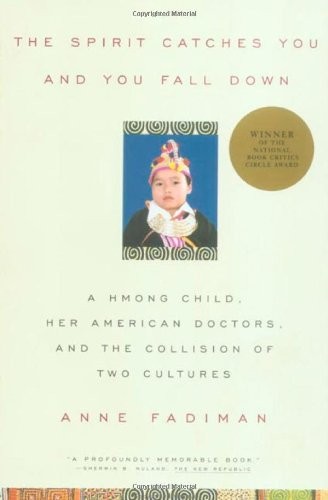
The Spirit Catches You and You Fall Down
by Anne Fadiman
★ Top 25 book of 1997 · #12 on Best Books of 1997
A young Hmong refugee's epilepsy in Merced, California becomes a collision between her parents' spiritual understanding of illness and her doctors' medical one. The book follows both sides, from Laos to hospital wards, to show how two worldviews clash.
Best for: Readers curious about cultural conflict, medicine, and how belief shapes healing
The Spirit Catches You and You Fall Down is #12 on BookWard's Best Books of 1997, out of 28 1997 books that cleared our data bar.
What The Spirit Catches You and You Fall Down is about
When Lia Lee was three months old, she had her first seizure. Her parents, Hmong refugees from Laos living in Merced, California, understood it as a spirit catching her and her soul wandering away. Her doctors ascribed her seizures to the misfiring of her neurons and prescribed anticonvulsants. With no Hmong interpreters at the hospital, neither side could really explain itself to the other, and the gap between them grew.
Anne Fadiman follows the family and the medical staff with equal care, and she gives the Hmong history behind their journey to America, including the 'Quiet War' in Laos. She argues that good intentions are not enough when two cultures cannot understand each other, and she never makes villains of either side. It will help doctors, nurses and students, and anyone interested in immigration, belief and how people care for their children.
The Spirit Catches You and You Fall Down on the Best Books of 1997
The Spirit Catches You and You Fall Down came out in 1997. Of the 28 books first published in 1997 that met BookWard's data bar, it ranks #12 on our Best Books of 1997 list.
Why it made the list: 230 readers have shelved it on Open Library; 21 are reading it right now. The list ranks each year’s books on how many readers have picked them up, how highly readers rate them, and how many are reading them right now.
Nearby on the 1997 list
- The Subtle Knife Philip Pullman, #10
- Killing Floor Lee Child, #11
- Sex and the City Candace Bushnell, #13
- A Walk in the Woods Bill Bryson, #14
See all Best Books of 1997 Best books by year
More years: Best Books of 1996 Best Books of 1998.
The numbers behind it
- Readers: 195 want to read it, 21 are reading it now and 14 have read it, according to Open Library.
| Signal | This book (0 to 100) | Weight |
|---|---|---|
| Reach | 46 | 55% |
| Reader love | 61 | 25% |
| Being read right now | 71 | 20% |
Questions about The Spirit Catches You and You Fall Down
When was The Spirit Catches You and You Fall Down published?
The Spirit Catches You and You Fall Down by Anne Fadiman was first published in 1997.
Was The Spirit Catches You and You Fall Down one of the best books of 1997?
The Spirit Catches You and You Fall Down is #12 on BookWard's Best Books of 1997, out of 28 1997 books that cleared our data bar. 230 readers have shelved it on Open Library; 21 are reading it right now.
Why is The Spirit Catches You and You Fall Down on the Best Books of 1997 list?
230 readers have shelved it on Open Library; 21 are reading it right now.
More of the best books of 1997
- Harry Potter and the Philosopher's Stone J. K. Rowling, #1
- Rich Dad, Poor Dad Robert T. Kiyosaki, #2
- Guns, Germs, and Steel Jared Diamond, #3
- The Adventures of Captain Underpants Dav Pilkey, #4
- The Power of Now Eckhart Tolle, #5
- Into Thin Air Jon Krakauer, #6
See the full Best Books of 1997, the Top 100, or new books on Rising.
How we know
This page uses public data: Open Library reader counts and ratings, and Wikipedia page views for recent years. The description is paraphrased from real source text. Rankings reflect reading interest, not quality or sales, and can be affected by data gaps. Lists update monthly.
Suits mature teens and adults, and is widely read in college and professional courses.
Depends on the edition you pick.
A child's illness becomes a study of two worlds colliding. 62% taste match
 BookWard’s take
A child's illness becomes a study of two worlds colliding
Anne Fadiman alternates between Lia Lee's medical story and chapters on Hmong history, customs and the American role in the war in Laos. That structure is the book's signature: the scenes of Lia's illness keep the rigor and the authorial voice humane rather than clinical. Fadiman gives the doctors and the family equal sympathy, so the moral picture stays deliberately ambiguous, which is harder on the reader than most nonfiction. The opening drops you straight into a family and a hospital, and the sentiment stays restrained even when the material is heartbreaking. It is a book about what happens when two sincere worldviews cannot translate each other, and it earns its seriousness without leaning on shock.
A full-length work that moves between a family's story and wide cultural history, longer than BookWard's taste for the tight.
Alternating chapters give it steady movement, but the history sections slow the story down on purpose.
The paired structure and its even-handed anthropology make it unlike most medical narratives.
Clear and elegant with some literary flourish, never dense or showy.
It follows people and their choices more than a plot machine.
A tragedy of missed connection, with little consolation in how it turns out.
Alternating Lia and history chapters is a deliberate, noticeable design, though not radical.
The subject is grave, with only the occasional dry observation.
A child's grave illness and a family's grief are at the center.
The feeling builds through accumulated detail rather than display.
See all 50 dialsEvery position, side by side with this book
Where it lines up
- OriginalityBookWard 9 · book 9
- SentimentBookWard 8 · book 8
- Shock for effectBookWard 9 · book 9
Where it pulls apart
- LengthBookWard 1 · book 6
- EndingBookWard 8 · book 4
- ExpositionBookWard 2 · book 6
A full-length work that moves between a family's story and wide cultural history, longer than BookWard's taste for the tight.
It avoids the usual cultural-clash tropes by refusing to cast either side as villain.
Its account of how the misunderstandings compound is carefully reasoned and holds together.
Alternating chapters give it steady movement, but the history sections slow the story down on purpose.
The paired structure and its even-handed anthropology make it unlike most medical narratives.
Lia's parents and doctors are drawn with real complexity, each with understandable reasons for what they do.
The outcome is stated plainly, but the larger questions the book raises are left open.
Fadiman stays composed on painful material and lets events carry the feeling.
The hard moments come from events that matter to the argument, not from effect.
Built on extensive interviews and research into Hmong history, medicine and culture.
Fadiman's curious, humane and exact voice is unmistakably hers.
The story of Lia carries the ideas, but the cultural analysis is just as central.
The history chapters explain outright, while the Lia chapters work through scene and detail.
The alternating structure keeps momentum, though a few history chapters can feel like detours.
Clear and elegant with some literary flourish, never dense or showy.
It follows people and their choices more than a plot machine.
A tragedy of missed connection, with little consolation in how it turns out.
Alternating Lia and history chapters is a deliberate, noticeable design, though not radical.
The subject is grave, with only the occasional dry observation.
Accessible to read, but the cultural and medical material rewards attention.
It deliberately gives both the Hmong family and the American doctors their own perspective.
It moves between Lia's present and wider Hmong history, but each strand stays easy to follow.
Hmong spiritual beliefs are central, yet the book treats them as lived reality, not fantasy.
Family members, doctors, and community figures give it a moderately sized cast.
One child's illness is set against the sweep of war, migration and two cultures.
It leans toward the thoughts and beliefs that shape actions, balanced with events.
Interviews and remembered exchanges appear throughout without dominating.
Romance is not a concern here.
Hmong culture and hospital life are likely unfamiliar to most readers, and the book makes them concrete.
Set largely in the 1980s and earlier, but its questions still feel current.
Its questions about care across cultural difference remain relevant decades later.
Fadiman tells it straightforwardly and is open about her own role in assembling the account.
Both sides are sincere and both make mistakes, so it refuses easy verdicts.
Homes, hospitals and landscapes are rendered in vivid detail.
Narrative reportage leads, with analysis woven in between.
Fadiman is present as a researcher and witness without making it about herself.
A standalone work.
It is not built on surprises, though some of its revelations land hard.
It asks readers to question their assumptions about medicine, culture and who is right.
A child's grave illness and a family's grief are at the center.
The feeling builds through accumulated detail rather than display.
Any humor is dry and incidental.
War and medical crises appear but are not dwelt on graphically.
Essentially absent.
American involvement in the war in Laos and immigration policy give it real political weight, without a partisan edge.
The prose is plain, though Hmong terms and medical vocabulary appear.
It presents the case evenhandedly while staying clearly sympathetic to the Hmong.
Rooted in the past, with a view toward how care could be better.
Idealistic in wanting understanding across divides, but sober about how rarely it happens.
Review written by BookWard, dial version 1, November 2026.
Who is The Spirit Catches You and You Fall Down right for?
Suits mature teens and adults, and is widely read in college and professional courses. It deals with a child's serious illness, medical crisis and the aftermath of war, which some readers may find upsetting.
Accessible to read, but the cultural and medical material rewards attention.
A child's grave illness and a family's grief are at the center.
The feeling builds through accumulated detail rather than display.
War and medical crises appear but are not dwelt on graphically.
Book CompanionThe Spirit Catches You and You Fall Down: ideas, characters, themes
When a Hmong family and American doctors both try to help a gravely ill child, their incompatible beliefs about illness and healing produce a tragedy neither side intended.
- Two explanations for one illness. Lia's doctors saw misfiring neurons and prescribed anticonvulsants, while her parents saw a wandering soul and turned to ritual and sacrifice.
- Alternating structure. Every other chapter returns to Lia, while the chapters between explore Hmong culture, history and the immigrant experience.
- Fault on both sides. Fadiman presents the situation from the doctors' and the family's perspectives, showing how both wanted the best for Lia.
- A communication gap. The hospital had no Hmong interpreters at first, and misunderstandings about medication doses compounded over time.
- The wider backdrop. The book connects the Lees' situation to the war in Laos, American responsibility for it, and the struggles of assimilation.
Characters
Lia Lee
The child at the center
A Hmong girl diagnosed with a severe form of epilepsy, whose illness drives the book.
Foua and Nao Kao Lee
Lia's parents
Hmong refugees who care deeply for Lia and hold spiritual beliefs about her condition.
Neil and Peggy Ernst
Lia's doctors
The physicians who treat Lia and struggle to bridge the cultural gap with her family.
Themes
How deeply different worldviews can make sincere people fail to understand each other.
The tension between scientific and spiritual ways of explaining illness.
The pressures of assimilation, discrimination and displacement after war.
What caregivers owe to those whose culture they do not understand.
Discussion questions
- Who, if anyone, is most responsible for what happens to Lia, and does the book want you to assign blame?
- How does alternating between Lia's story and broader history change the way you read each?
- What could the doctors have done differently, and what could the family have done differently?
- Can scientific medicine respect traditional beliefs without compromising care?
- What does the book suggest about America's responsibility toward the people it displaces?
Personalize your Book Companion
This is the general edition. In BookWard, the Companion is written for you: your reading profile, your notes, and spoiler-safe to the page you are on.
Buy, listen or borrow The Spirit Catches You and You Fall Down
Each link opens a search for this book on that store, in a new tab.
Read on a device
Borrow
Reviews and community
If you liked The Spirit Catches You and You Fall Down
A cell line changed medicine; the woman behind it was forgotten
Into the WildJon KrakauerA reported hunt for why a young man walked into Alaska
EvictedMatthew DesmondEight Milwaukee households, and the profit made from their rent
FlashlightSusan ChoiA family wrecked by one night on a breakwater
Find your own best books
Add what you have read, rate it, and BookWard will recommend what to read next.
Free to start. No credit card needed.