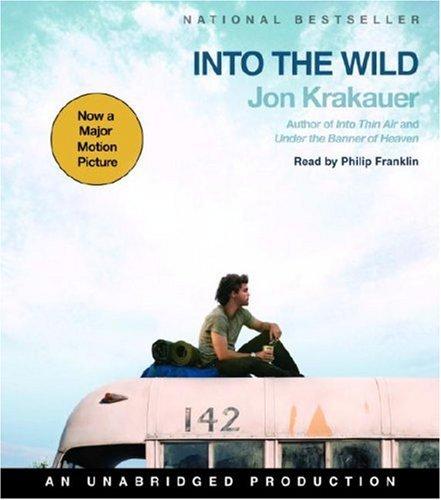
Into the Wild
by Jon Krakauer
★ Top 25 book of 1996 · #11 on Best Books of 1996
In 1992, young Christopher McCandless gave away his savings, burned his cash and walked alone into the Alaskan wilderness under a new name. Jon Krakauer pieces together the facts of his life to explain how he came to die there.
Best for: Readers drawn to true stories of wilderness, restless young seekers and unsolved mysteries
Into the Wild is #11 on BookWard's Best Books of 1996, out of 39 1996 books that cleared our data bar.
What Into the Wild is about
In April 1992, Chris McCandless hitchhiked to Alaska. He had started calling himself Alexander Supertramp. Jon Krakauer follows his path, from months working in a South Dakota grain elevator to the Stampede Trail, where his body was found in an abandoned bus that September. Krakauer began with a magazine article and expanded it into a fuller inquiry.
He weighs what drew McCandless to Thoreau and Jack London, compares him with other young men who vanished into the wild, and measures him against his own youthful attempt on Devils Thumb. He also considers what may have gone wrong and the grief his family carried. It suits readers who like thoughtful, humane reporting on risk, idealism and the pull of wild places.
Into the Wild on the Best Books of 1996
Into the Wild came out in 1996. Of the 39 books first published in 1996 that met BookWard's data bar, it ranks #11 on our Best Books of 1996 list.
Why it made the list: 628 readers have shelved it on Open Library; readers rate it 3.9 out of 5 (84 ratings). The list ranks each year’s books on how many readers have picked them up, how highly readers rate them, and how many are reading them right now.
Nearby on the 1996 list
- Desperation Stephen King, #9
- Airframe Michael Crichton, #10
- The Night Stalker Philip Carlo, #12
- 100 Ways to Motivate Yourself Steve Chandler, #13
See all Best Books of 1996 Best books by year
More years: Best Books of 1995 Best Books of 1997.
The numbers behind it
- Readers: 492 want to read it, 12 are reading it now and 124 have read it, according to Open Library.
- Ratings: 3.9 out of 5 from 84 Open Library ratings.
| Signal | This book (0 to 100) | Weight |
|---|---|---|
| Reach | 87 | 55% |
| Reader love | 33 | 25% |
| Being read right now | 44 | 20% |
Questions about Into the Wild
When was Into the Wild published?
Into the Wild by Jon Krakauer was first published in 1996.
Was Into the Wild one of the best books of 1996?
Into the Wild is #11 on BookWard's Best Books of 1996, out of 39 1996 books that cleared our data bar. 628 readers have shelved it on Open Library; readers rate it 3.9 out of 5 (84 ratings).
Why is Into the Wild on the Best Books of 1996 list?
628 readers have shelved it on Open Library; readers rate it 3.9 out of 5 (84 ratings).
More of the best books of 1996
- A Game of Thrones George R. R. Martin, #1
- The Green Mile Stephen King, #2
- Forbidden Knowledge Roger Shattuck, #3
- Fight Club Chuck Palahniuk, #4
- Push Sapphire, #5
- Neverwhere Neil Gaiman, #6
See the full Best Books of 1996, the Top 100, or new books on Rising.
How we know
This page uses public data: Open Library reader counts and ratings, and Wikipedia page views for recent years. The description is paraphrased from real source text. Rankings reflect reading interest, not quality or sales, and can be affected by data gaps. Lists update monthly.
Suited to teenagers and adults, and widely used in high school and college courses.
Depends on the edition you pick.
A reported hunt for why a young man walked into Alaska. 64% taste match
 BookWard’s take
A reported hunt for why a young man walked into Alaska
Krakauer takes a death that is already known and makes it a mystery anyway. The hook is immediate: a body in a bus, then a rewind to find out how Chris McCandless got there. The reporting is rigorous, since the book retraces his route and sets it beside other young men who vanished into wild country. The voice is distinctive, because Krakauer writes himself into the story with his own Devils Thumb climb, which gives the book a personal edge that few reported nonfiction books risk. The moral picture stays ambiguous: it neither canonizes nor condemns McCandless. The pace is brisk, and the book holds back on sentiment even when grief is the subject. It's a strong book on nearly every count.
The chapters move quickly between McCandless's journey and the side stories, though the digressions slow it in places.
A reported investigation fused with memoir and a roster of other disappearances is a distinctive way to tell a familiar kind of story.
Clear, clean reportorial prose that turns lyrical only when describing the landscape.
Driven by the question of who McCandless was and why he acted as he did more than by events.
The ending is a death, and the book carries grief and futility, with only glints of hope in what McCandless found along the way.
It moves between McCandless's travels, Krakauer's research and other cases, which is a loose but controlled pattern.
A young man's death by starvation and the grief of his family are central, but handled without gore.
The grief of McCandless's family carries real weight, while the narration stays measured.
See all 50 dialsEvery position, side by side with this book
Where it lines up
- Character depthBookWard 8 · book 8
- Authorial voiceBookWard 9 · book 9
- OpeningBookWard 10 · book 9
Where it pulls apart
- Familiar tropesBookWard 10 · book 7
- LengthBookWard 1 · book 3
- Internal logicBookWard 10 · book 8
It opens on the discovery of McCandless's body, which makes the reader need to know how he got there.
The lost-young-man premise could turn into a cliche, but Krakauer's reporting and personal digressions keep it from tipping into one.
The reconstruction of McCandless's route and final months is argued carefully from journals, interviews and evidence, so the case holds together.
The chapters move quickly between McCandless's journey and the side stories, though the digressions slow it in places.
A reported investigation fused with memoir and a roster of other disappearances is a distinctive way to tell a familiar kind of story.
McCandless is drawn through those who knew him and his own writing, and he comes across as contradictory rather than a symbol.
Krakauer offers a reasoned hypothesis about the death, but the larger question of why McCandless went stays open.
The family's grief is handled plainly, and the book avoids turning McCandless into a saint.
The darkness comes from the facts of the death itself and is never used for effect.
Krakauer retraces the route, interviews those who met McCandless, and tests theories about the death against the evidence.
Krakauer's presence, including his own climbing history, gives the narration a strong and recognizable personality.
A story with a real mystery at its centre, though it keeps stepping back to ask what draws people into the wilderness.
Much is explained by the author directly, especially in the digressions, but the McCandless chapters are told as narrative.
The Devils Thumb and other side stories cause the odd lull, but the central mystery carries the book through.
Clear, clean reportorial prose that turns lyrical only when describing the landscape.
Driven by the question of who McCandless was and why he acted as he did more than by events.
The ending is a death, and the book carries grief and futility, with only glints of hope in what McCandless found along the way.
It moves between McCandless's travels, Krakauer's research and other cases, which is a loose but controlled pattern.
Accessible and widely taught; the pages go down easily even when the questions stay hard.
Told through Krakauer, McCandless's journals, and the memories of family, friends and others who crossed his path.
The book begins at the end, then reconstructs McCandless's two years, which means it keeps shifting.
Entirely real events and places, with no embellishment.
A moderate group of relatives, friends and encounters along the road, none of them overwhelming.
A single young man's journey, though the questions it raises are large.
It follows both McCandless's physical journey and the question of what drove him, balancing action and interior.
Reported speech and quoted journals appear, but the book is mostly narration and reporting.
Romance is not part of the story.
Most readers will not know the Alaskan wilderness or the life of a rootless wanderer.
Set in the early 1990s and told in the mid-1990s, so it reads as recent past.
The pull of the wild and the urge to reinvent oneself are lasting subjects, and the book remains on school reading lists.
Krakauer is open about his own bias and obsession, which makes him a reliable guide.
The book sets out evidence for and against McCandless and leaves the reader to judge him.
The wilderness and the road across the West are rendered in careful, vivid detail.
It reads as narrative nonfiction, driven by scene and chronology rather than argument.
Krakauer writes himself into the book openly, which makes the perspective personal.
A standalone book with no sequel.
The core fact is known from the start, so surprises are few, though the cause of death is revealed late.
The book raises hard questions about risk, idealism and responsibility without offering easy comfort.
A young man's death by starvation and the grief of his family are central, but handled without gore.
The grief of McCandless's family carries real weight, while the narration stays measured.
There is little humor, and what there is stays dry.
Little interpersonal violence; the harm comes from the wilderness and starvation.
Sexual content is essentially absent.
Politics sits in the background, in debates about American self-reliance and wilderness, but it is not the point.
The language is plain and easy to follow.
Krakauer shares his own views and identifications, so the narration is far from neutral.
It looks back, reconstructing a past event in order to understand it.
It treats McCandless's idealism seriously while showing its costs.
Review written by BookWard, dial version 1, November 2026.
Who is Into the Wild right for?
Suited to teenagers and adults, and widely used in high school and college courses. It deals with death by starvation and a family's grief, which some younger readers may find upsetting.
Accessible and widely taught; the pages go down easily even when the questions stay hard.
A young man's death by starvation and the grief of his family are central, but handled without gore.
The grief of McCandless's family carries real weight, while the narration stays measured.
Little interpersonal violence; the harm comes from the wilderness and starvation.
Book CompanionInto the Wild: ideas, characters, themes
Krakauer reconstructs the last two years of Chris McCandless's life to explain how he came to die in the Alaskan wilderness, and what drew him there.
- The discovery. The book opens with the finding of McCandless's body in an abandoned bus on the Stampede Trail in Alaska in September 1992.
- Alexander Supertramp. After graduating, McCandless shed his legal name and adopted a new one, then traveled the West and Southwest.
- Influences. Krakauer ties McCandless's ascetic streak to the writings of Thoreau and Jack London.
- Krakauer's own story. The author recounts his own attempt on Devils Thumb to explore what such drives feel like from the inside.
- The cause of death. Krakauer proposes a hypothesis, based on a journal entry, about what went wrong in McCandless's final weeks.
Characters
Chris McCandless
Subject
A college graduate who changed his name, gave away his savings and walked into the Alaskan wilderness.
Jon Krakauer
Author and narrator
He retraces McCandless's steps and compares them with his own youthful ambitions.
Wayne Westerberg
Employer and friend
A South Dakota grain elevator owner who hired McCandless for months of labor.
Carine McCandless
Sister
Chris's sister, one of the family members left in grief and puzzlement.
Themes
The pull the wild exerts on people who want something purer than ordinary life.
How far a belief in self-reliance can carry someone before it becomes dangerous.
The wish to drop an old identity and begin again under a new name.
What is left behind for those who cannot understand a loved one's choice.
How a writer's own history shapes the way he tells another person's story.
Discussion questions
- Did McCandless's choices come from courage, naivety, or both?
- How does Krakauer's decision to include his own climbing story shape your view of McCandless?
- Why does Krakauer set McCandless beside other men who vanished into the wild?
- What does the family's grief add to the story?
- Is it fair to judge McCandless by what happened at the end?
Personalize your Book Companion
This is the general edition. In BookWard, the Companion is written for you: your reading profile, your notes, and spoiler-safe to the page you are on.
Buy, listen or borrow Into the Wild
Each link opens a search for this book on that store, in a new tab.
Read on a device
Borrow
Reviews and community
If you liked Into the Wild
A first-person Everest disaster account that grips from page one
The Bridge of San Luis ReyThornton WilderA short, hard question about why the bridge fell when it did
The Spirit Catches You and You Fall DownAnne FadimanA child's illness becomes a study of two worlds colliding
The Immortal Life of Henrietta LacksRebecca SklootA cell line changed medicine; the woman behind it was forgotten
Find your own best books
Add what you have read, rate it, and BookWard will recommend what to read next.
Free to start. No credit card needed.