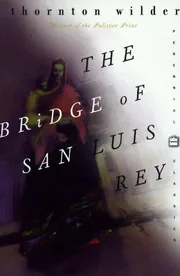
The Bridge of San Luis Rey
by Thornton Wilder · 1927
Suits mature teens and adults who enjoy reflective, idea-driven fiction.
144 pages, about 2.5 to 3.5 hours.
A short, hard question about why the bridge fell when it did. 62% taste match
The story
Thornton Wilder's The Bridge of San Luis Rey is a work of historical fiction first published in 1927. It was his second novel, and it received the Pulitzer Prize for fiction in 1928. At around 144 pages, it is a compact book, and it has appeared in some 110 editions, including translations into Spanish and Russian.
The story is set in Peru in the 18th century. On a July day in 1714, the finest bridge in the country gives way and sends five travelers into the gulf below. The novel follows the people caught in that accident, with Amy Drevenstedt among those named, and considers who they were. Beneath the incident lies a broader question about why misfortune falls on particular people, a question the book treats in philosophical terms. Readers interested in accidents and their victims, in colonial South America, or in early twentieth-century American fiction will find a short, focused example of each here.
On Friday noon, July the twentieth, 1714, the finest bridge in all Peru broke and precipitated five travelers into the gulf below.
Characters
Amy Drevenstedt
Setting
PeruLatin AmericaSouth AmericaUSA
Period
18th century20th century18th Century / 20th Century
Themes
Accident victimsAccidentsBridgesHistoryPulitzer Prize WinnerRussian languageText18.06 Anglo-American literature
- Want to read 64
- Reading now 3
- Read 21
Most people shelving it are saving it for later.
Of 88 readers who put it on a shelf, 73% want to read it, 3% are reading it now, 24% have finished it and 0% stopped before the end.
By the numbers
- The median edition runs 144 pages. Counting about 275 words a page and an adult reading pace of 250 words a minute, that is about 2.6 hours of reading.
- Open Library tracks 110 editions from 63 publishers, the earliest dated 1927 and the latest 2023, across 8 languages.
- On reader demand it ranks in the top 13% of the classic books in our catalog (8,749 of them).
- Libraries shelve it under Dewey 813.5 and Library of Congress class PZ-0003.00000000.W6468Br 1976.
 BookWard’s take
A short, hard question about why the bridge fell when it did
In 1714 a bridge in Peru gives way and five travelers fall. What Wilder does with that moment is the whole book: he asks who these people were and whether their deaths meant anything. At 144 pages it is tight, and the idea leads the story, which suits a reader who likes a clean argument over a sprawling plot. Where BookWard prizes airtight internal logic and a restrained tone, the book's cool, measured handling of feeling will appeal. Its moral picture is deliberately ambiguous, and its prose is more formal than fast. The Pulitzer in 1928 and a place on the Modern Library's list of the century's best novels are earned by how much it packs into so little space.
At 144 pages it is about as compact as a prize-winning novel gets, which matches BookWard's love of the short and tight.
The book moves briskly through each life, though its reflective pauses keep it from racing.
A single disaster linking strangers whose pasts unfold afterward was an inventive template in 1927.
The sentences are polished and formal, closer to elegant than plain.
What happens is minimal, and the interest lies in who these people were and what drove them.
It asks hard questions about chance and suffering yet leaves some room for meaning to be found.
Going back through the victims' lives after the collapse is a mildly unusual arrangement for its day.
The tone is grave and contemplative, with little room for comedy.
Death drives the book, yet it is handled with reflection rather than gore.
The feeling builds quietly, in lives that were cut short.
See all 50 dialsEvery position, side by side with this book
Where it lines up
- LengthBookWard 1 · book 1
- Authorial voiceBookWard 9 · book 9
- Sagging middleBookWard 8 · book 8
Where it pulls apart
- Rigor (nonfiction)BookWard 9 · book 4
- Story or ideasBookWard 3 · book 8
- Familiar tropesBookWard 10 · book 7
At 144 pages it is about as compact as a prize-winning novel gets, which matches BookWard's love of the short and tight.
The bridge collapses in the opening premise, so the central event is on the table before anything else.
It is the forerunner of the disaster ensemble story, so the form feels fresh here even if it later became familiar.
Its whole structure rests on one question and each life is weighed against it, so the design holds together.
The book moves briskly through each life, though its reflective pauses keep it from racing.
A single disaster linking strangers whose pasts unfold afterward was an inventive template in 1927.
Each of the travelers is given a past and a private want, so they read as people more than as symbols.
The question it poses gets a considered answer, though it stays more reflective than neatly tied off.
Feeling is present but held at arm's length by a cool, measured narrator.
The deaths are the premise, not a trick, and they serve the larger inquiry into why they happen.
This is fiction, but the philosophical question is pursued with discipline rather than left vague.
Wilder's narrator has a composed, authoritative personality that is hard to mistake for anyone else.
The book exists to test a question about misfortune, with the characters serving the argument.
The narrator often explains and reflects directly rather than letting scenes speak for themselves.
At this length the inquiry stays focused with no room for the middle to go slack.
The sentences are polished and formal, closer to elegant than plain.
What happens is minimal, and the interest lies in who these people were and what drove them.
It asks hard questions about chance and suffering yet leaves some room for meaning to be found.
Going back through the victims' lives after the collapse is a mildly unusual arrangement for its day.
The tone is grave and contemplative, with little room for comedy.
Short and clear, though its philosophical weight asks the reader to slow down and think.
The story turns on several travelers, each treated in turn.
Events are told in the light of the collapse, with lives revisited from before it.
It is a grounded historical setting with no supernatural element.
A handful of central travelers keep the cast small and manageable.
One accident and a few lives make this an intimate story, even with a colonial backdrop.
The weight falls on motives, regrets, and private longing more than on action.
The narrator carries most of the book, so spoken exchanges stay in the background.
Love and longing surface in the lives it examines but are not the book's center.
Eighteenth-century Peru is a setting most readers will find unfamiliar.
It is set in 1714 and written in 1927, far from the present day.
A question about why misfortune strikes particular people never goes out of date.
The narrator is an openly investigating, confident guide whose account we are meant to trust.
It resists a tidy verdict on whether the deaths were deserved or meaningless.
Setting and people are sketched with economy rather than lavish detail.
It stands alone as a complete novel.
The collapse is known from the start, so the interest is in understanding, not in surprises.
It confronts uncomfortable questions about suffering and fairness without offering easy comfort.
Death drives the book, yet it is handled with reflection rather than gore.
The feeling builds quietly, in lives that were cut short.
Any lightness is dry and understated.
The deaths happen by accident and are not dwelt on in graphic terms.
Desire is part of some lives but is not dwelt upon on the page.
The setting is colonial, but the book is about private lives, not political argument.
The language is formal and clear, with no heavy dialect.
The narrator freely offers judgments and interpretations rather than staying neutral.
It looks back, reconstructing lives after the fact.
It wrestles honestly with whether life has meaning without settling into either cynicism or easy faith.
Review written by BookWard, dial version 1, November 2026.
Who is The Bridge of San Luis Rey right for?
Suits mature teens and adults who enjoy reflective, idea-driven fiction. It deals with death and grief, though without graphic detail.
Short and clear, though its philosophical weight asks the reader to slow down and think.
Death drives the book, yet it is handled with reflection rather than gore.
The feeling builds quietly, in lives that were cut short.
The deaths happen by accident and are not dwelt on in graphic terms.
Book CompanionThe Bridge of San Luis Rey: ideas, characters, themes
When a bridge fails and kills five travelers, the novel asks whether their deaths were chance or part of some pattern.
- The collapse. In July 1714, the finest bridge in Peru gives way and five travelers fall into the gulf below.
- Lives after the fact. The book looks at who the victims were rather than just describing the accident.
- A philosophical question. Beneath the event sits the problem of why misfortune lands on particular people.
- A compact form. At about 144 pages, it makes its case without padding.
- Recognition. It won the Pulitzer Prize for fiction in 1928 and was a best seller that year.
Characters
The five travelers
The people on the bridge when it collapses
The novel considers who each of them was, looking at their lives rather than only the accident.
Themes
Whether events happen at random or fit some larger plan.
Why bad things seem to befall people who have not earned them.
What a person's existence amounts to once it is cut short.
How private attachments shape the way people live and are remembered.
Discussion questions
- Does the book want you to believe the bridge fell for a reason?
- How does knowing the outcome early change the way you read each life?
- Which traveler's story stayed with you most, and why?
- What does the narrator's confident, judging voice add or take away?
- Is it fair to look for meaning in a random accident?
Personalize your Book Companion
This is the general edition. In BookWard, the Companion is written for you: your reading profile, your notes, and spoiler-safe to the page you are on.
Buy, listen or borrow The Bridge of San Luis Rey
Each link opens a search for this book on that store, in a new tab.
Read on a device
Borrow
Reviews and community
If you liked The Bridge of San Luis Rey
A reported hunt for why a young man walked into Alaska
John BarleycornJack LondonJack London's candid, argumentative memoir of drink and his long struggle
Black in BluesImani PerryA meditation on Blackness, told through one color
The Joy Luck ClubAmy TanFour mothers, four daughters, and the stories between them
Sources: Open Library.
Track The Bridge of San Luis Rey and find your next favorite
Add it to your shelf, rate what you have read, and BookWard will recommend what fits you.
Free to start. No credit card needed.