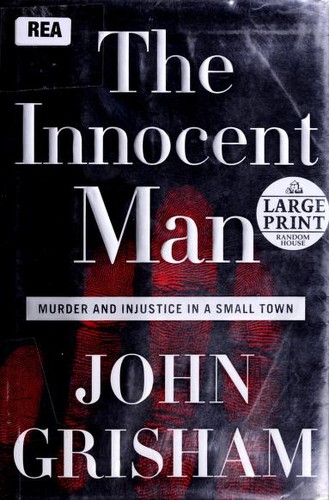
The Innocent Man
by John Grisham
★ Top 25 book of 2006 · #22 on Best Books of 2006
Grisham's first non-fiction book follows a former baseball prospect from Oklahoma who is convicted of a murder in his hometown. It questions small-town justice, flimsy evidence and the death penalty.
Best for: Readers curious about wrongful convictions and the fairness of the justice system
The Innocent Man is #22 on BookWard's Best Books of 2006, out of 47 2006 books that cleared our data bar.
What The Innocent Man is about
John Grisham's first work of non-fiction tells a true story of small-town justice going badly wrong. Ron Williamson was once a baseball prospect, the first player chosen from Oklahoma in the 1971 major league draft, and he signed with the Oakland A's. Six years later he came home to Ada with his dreams broken by a bad arm, drinking, drugs and women, and he began to show signs of mental illness. In 1982 a 21-year-old cocktail waitress, Debra Sue Carter, was raped and murdered in the town. Police went five years without solving the crime, then arrested Williamson and his friend Dennis Fritz and charged them with capital murder. The prosecution had no physical evidence and leaned on junk science and testimony from jailhouse snitches and convicts. Fritz received a life sentence, and Williamson was sent to Death Row. The book argues, through one case, how easily a justice system can fail, and it will interest readers of true crime and anyone curious about wrongful convictions.
The Innocent Man on the Best Books of 2006
The Innocent Man came out in 2006. Of the 47 books first published in 2006 that met BookWard's data bar, it ranks #22 on our Best Books of 2006 list.
Why it made the list: 219 readers have shelved it on Open Library; readers rate it 4.3 out of 5 (11 ratings). The list ranks each year’s books on how many readers have picked them up, how highly readers rate them, and how many are reading them right now.
Nearby on the 2006 list
- Don't Let the Pigeon Stay up Late! Mo Willems, #20
- The Audacity of Hope Barack Obama, #21
- Wintersmith Terry Pratchett, #23
- American Born Chinese Gene Luen Yang, #24
See all Best Books of 2006 Best books by year
More years: Best Books of 2005 Best Books of 2007.
The numbers behind it
- Readers: 187 want to read it, 10 are reading it now and 22 have read it, according to Open Library.
- Ratings: 4.3 out of 5 from 11 Open Library ratings.
| Signal | This book (0 to 100) | Weight |
|---|---|---|
| Reach | 45 | 55% |
| Reader love | 68 | 25% |
| Being read right now | 40 | 20% |
Questions about The Innocent Man
When was The Innocent Man published?
The Innocent Man by John Grisham was first published in 2006.
Was The Innocent Man one of the best books of 2006?
The Innocent Man is #22 on BookWard's Best Books of 2006, out of 47 2006 books that cleared our data bar. 219 readers have shelved it on Open Library; readers rate it 4.3 out of 5 (11 ratings).
Why is The Innocent Man on the Best Books of 2006 list?
219 readers have shelved it on Open Library; readers rate it 4.3 out of 5 (11 ratings).
More of the best books of 2006
- The Sea of Monsters Rick Riordan, #1
- The Book Thief Markus Zusak, #2
- Half of a Yellow Sun Chimamanda Ngozi Adichie, #3
- The Boy in the Striped Pyjamas John Boyne, #4
- The Secret Rhonda Byrne, #5
- Mindset Carol S. Dweck, #6
See the full Best Books of 2006, the Top 100, or new books on Rising.
How we know
This page uses public data: Open Library reader counts and ratings, and Wikipedia page views for recent years. The description is paraphrased from real source text. Rankings reflect reading interest, not quality or sales, and can be affected by data gaps. Lists update monthly.
Best suited to older teens and adults.
Depends on the edition you pick.
Grisham's true-crime exposé of a small-town wrongful conviction in Oklahoma. 61% taste match
 BookWard’s take
Grisham's true-crime exposé of a small-town wrongful conviction in Oklahoma
This is Grisham's first work of nonfiction, and it reads the way his best legal thrillers do: a crime, a town that wants it solved, and a man in the wrong place. The Debra Sue Carter case gives it a hook from the first chapters, and the pace stays brisk because the story itself keeps moving. It is narrative nonfiction first, driven more by story than by argument. The case it makes rests on the weakness of the prosecution's evidence rather than on anecdote. The darkness is real but earned, since it comes from what actually happened rather than from any effort to rattle the reader. The moral stakes are plain, and the mood is heavy throughout. Ron Williamson is drawn as a full person, not a symbol.
A full-length narrative of a case spanning years, longer than BookWard's taste for tight books, though the story justifies most of it.
Events move steadily from the crime through arrests and trial, a little slower than BookWard likes at its densest.
Few books pair a major novelist's craft with a real wrongful-conviction case, though the genre itself is familiar.
The prose is plain and clear, serving the story instead of calling attention to itself, roughly where BookWard sits.
Plot and character share the load, with the case driving events and Williamson's life giving them weight.
It is a dark account of injustice, with limited relief, leaning bleaker than BookWard's mild optimism.
It follows a conventional chronological arc through crime, arrest, trial and aftermath, a touch plainer than BookWard prefers.
The subject is grim and the tone serious throughout, so humor has little place, unlike BookWard's lighter streak.
A rape, murder and wrongful death sentence make this heavy material, darker than BookWard's midpoint.
The injustice and its human cost land hard, giving a strong emotional charge.
See all 50 dialsEvery position, side by side with this book
Where it lines up
- Story or ideasBookWard 3 · book 3
- OpeningBookWard 10 · book 9
- PaceBookWard 8 · book 7
Where it pulls apart
- LengthBookWard 1 · book 6
- Familiar tropesBookWard 10 · book 7
- Internal logicBookWard 10 · book 8
A full-length narrative of a case spanning years, longer than BookWard's taste for tight books, though the story justifies most of it.
True-crime and legal-thriller conventions shape the structure, though the real facts keep it from feeling formulaic.
The account of how the case was built and unraveled holds together step by step, a good fit for BookWard.
Events move steadily from the crime through arrests and trial, a little slower than BookWard likes at its densest.
Few books pair a major novelist's craft with a real wrongful-conviction case, though the genre itself is familiar.
Ron Williamson in particular is rendered as a whole person with ambition, flaws and illness, which BookWard values.
The case reaches a real resolution, though the damage it exposes stays unresolved, close to BookWard's preference.
The anger is open and the sympathy plain, but it mostly lets the facts carry the weight.
What disturbs here is real, drawn from documented events, not manufactured for effect, which BookWard respects.
It rests on court-case facts and the weakness of the evidence, though it reads as narrative, not as scholarship.
Grisham's plain, confident storytelling is recognizable, though less singular here than in his fiction.
This is story-led, following people and events, which matches BookWard's preference for narrative over argument.
Legal and forensic details are explained directly at times, somewhat more than BookWard's show-in-scene taste.
The case keeps escalating, so the middle holds, in line with what BookWard wants.
The prose is plain and clear, serving the story instead of calling attention to itself, roughly where BookWard sits.
Plot and character share the load, with the case driving events and Williamson's life giving them weight.
It is a dark account of injustice, with limited relief, leaning bleaker than BookWard's mild optimism.
It follows a conventional chronological arc through crime, arrest, trial and aftermath, a touch plainer than BookWard prefers.
The subject is grim and the tone serious throughout, so humor has little place, unlike BookWard's lighter streak.
It reads easily despite the subject, with accessible language and a clear line, similar to BookWard's comfort level.
The story centers mainly on the accused men and the case against them, narrower than BookWard's taste for many viewpoints.
It moves in broadly chronological order from the murder through trial, simpler than BookWard's usual shifting timelines.
Entirely grounded in a real case, with nothing invented beyond the world as it is.
A murder case in a small town draws in police, prosecutors, witnesses and family, giving it a sizable cast.
It stays close to one town and one case, intimate in setting even as its implications are broad.
It follows events and the machinery of a case more than private thought, leaning toward outer action.
Scenes and testimony carry quoted speech, but narration dominates, giving a moderate amount of dialogue.
Romance plays almost no part in what is a crime and justice story.
A small Oklahoma town and its courts are a specific, less commonly seen setting, somewhat unfamiliar to many readers.
The events run from the 1970s through the 2000s, recent history but not present day.
Questions of wrongful conviction and flawed evidence stay relevant, giving it lasting power beyond its moment.
The narrator is a straightforward chronicler, reliable and clear, far from BookWard's unreliable-narrator tolerance.
The book takes a clear stand on the injustice at its center, more settled than BookWard's appetite for ambiguity.
It sketches the town, courtroom and people with moderate detail, enough to place you without lingering.
It tells its case as a story, strongly narrative, a bit more story-driven than BookWard's balance.
The author stays mostly out of the frame, but the sympathy for the accused is clear, so it is not wholly detached.
A standalone account with no sequel built in.
Reversals come from how the case turns, moderately many, though the outline is known going in.
It forces readers to question how justice works, which suits BookWard's appetite for challenge.
A rape, murder and wrongful death sentence make this heavy material, darker than BookWard's midpoint.
The injustice and its human cost land hard, giving a strong emotional charge.
Humor is essentially absent in the telling, so the broad-versus-dry question barely applies.
A brutal murder is central, though most of the book concerns procedure and aftermath, not on-page violence.
The crime involves sexual violence, but it is handled factually, not graphically for effect.
The justice system and the death penalty are central concerns, giving it a real political edge.
The language is plain and clear, with courtroom terms explained, easier than BookWard's midpoint.
Grisham's outrage shows through in the telling, more opinionated than BookWard's slightly opinionated tilt.
It looks back at past events, though with an eye on reform, leaning toward the past.
It is angry at a failing system yet sustained by a belief that justice should work, sitting near the middle.
Review written by BookWard, dial version 1, November 2026.
Who is The Innocent Man right for?
Best suited to older teens and adults. It deals directly with a rape and murder, mental illness, and a death sentence, so it can be upsetting.
It reads easily despite the subject, with accessible language and a clear line, similar to BookWard's comfort level.
A rape, murder and wrongful death sentence make this heavy material, darker than BookWard's midpoint.
The injustice and its human cost land hard, giving a strong emotional charge.
A brutal murder is central, though most of the book concerns procedure and aftermath, not on-page violence.
Book CompanionThe Innocent Man: ideas, characters, themes
A man chosen for baseball glory ends up on Death Row for a murder he did not commit, exposing how a small-town justice system can go terribly wrong.
- A fallen prospect. Ron Williamson is first picked from Oklahoma in the 1971 major league draft, then returns to Ada after his dreams break down.
- An unsolved murder. In 1982 a young cocktail waitress named Debra Sue Carter is raped and murdered, and police go five years without solving it.
- Suspicion without cause. Police come to suspect Williamson and his friend Dennis Fritz for reasons that were never clear.
- A weak case. With no physical evidence, the prosecution leans on junk science and testimony from jailhouse snitches and convicts.
- Two outcomes. Dennis Fritz receives a life sentence while Ron Williamson is sent to Death Row.
Characters
Ron Williamson
Former baseball prospect and accused man
Drafted out of Oklahoma, he returns home after his career falters and shows signs of mental illness before being charged.
Dennis Fritz
Williamson's friend and co-accused
Arrested with Williamson and found guilty, he receives a life sentence.
Debra Sue Carter
Murder victim
A 21-year-old cocktail waitress in Ada whose rape and murder in 1982 begins the case.
Themes
How innocent people can be convicted when weak evidence is treated as proof.
The dangers of junk science and unreliable informant testimony.
What it means to sentence someone to die when the case against them is shaky.
How a man's troubles can make him a target instead of earning him help.
How local pressure to close a case can bend fairness.
Discussion questions
- Why do you think the police settled on Williamson and Fritz despite the lack of physical evidence?
- How does Williamson's background as a baseball prospect shape the way his story lands?
- What responsibility do jurors and prosecutors bear when a case rests on informants and weak science?
- Did the book change how you think about the death penalty, and why?
- Is Grisham's open anger a strength or a weakness in a work of nonfiction?
Personalize your Book Companion
This is the general edition. In BookWard, the Companion is written for you: your reading profile, your notes, and spoiler-safe to the page you are on.
Buy, listen or borrow The Innocent Man
Each link opens a search for this book on that store, in a new tab.
Read on a device
Borrow
Reviews and community
If you liked The Innocent Man
Ten true wrongful-conviction cases, told with a novelist's drive
Between Shades of GrayRuta SepetysA girl's drawings carry a family through Stalin's Siberian deportation
Different SeasonsStephen KingFour King novellas, one for each season, with horror held back
Small sacrificesAnn RuleA long, documented true-crime case study of one Oregon prosecution
Find your own best books
Add what you have read, rate it, and BookWard will recommend what to read next.
Free to start. No credit card needed.