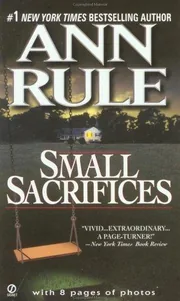
Small sacrifices
by Ann Rule · 1987
Suited to adult readers of true crime.
494 pages, about 8 to 11.5 hours.
A long, documented true-crime case study of one Oregon prosecution. 53% taste match
What it covers
Small Sacrifices is a work of true crime by Ann Rule, first published in 1987 and running to roughly 494 pages. It belongs to the biography and memoir shelf, with a focus on criminal investigation and the psychology of a killer.
The book examines the case of Diane Downs, born in 1955, who was accused of shooting her three children in Oregon. The events unfold in the Springfield and Eugene area, and the narrative follows the investigation, the evidence gathered, and the murder trial that followed. One daughter died, while the other two children survived with severe injuries. Rule draws a portrait of Downs as a person and looks closely at her conduct and behavior, including her demeanor in court. The account also touches on the people around the case, among them an emergency room doctor who treated patients in the region.
As a case study in murder and criminal psychology set in the United States during the 1980s, it speaks to readers of true crime who want a detailed, document-driven look at a single prosecution. Fourteen editions have appeared over the years.
gency room doctor; his assessment of patient's needs is deft. In his late thirties, married, and the father of young children, he had worked full-time in the ER for eight years.
Characters
Diane Downs
Setting
OregonSpringfieldEugene
Themes
MurderTrials (Murder)Case studiesMurderersBiographyCriminalsCriminals, biographyMurder, oregon
- Want to read 213
- Reading now 13
- Read 17
Most people shelving it are saving it for later.
Of 243 readers who put it on a shelf, 88% want to read it, 5% are reading it now, 7% have finished it and 0% stopped before the end.
By the numbers
- The median edition runs 494 pages. Counting about 275 words a page and an adult reading pace of 250 words a minute, that is about 9.1 hours of reading.
- Open Library tracks 14 editions from 10 publishers, the earliest dated 1987 and the latest 2021.
- On reader demand it ranks in the top 8% of the modern books in our catalog (15,152 of them).
- Libraries shelve it under Dewey 364.15230979531 and Library of Congress class HV-6248.00000000.D68.
 BookWard’s take
A long, documented true-crime case study of one Oregon prosecution
Small Sacrifices follows the Diane Downs case from the shooting through the investigation to the trial, and it takes its time doing so. At 494 pages it runs long, which is a real cost for anyone who prefers a tighter book. The opening is strong, since the crime itself anchors the story from the start, and the ending is fully resolved because a verdict closes the case. Where the book earns its place is in its rigor: Rule lays out the evidence piece by piece, which will satisfy readers who want an airtight account. The characterization comes from a close study of Downs herself, her conduct and her courtroom demeanor. Expect dark material handled plainly, and a book driven by story rather than by ideas.
At 494 pages it is a long, thorough account, well past BookWard's preference for short books.
The investigation and trial move steadily, but a book this long and detailed is not a fast read.
A single prosecution told in familiar true-crime form, so it is more established than inventive.
Plain, direct reporting prose without ornament, a little plainer than BookWard's middle position.
The case drives events, but the portrait of Downs gives character a strong share too.
A story of murder and lasting harm to children, with little uplift beyond the verdict.
A conventional run from crime to investigation to trial.
There is no humor to speak of in this material.
Infanticide and a sociopathic subject make this about as dark as nonfiction gets.
The harm to the children and Downs's coldness make for an intense read.
See all 50 dialsEvery position, side by side with this book
Where it lines up
- Character depthBookWard 8 · book 8
- Story or ideasBookWard 3 · book 3
- EndingBookWard 8 · book 9
Where it pulls apart
- LengthBookWard 1 · book 9
- Familiar tropesBookWard 10 · book 6
- OriginalityBookWard 9 · book 5
At 494 pages it is a long, thorough account, well past BookWard's preference for short books.
The shooting of three children gives the story an immediate pull, close to BookWard's taste for openings that grab at once.
True-crime conventions of investigation and trial are present, though the real case keeps it from reading as formula.
The case is built from evidence laid out step by step, which fits BookWard's liking for airtight reasoning.
The investigation and trial move steadily, but a book this long and detailed is not a fast read.
A single prosecution told in familiar true-crime form, so it is more established than inventive.
Rule studies Downs closely, her behavior and courtroom conduct, which gives the central figure real depth.
A trial brings the case to a verdict, so the story ends fully resolved, as BookWard prefers.
The material is handled plainly, with little softening, though the children's suffering carries real feeling.
The crime is horrifying, but it is the actual case being reported, not darkness added for effect.
Rule describes the evidence in detail, which supports BookWard's high regard for documented nonfiction.
A clear, reportorial style with a steady presence, competent more than strikingly individual.
This is firmly story-led, following a case through events rather than arguing an idea.
Much of the case is explained and laid out by the author, leaning away from BookWard's show-in-scene taste.
A book of this length can drag in the detail of investigation, though the case keeps interest up.
Plain, direct reporting prose without ornament, a little plainer than BookWard's middle position.
The case drives events, but the portrait of Downs gives character a strong share too.
A story of murder and lasting harm to children, with little uplift beyond the verdict.
A conventional run from crime to investigation to trial.
There is no humor to speak of in this material.
Accessible to read, though the length and subject ask for stamina.
Rule draws on investigators, medical staff, family and the accused, giving several angles on the case.
The account follows the case in a mostly linear way.
Entirely grounded in a real criminal case.
Investigators, doctors, family members and lawyers make for a sizable cast around the case.
One family and one prosecution make this an intimate story, though told in depth.
It balances the outward events of investigation and trial with a study of Downs's mind.
Courtroom exchanges and testimony feature, but the book is mostly narrated account.
A relationship with a married man bears on the motive, but romance is not the focus.
A 1980s Oregon community, Springfield and Eugene, is ordinary and recognizable.
Set in the 1980s and published in 1987, so it belongs to the past.
True-crime interest in psychopathy endures, though the book is tied to its period.
A reporting author lays out the evidence, with no sign of an unreliable narrator.
The case reads as a clear matter of wrongdoing, with little moral ambiguity.
Rule describes evidence, places and conduct in considerable detail.
It reads as narrative true crime, telling the case as a story.
Rule engages closely with her subject rather than standing back at a distance.
A standalone account of a single case.
Developments in the investigation and trial surprise, but the outcome is known history.
The subject matter is disturbing and asks the reader to stay with hard material.
Infanticide and a sociopathic subject make this about as dark as nonfiction gets.
The harm to the children and Downs's coldness make for an intense read.
There is no humor in the book.
The shootings and their aftermath are central, and the injuries are described.
The relationship with a married man is part of the backstory but not dwelt on.
The book is about crime and justice, not political questions.
Plain language throughout, with some legal and medical terms.
Rule conveys clear judgments about Downs's conduct rather than staying neutral.
It looks backward, reconstructing a crime and trial already past.
A cold portrait of a person who harms her own children, with little room for idealism.
Review written by BookWard, dial version 1, November 2026.
Who is Small sacrifices right for?
Suited to adult readers of true crime. It contains a detailed account of violence against children and its aftermath, which many readers will find distressing.
Accessible to read, though the length and subject ask for stamina.
Infanticide and a sociopathic subject make this about as dark as nonfiction gets.
The harm to the children and Downs's coldness make for an intense read.
The shootings and their aftermath are central, and the injuries are described.
Book CompanionSmall sacrifices: ideas, characters, themes
Ann Rule reconstructs the Diane Downs case, from the shooting of her three children in Oregon through the investigation to the trial, while examining Downs's personality and behavior.
- The crime. Diane Downs, accused of shooting her three children in Oregon, is the center of the case. One daughter died and the other two children survived with severe injuries.
- The investigation. Rule describes the evidence gathered in the Springfield and Eugene area and how it was presented.
- The portrait of Downs. The book studies Downs as a person, looking closely at her conduct and manner.
- The trial. The murder trial brings the evidence together, and Downs's demeanor in court is part of the account.
- The people around the case. Medical staff and others in the region figure in the story, including an emergency room doctor who treated patients.
Characters
Diane Downs
Accused
Born in 1955, she is accused of shooting her three children in Oregon and is the book's central subject.
Themes
The book probes the personality and conduct of a person accused of a terrible crime.
The case is built on detailed evidence and tested at trial.
The suffering of the three children lies at the heart of the story.
Downs's courtroom behavior is examined as a window into her character.
Discussion questions
- How does Rule's close attention to Downs's courtroom behavior shape your view of her?
- What role does the physical evidence play in making the case understandable?
- Does a long, detailed account make the story more convincing or more wearing?
- How does the book balance the accused with the children who were harmed?
- What does a case study like this tell us about how communities respond to a crime like this?
Personalize your Book Companion
This is the general edition. In BookWard, the Companion is written for you: your reading profile, your notes, and spoiler-safe to the page you are on.
Buy, listen or borrow Small sacrifices
Each link opens a search for this book on that store, in a new tab.
Read on a device
Borrow
Reviews and community
If you liked Small sacrifices
Grisham's true-crime exposé of a small-town wrongful conviction in Oklahoma
CujoStephen KingA rabid Saint Bernard, a stalled car, and nowhere to run
The Dark HalfStephen KingKing's novelist-versus-pseudonym horror, sturdy and fast but familiar
Different SeasonsStephen KingFour King novellas, one for each season, with horror held back
Sources: Open Library.
Track Small sacrifices and find your next favorite
Add it to your shelf, rate what you have read, and BookWard will recommend what fits you.
Free to start. No credit card needed.