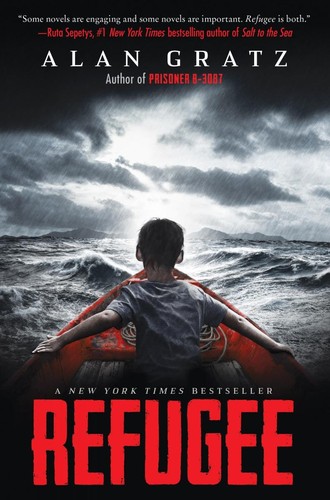
Refugee
by Alan Gratz
★ Top 25 book of 2017 · #13 on Best Books of 2017
Three young people from different eras flee danger: a Jewish boy in Nazi Germany, a Cuban girl in 1994 and a Syrian boy in 2015. Their harrowing journeys in search of refuge are tied together by surprising connections.
Best for: Middle-grade and teen readers interested in history, migration and stories of courage and hope
Refugee is #13 on BookWard's Best Books of 2017, out of 73 2017 books that cleared our data bar.
What Refugee is about
Three young people, three eras, one desperate need to find safety. Josef is a German Jew in the 1930s, boarding a ship with his family as the threat of concentration camps closes in. Isabel is a Cuban girl in 1994, setting out on a raft with her family to escape hunger and reach America. Mahmoud is a Syrian boy in 2015 whose home is destroyed by a missile, leaving his family to begin a long trek toward Europe and asylum in Germany.
Each faces real dangers, including drownings, bombings and betrayals. The tone is harrowing and urgent, yet hope keeps surfacing, and the stories are tied together in surprising ways. Written for middle grade readers, the novel was praised for its style and historical accuracy and reached The New York Times Best Seller list. It offers a human way into the long history of people forced to flee.
Refugee on the Best Books of 2017
Refugee came out in 2017. Of the 73 books first published in 2017 that met BookWard's data bar, it ranks #13 on our Best Books of 2017 list.
Why it made the list: 558 readers have shelved it on Open Library; readers rate it 4.1 out of 5 (36 ratings); 41 are reading it right now. The list ranks each year’s books on how many readers have picked them up, how highly readers rate them, and how many are reading them right now.
It earns Being read right now.
Nearby on the 2017 list
- Norse Mythology Neil Gaiman, #11
- Nightfall Shannon Messenger, #12
- Oathbringer Brandon Sanderson, #14
- Dream Psychology Sigmund Freud, #15
See all Best Books of 2017 Best books by year
More years: Best Books of 2016 Best Books of 2018.
The numbers behind it
- Readers: 479 want to read it, 41 are reading it now and 38 have read it, according to Open Library.
- Ratings: 4.1 out of 5 from 36 Open Library ratings.
| Signal | This book (0 to 100) | Weight |
|---|---|---|
| Reach | 81 | 55% |
| Reader love | 53 | 25% |
| Being read right now | 90 | 20% |
Questions about Refugee
When was Refugee published?
Refugee by Alan Gratz was first published in 2017.
Was Refugee one of the best books of 2017?
Refugee is #13 on BookWard's Best Books of 2017, out of 73 2017 books that cleared our data bar. 558 readers have shelved it on Open Library; readers rate it 4.1 out of 5 (36 ratings); 41 are reading it right now.
Why is Refugee on the Best Books of 2017 list?
558 readers have shelved it on Open Library; readers rate it 4.1 out of 5 (36 ratings); 41 are reading it right now.
More of the best books of 2017
- The Hate U Give Angie Thomas, #1
- The Seven Husbands of Evelyn Hugo Taylor Jenkins Reid, #2
- A Court of Wings and Ruin Sarah J. Maas, #3
- One of Us Is Lying Karen M. McManus, #4
- Why We Sleep Matthew P. Walker, #5
- The Dark Prophecy Rick Riordan, #6
See the full Best Books of 2017, the Top 100, or new books on Rising.
How we know
This page uses public data: Open Library reader counts and ratings, and Wikipedia page views for recent years. The description is paraphrased from real source text. Rankings reflect reading interest, not quality or sales, and can be affected by data gaps. Lists update monthly.
It suits upper elementary and middle grade readers, and is also strong for older readers who want a quick, moving read.
Depends on the edition you pick.
Three child refugees, three eras, one relentless race to safety. 62% taste match
 BookWard’s take
Three child refugees, three eras, one relentless race to safety
Refugee braids the stories of Josef, Isabel and Mahmoud, a Jewish boy in 1930s Germany, a Cuban girl in 1994 and a Syrian boy in 2015, each fleeing for their lives. It hooks at once: every thread opens already in danger, and the pace stays brisk because the three journeys keep trading the baton. Viewpoints are many and the timeline shifts, but the structure stays easy to follow. The prose is plain and direct rather than ornate, which suits a middle grade audience. Its darkness is earned: the drownings and bombings come from real history, not shock for effect. The ending offers hope and ties the strands together. If you like story-led books that teach without lecturing, this delivers. Readers who want subtle, ambiguous character work may find the cast drawn in broad, urgent strokes.
Cutting between three escapes keeps momentum high and close to BookWard's quick preference.
The triple-timeline premise is distinctive, even if each single story is a known kind of tale.
The prose is plain and direct, built for clarity and speed rather than ornament.
Events drive the book, with character growth shaped by the next threat.
Despite the peril, each journey holds onto hope, and the book closes on a hopeful note.
Interleaving three eras is a mildly inventive frame, though it stays easy to follow.
The subject is grave and the tone serious throughout.
Drownings, bombings and persecution make this a dark book, tempered by hope.
The stakes and family bonds make it emotionally intense.
See all 50 dialsEvery position, side by side with this book
Where it lines up
- EndingBookWard 8 · book 8
- Sagging middleBookWard 8 · book 8
- OpeningBookWard 10 · book 9
Where it pulls apart
- Familiar tropesBookWard 10 · book 6
- LengthBookWard 1 · book 4
- Internal logicBookWard 10 · book 8
Each thread opens already in danger, so the book grabs you at once, which matches BookWard's taste.
Refugee stories and the dangerous-journey shape are familiar ground, though the three-era braid freshens it somewhat.
Each journey follows a believable chain of cause and effect, rooted in real historical events.
Cutting between three escapes keeps momentum high and close to BookWard's quick preference.
The triple-timeline premise is distinctive, even if each single story is a known kind of tale.
The three young leads are clearly drawn and sympathetic, though urgency favors action over deep interiority.
The strands come together and resolve with a sense of closure rather than leaving things open.
It leans into emotion openly, as middle grade does, with some moments pitched to move the reader.
The dangers reflect real events, so the dark moments feel earned rather than gratuitous.
Praised for historical accuracy, it grounds fiction in real events, though it remains a novel.
The storytelling is clear and propulsive, with a recognizable but not strongly idiosyncratic voice.
This is firmly story-led; the ideas about displacement arrive through what happens to the characters.
Context mostly comes through scenes of travel and danger, with some explaining for young readers.
Three alternating threads keep the middle moving, so momentum rarely stalls.
The prose is plain and direct, built for clarity and speed rather than ornament.
Events drive the book, with character growth shaped by the next threat.
Despite the peril, each journey holds onto hope, and the book closes on a hopeful note.
Interleaving three eras is a mildly inventive frame, though it stays easy to follow.
The subject is grave and the tone serious throughout.
Written for middle grade readers, it reads easily even as the content weighs heavily.
Three protagonists share the telling, giving it a clear multi-viewpoint design.
The story hops between the 1930s, 1994 and 2015, though each strand moves forward in order.
Entirely grounded in real historical events and places.
Three leads and their families make a moderate cast, not a crowded one.
It spans continents and decades, yet stays focused on individual families' flight.
Escape and survival dominate, so external action outweighs reflection.
Conversation carries the family dynamics and tension, in balance with action.
Romance is not a focus; family and survival are the central bonds.
Readers move through settings from Nazi Germany to Cuba to Syria, likely new to many young readers.
It covers the 1930s, 1994 and 2015, mixing past and recent times.
Displacement and refuge remain pressing, so the book keeps its relevance.
The narration is straightforward and trustworthy, with no games played with the reader.
The moral stakes are plain: flight from persecution and violence is sympathetic and clearly framed.
Description serves the action and danger rather than lingering for its own sake.
Close, intimate access to each child's fears keeps the perspective personal.
It is a standalone novel.
Betrayals and sudden dangers surprise, and the connecting links between the stories land late.
The subject is heavy and asks readers to face hard realities, though it is written to be accessible.
Drownings, bombings and persecution make this a dark book, tempered by hope.
The stakes and family bonds make it emotionally intense.
Humor is nearly absent given the grim circumstances.
Violence appears on the page as part of war and flight, moderated for a young audience.
No sexual content is part of this story.
Persecution, war and asylum are central, though told through personal experience.
The language is plain and accessible for young readers.
The narration stays close to events, letting the situations carry the argument.
It looks back at history to speak to the present, leaning neither fully backward nor forward.
It believes in resilience and the chance of safety, while showing real cruelty.
Review written by BookWard, dial version 1, November 2026.
Who is Refugee right for?
It suits upper elementary and middle grade readers, and is also strong for older readers who want a quick, moving read. It depicts war, drowning, persecution and loss, so younger or sensitive readers may want adult company.
Written for middle grade readers, it reads easily even as the content weighs heavily.
Drownings, bombings and persecution make this a dark book, tempered by hope.
The stakes and family bonds make it emotionally intense.
Violence appears on the page as part of war and flight, moderated for a young audience.
Book CompanionRefugee: ideas, characters, themes
Three children in different eras flee violence and persecution, showing that the search for refuge is a repeating human story.
- Three eras, one need. Josef, Isabel and Mahmoud live in 1930s Germany, 1994 Cuba and 2015 Syria, each driven to escape.
- Journeys by sea and land. The stories follow dangerous passages, including a ship, a raft and a long trek toward Europe.
- Real history underneath. Each strand draws on actual events, which is why the book is noted for its historical accuracy.
- Threads that connect. Although separated by decades and continents, the stories are tied together in surprising ways by the end.
- Hope as fuel. Despite drownings, bombings and betrayals, each child keeps hoping for tomorrow.
Characters
Josef Landau
A Jewish boy in 1930s Germany
He and his family board a ship seeking to leave Nazi Germany.
Isabel Fernandez
A Cuban girl in 1994
She and her family set out on a raft hoping to reach America.
Mahmoud Bishara
A Syrian boy in 2015
After his home is destroyed, his family begins the trek toward asylum in Germany.
Themes
The need for a safe place when home is no longer safe.
Bonds that drive each child's choices and survival.
The belief in tomorrow that keeps the characters moving.
The forces that uproot people across different times and places.
How separate stories echo and link one another.
Discussion questions
- How do the three stories echo one another despite different eras and places?
- What does each child risk by leaving, and what do they risk by staying?
- Why might the author alternate between the three stories instead of telling them one after another?
- How does hope shape the choices each character makes?
- What did the historical settings teach you that you did not already know?
Personalize your Book Companion
This is the general edition. In BookWard, the Companion is written for you: your reading profile, your notes, and spoiler-safe to the page you are on.
Buy, listen or borrow Refugee
Each link opens a search for this book on that store, in a new tab.
Read on a device
Borrow
Reviews and community
If you liked Refugee
Ten true wrongful-conviction cases, told with a novelist's drive
Before We Were YoursLisa WingateA shantyboat childhood torn apart, and a descendant who digs
The Innocent ManJohn GrishamGrisham's true-crime exposé of a small-town wrongful conviction in Oklahoma
Across So Many SeasRuth BeharFour Jewish girls, four centuries, one family's long journey home
Find your own best books
Add what you have read, rate it, and BookWard will recommend what to read next.
Free to start. No credit card needed.