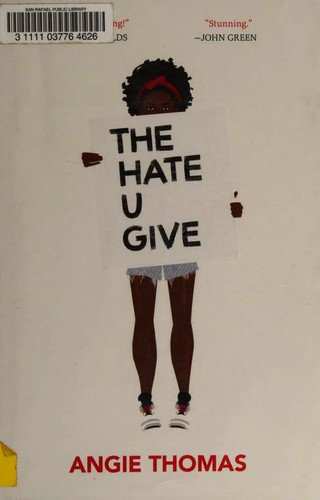
The Hate U Give
by Angie Thomas
★ Most-read book of 2017 · #1 on Best Books of 2017
Sixteen-year-old Starr Carter moves between her poor neighborhood and an affluent private school. After she witnesses a police officer kill her childhood friend, she begins speaking out publicly as tensions in her community rise.
Best for: Readers wanting a timely, discussion-worthy novel about justice, identity and speaking up
The Hate U Give is #1 on BookWard's Best Books of 2017, out of 73 2017 books that cleared our data bar.
What The Hate U Give is about
Starr Carter, sixteen, moves between two worlds. At home in Garden Heights, a poor neighborhood, she is one person. At Williamson Prep, an affluent and mostly white private school, she is carefully another. Her father, Maverick, who left the King Lords gang and now runs the neighborhood grocery store, has raised her to be proud and watchful.
The balance she has built breaks when her childhood friend Khalil is shot and killed by a white police officer after a traffic stop, and Starr is the one who saw it happen. As the media paints Khalil in an unkind light and the case moves toward a grand jury, she has to decide whether to speak, and what speaking might cost her, her family and her community.
Angie Thomas wrote this debut for young adults, growing it from a college short story written in response to the police shooting of Oscar Grant. It is urgent and emotional, and it asks readers to understand the Black Lives Matter movement through one girl's voice.
The Hate U Give on the Best Books of 2017
The Hate U Give came out in 2017. Of the 73 books first published in 2017 that met BookWard's data bar, it ranks #1 on our Best Books of 2017 list.
Why it made the list: 3,160 readers have shelved it on Open Library; readers rate it 4.4 out of 5 (137 ratings); 164 are reading it right now. The list ranks each year’s books on how many readers have picked them up, how highly readers rate them, and how many are reading them right now.
It earns Most-read of 2017 and reader favorite and being read right now.
Nearby on the 2017 list
- The Seven Husbands of Evelyn Hugo Taylor Jenkins Reid, #2
- A Court of Wings and Ruin Sarah J. Maas, #3
See all Best Books of 2017 Best books by year
More years: Best Books of 2016 Best Books of 2018.
The numbers behind it
- Readers: 2,825 want to read it, 164 are reading it now and 171 have read it, according to Open Library.
- Ratings: 4.4 out of 5 from 137 Open Library ratings.
| Signal | This book (0 to 100) | Weight |
|---|---|---|
| Reach | 99 | 55% |
| Reader love | 95 | 25% |
| Being read right now | 99 | 20% |
Questions about The Hate U Give
When was The Hate U Give published?
The Hate U Give by Angie Thomas was first published in 2017.
Was The Hate U Give one of the best books of 2017?
The Hate U Give is #1 on BookWard's Best Books of 2017, out of 73 2017 books that cleared our data bar. 3,160 readers have shelved it on Open Library; readers rate it 4.4 out of 5 (137 ratings); 164 are reading it right now.
Why is The Hate U Give on the Best Books of 2017 list?
3,160 readers have shelved it on Open Library; readers rate it 4.4 out of 5 (137 ratings); 164 are reading it right now.
More of the best books of 2017
- The Seven Husbands of Evelyn Hugo Taylor Jenkins Reid, #2
- A Court of Wings and Ruin Sarah J. Maas, #3
- One of Us Is Lying Karen M. McManus, #4
- Why We Sleep Matthew P. Walker, #5
- The Dark Prophecy Rick Riordan, #6
- Becoming Supernatural Joe Dispenza, #7
See the full Best Books of 2017, the Top 100, or new books on Rising.
How we know
This page uses public data: Open Library reader counts and ratings, and Wikipedia page views for recent years. The description is paraphrased from real source text. Rankings reflect reading interest, not quality or sales, and can be affected by data gaps. Lists update monthly.
This suits teens and adults, and it is widely read in young adult circles.
Depends on the edition you pick.
A debut that makes a teenager's split life feel urgent. 66% taste match
 BookWard’s take
A debut that makes a teenager's split life feel urgent
Starr Carter moves between Garden Heights and an elite, mostly white prep school, and the book opens on the night that split life breaks open. That hook is immediate, and the pace stays brisk because Starr's voice carries the story. This is character-driven fiction with a distinctive narrator, and the dialogue-heavy scenes show her family and friends rather than explaining them. The politics are front and center, which will suit readers who want a book to take a stance. The outlook is more hopeful than the subject would suggest, and the ending resolves its main threads instead of drifting. Where BookWard prizes restraint, the book is more emotionally open, and it leans on the familiar contours of a young adult novel. But it earns its seriousness, and Starr's divided self keeps the middle from sagging.
A full-length young adult novel that takes its time with family and neighborhood without turning sprawling, slightly longer than BookWard likes.
Events keep moving, from the shooting through interviews and public pressure to the grand jury, close to BookWard's quick preference.
The subject is not new to fiction, but a teen witness caught between two worlds gives it a fresh angle.
The language is direct, conversational and voice-driven rather than ornate, a touch plainer than BookWard.
The plot is set off by one event, but Starr's inner conflict drives most of what matters, matching BookWard.
The subject is grim, but family, community and Starr's growing voice leave real room for hope.
A single narrator tells the story in order, and BookWard leans slightly more toward formal play.
Humor shows up in family banter and Starr's asides, yet the tone stays serious overall.
See all 50 dialsEvery position, side by side with this book
Where it lines up
- Character depthBookWard 8 · book 8
- Authorial voiceBookWard 9 · book 9
- OpeningBookWard 10 · book 9
Where it pulls apart
- Familiar tropesBookWard 10 · book 5
- LengthBookWard 1 · book 5
- Internal logicBookWard 10 · book 8
A full-length young adult novel that takes its time with family and neighborhood without turning sprawling, slightly longer than BookWard likes.
It opens on a party, a car ride and a police stop, so the stakes land at once, as BookWard prefers.
The prep-school and neighborhood setup is recognizable, but the subject and Starr's voice keep it from feeling formulaic.
Cause and effect hold together: the shooting, the witness decision and the public fallout follow believably from each other.
Events keep moving, from the shooting through interviews and public pressure to the grand jury, close to BookWard's quick preference.
The subject is not new to fiction, but a teen witness caught between two worlds gives it a fresh angle.
Starr, her family and the people around her are drawn with real texture and divided loyalties, which BookWard values.
The central events reach a clear outcome, even though the wider injustice stays unresolved, in line with BookWard.
It is openly emotional and warm about family, though it avoids easy comfort, sitting a little warmer than BookWard.
The violence is the engine of the story and serves its argument, not spectacle, which BookWard respects.
Starr's narration is specific, sharp and unmistakably hers, exactly the distinctive voice BookWard rewards.
It carries real ideas about code switching and protest, but they arrive through a story, which BookWard prefers.
Ideas and background come out through scenes, family conversations and Starr's reactions rather than lecturing.
Starr's mounting pressure at home, school and in public keeps the middle moving, close to BookWard's standard.
The language is direct, conversational and voice-driven rather than ornate, a touch plainer than BookWard.
The plot is set off by one event, but Starr's inner conflict drives most of what matters, matching BookWard.
The subject is grim, but family, community and Starr's growing voice leave real room for hope.
A single narrator tells the story in order, and BookWard leans slightly more toward formal play.
Humor shows up in family banter and Starr's asides, yet the tone stays serious overall.
The prose is accessible and quick to read, though the subject asks for emotional attention, easier than BookWard.
The story stays entirely inside Starr's head, a narrower lens than BookWard's taste for many viewpoints.
Events move forward in order with little jumping around, simpler than BookWard's mix.
This is firmly realistic fiction rooted in a recognizable American city, a bit more grounded than BookWard.
Starr's family, neighborhood and school friends make a sizable ensemble, somewhat larger than BookWard's usual.
The story is personal at its core, even as it grows into a national news event and a riot.
Starr's thoughts and public events share the page about equally, close to BookWard's balance.
Conversations carry much of the story, from family dinners to school and interviews, in line with BookWard.
Starr's relationship with Chris is part of her split life, but it is not the central story.
Garden Heights and the prep school are vividly specific, though the setting is recognizable to many readers.
The story reflects the contemporary climate of the 2010s, near BookWard's lean toward the present.
The specific events are of their moment, but the questions about justice and voice still hold.
Starr tells it straight and sincerely, a reliable guide, where BookWard leans toward unreliability.
The book takes a clear moral side on Khalil's death and its aftermath, more certain than BookWard's taste for ambiguity.
Setting and people are sketched through telling detail, not long passages, a bit leaner than BookWard.
Review written by BookWard, dial version 1, November 2026.
Who is The Hate U Give right for?
This suits teens and adults, and it is widely read in young adult circles. It includes a fatal police shooting, gang references, a riot and strong language, which have made it one of the most frequently challenged books.
The prose is accessible and quick to read, though the subject asks for emotional attention, easier than BookWard.
Book CompanionThe Hate U Give: ideas, characters, themes
A teenager who lives between two worlds must decide whether to speak publicly after witnessing a police shooting of her friend.
- One night, one choice. Starr watches a police officer shoot her childhood friend Khalil after a traffic stop, and that moment sets everything else in motion.
- Two versions of Starr. She lives in Garden Heights but attends the affluent, mostly white Williamson Prep, and carefully adjusts how she speaks and acts in each place.
- The pressure to stay silent. Starr's identity as the witness is first kept secret, and hiding it from friends and her boyfriend weighs on her.
- How the story gets told. Khalil becomes a national news story, and the media portrays him as a gang banger while treating the officer more favorably.
- Speaking up in public. Starr gradually speaks out in more public ways, and tension grows until a grand jury decision leads to a riot.
Characters
Starr Carter
Narrator and protagonist
A 16-year-old who moves between Garden Heights and her private school while carrying what she saw.
Khalil
Starr's childhood friend
The friend whose killing at a police stop drives the story.
Maverick
Starr's father
Owner of the Garden Heights grocery store, a former gang member who served three years in prison.
Uncle Carlos
Detective and father figure
A detective who helped raise Starr while her father was in prison and encourages her to speak to police.
Chris
Starr's boyfriend
Her white boyfriend at Williamson Prep, from whom she keeps her secret.
Themes
Changing how you speak and act to fit different communities, and the cost of doing so.
The risk and responsibility of being a witness when your voice matters.
How news coverage shapes public opinion of victims and officers.
The support, loyalty and conflict found among the people closest to you.
What people do when the legal system fails to deliver accountability.
Discussion questions
- How does Starr behave differently at home and at school, and what does each version cost her?
- Why is it so hard for Starr to speak publicly about what she saw?
- How does the media's portrayal of Khalil shape how people respond to his death?
- What role do Starr's family and neighborhood play in helping her decide what to do?
- Does the book's ending feel hopeful, and what makes it so or not?
Personalize your Book Companion
This is the general edition. In BookWard, the Companion is written for you: your reading profile, your notes, and spoiler-safe to the page you are on.
Buy, listen or borrow The Hate U Give
Each link opens a search for this book on that store, in a new tab.
Read on a device
Borrow
Reviews and community
If you liked The Hate U Give
A rapper's rise, sharp-voiced, and a little long
Dear MartinNic StoneA short, urgent YA novel built on one unforgettable night
Compound FractureAndrew Joseph WhiteA trans, autistic teen fights a sheriff and a haunting
Black BoyRichard WrightA hungry boy in the Jim Crow South, told without flinching
Find your own best books
Add what you have read, rate it, and BookWard will recommend what to read next.
Free to start. No credit card needed.