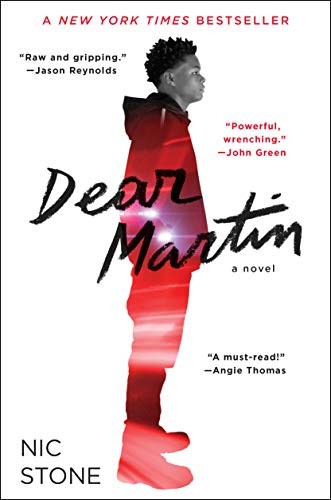
Dear Martin
by Nic Stone
★ Top 25 book of 2017 · #24 on Best Books of 2017
Justyce McAllister is a conscientious honor student, yet he is handcuffed by a police officer anyway. Seeking answers, he writes journal letters to Dr. Martin Luther King Jr., until a tense encounter with an off-duty cop turns violent.
Best for: Teen and adult readers interested in honest stories about race in America
Dear Martin is #24 on BookWard's Best Books of 2017, out of 73 2017 books that cleared our data bar.
What Dear Martin is about
Justyce McAllister does everything right. He is an honor student, a loyal friend, and someone who leaves his old neighborhood behind for a better path. Then a police officer handcuffs him anyway, and the record he worked so hard to build seems not to count for much. At school he faces ridicule from new classmates, and back home the scorn of former peers hasn't faded, so he belongs fully in neither place.
Looking for answers, Justyce turns to the teachings of Dr. Martin Luther King Jr. and starts writing him letters in a journal, asking whether those ideas still hold up today. Then a drive with his best friend Manny, music turned up loud, brings a furious encounter with a white off-duty cop. Nic Stone's debut, a #1 New York Times bestseller and William C. Morris Award Finalist, tackles American race relations through Justyce McAllister, a good kid and honor student.
Dear Martin on the Best Books of 2017
Dear Martin came out in 2017. Of the 73 books first published in 2017 that met BookWard's data bar, it ranks #24 on our Best Books of 2017 list.
Why it made the list: 295 readers have shelved it on Open Library; readers rate it 4.9 out of 5 (10 ratings). The list ranks each year’s books on how many readers have picked them up, how highly readers rate them, and how many are reading them right now.
Nearby on the 2017 list
- Tower of Dawn Sarah J. Maas, #22
- Children of Blood and Bone Tomi Adeyemi, #23
- All Systems Red Martha Wells, #25
See all Best Books of 2017 Best books by year
More years: Best Books of 2016 Best Books of 2018.
The numbers behind it
- Readers: 271 want to read it, 10 are reading it now and 14 have read it, according to Open Library.
- Ratings: 4.9 out of 5 from 10 Open Library ratings.
| Signal | This book (0 to 100) | Weight |
|---|---|---|
| Reach | 56 | 55% |
| Reader love | 89 | 25% |
| Being read right now | 45 | 20% |
Questions about Dear Martin
When was Dear Martin published?
Dear Martin by Nic Stone was first published in 2017.
Was Dear Martin one of the best books of 2017?
Dear Martin is #24 on BookWard's Best Books of 2017, out of 73 2017 books that cleared our data bar. 295 readers have shelved it on Open Library; readers rate it 4.9 out of 5 (10 ratings).
Why is Dear Martin on the Best Books of 2017 list?
295 readers have shelved it on Open Library; readers rate it 4.9 out of 5 (10 ratings).
More of the best books of 2017
- The Hate U Give Angie Thomas, #1
- The Seven Husbands of Evelyn Hugo Taylor Jenkins Reid, #2
- A Court of Wings and Ruin Sarah J. Maas, #3
- One of Us Is Lying Karen M. McManus, #4
- Why We Sleep Matthew P. Walker, #5
- The Dark Prophecy Rick Riordan, #6
See the full Best Books of 2017, the Top 100, or new books on Rising.
How we know
This page uses public data: Open Library reader counts and ratings, and Wikipedia page views for recent years. The description is paraphrased from real source text. Rankings reflect reading interest, not quality or sales, and can be affected by data gaps. Lists update monthly.
It suits teens and up, and works well for classroom or family discussion.
Depends on the edition you pick.
A short, urgent YA novel built on one unforgettable night. 61% taste match
 BookWard’s take
A short, urgent YA novel built on one unforgettable night
Dear Martin grabs hold in its opening pages, with Justyce in handcuffs for doing nothing wrong, and it never really lets go. It's short and quick, which suits a reader who likes tight, fast books. The journal letters to Dr. King give it a distinctive voice and a structure that steps a little outside the conventional. Where it lost me at times is in how openly it states its arguments rather than leaving them buried in scene, and the feeling runs warmer than I usually like. Still, the politics are front and center by design, and the characters have real depth for a book this lean. It earns its darkness rather than leaning on shock, which I respect. A brisk, purposeful read that asks real questions.
A compact YA novel that moves in short chapters and journal entries, which suits BookWard's preference for tight books.
Short chapters and a steady push of events keep it moving quickly, close to BookWard's own preference.
Letters to Dr. King as a framing device freshen a familiar subject, though the story itself follows recognizable lines.
The writing is plain and conversational, a touch simpler than BookWard's middle-of-the-road preference.
The events matter, but they are told through Justyce's evolving thinking, so it tilts modestly toward character.
It lands between anger and possibility, ending cautious rather than bleak, a bit less hopeful than BookWard leans.
Journal letters and shifting formats add some variety, though the main storyline stays conventional.
Humor shows up in friendships and banter, but the book is serious at heart, far from BookWard's lighter lean.
The central violence and its aftermath make the content serious and weighty, a bit darker than BookWard's middle point.
Anger, grief and confusion are felt strongly on the page, more intense than BookWard typically leans.
See all 50 dialsEvery position, side by side with this book
Where it lines up
- PaceBookWard 8 · book 8
- Sagging middleBookWard 8 · book 8
- LengthBookWard 1 · book 2
Where it pulls apart
- Familiar tropesBookWard 10 · book 5
- ExpositionBookWard 2 · book 7
- SentimentBookWard 8 · book 4
A compact YA novel that moves in short chapters and journal entries, which suits BookWard's preference for tight books.
It opens with Justyce handcuffed by a police officer, an immediate and charged scene that matches BookWard's love of instant hooks.
The high-school setting brings familiar YA beats, but the central situation is handled with specificity rather than formula.
Events follow cleanly from one another and Justyce's reactions stay consistent, which BookWard values.
Short chapters and a steady push of events keep it moving quickly, close to BookWard's own preference.
Letters to Dr. King as a framing device freshen a familiar subject, though the story itself follows recognizable lines.
Justyce is drawn with real inner conflict, though supporting characters are sketched more lightly than BookWard prefers.
The story reaches a settled point, though it leaves larger questions open on purpose, a little looser than BookWard likes.
It reaches for emotion directly and sometimes warmly, running less restrained than BookWard's taste.
The violence arrives with purpose and consequence rather than as spectacle, which BookWard rewards.
The mix of prose, journal letters and script-like passages gives it a recognizable, confident voice.
It carries real arguments but anchors them in Justyce's story, leaning a bit more idea-led than BookWard usually likes.
Characters often voice the book's arguments outright, more explained than BookWard's preference for showing in scene.
Short and focused, it holds its energy from first page to last, in line with BookWard's taste.
The writing is plain and conversational, a touch simpler than BookWard's middle-of-the-road preference.
The events matter, but they are told through Justyce's evolving thinking, so it tilts modestly toward character.
It lands between anger and possibility, ending cautious rather than bleak, a bit less hopeful than BookWard leans.
Journal letters and shifting formats add some variety, though the main storyline stays conventional.
Humor shows up in friendships and banter, but the book is serious at heart, far from BookWard's lighter lean.
Accessible language and short chapters make it an easy read, even when the subject is heavy.
It stays close to Justyce's perspective, which is narrower than BookWard's taste for many viewpoints.
The story moves forward in clear sequence, a touch more linear than BookWard prefers.
Entirely grounded in contemporary American life, with nothing fantastical, more real than BookWard's middle position.
A small circle of friends, classmates and family keeps the cast compact, close to BookWard's range.
It stays intimate, centered on one teenager and his immediate circle, near BookWard's middle position.
Justyce's thoughts and the journal letters drive much of the book, leaning inward more than BookWard does.
Conversations carry much of the story and the arguments, which matches BookWard's enjoyment of dialogue-heavy books.
A light romantic thread exists but stays secondary to the main story, below BookWard's middle point.
The settings of school, neighborhood and family are familiar contemporary spaces, more familiar than BookWard's lean.
Set in the present day, it fits BookWard's lean toward contemporary settings very well.
Its subject has lasting relevance, which suits BookWard, though it is firmly tied to its moment.
Justyce tells it honestly and openly, so the narration is reliable, unlike BookWard's lean toward unreliable voices.
The book takes clear stances while letting Justyce wrestle with real uncertainty, slightly clearer than BookWard prefers.
Description stays spare and functional, serving the dialogue and thought rather than lingering on setting.
It reads as a standalone story, lighter on series ties than BookWard's middle position.
The main turns are driven by events rather than reveals, giving fewer surprises than BookWard tends to like.
It asks readers to sit with uncomfortable questions about race and justice, matching BookWard's taste for challenge.
The central violence and its aftermath make the content serious and weighty, a bit darker than BookWard's middle point.
Anger, grief and confusion are felt strongly on the page, more intense than BookWard typically leans.
Where humor appears, it is easygoing banter, slightly drier than broad, near BookWard's middle position.
One shooting is central, but most of the book deals with its aftermath rather than repeated violence.
Sexual content is minimal and mild, below BookWard's middle position.
Race and policing sit at the heart of the book, making it as political as it gets.
The language is plain and accessible, easier than BookWard's middle position.
The book argues its position openly and wants readers to think, more opinionated than BookWard's slight lean.
It looks forward, asking what comes next for a young man and for the country, matching BookWard's lean.
Justyce keeps testing whether Dr. King's ideals still hold, giving the book a hopeful but questioning center.
Review written by BookWard, dial version 1, November 2026.
Who is Dear Martin right for?
It suits teens and up, and works well for classroom or family discussion. It deals with police violence, a shooting and racism, so some readers may want to talk it through.
Accessible language and short chapters make it an easy read, even when the subject is heavy.
The central violence and its aftermath make the content serious and weighty, a bit darker than BookWard's middle point.
Anger, grief and confusion are felt strongly on the page, more intense than BookWard typically leans.
One shooting is central, but most of the book deals with its aftermath rather than repeated violence.
Book CompanionDear Martin: ideas, characters, themes
A teenage honor student writes letters to Dr. Martin Luther King Jr. to test whether nonviolence and respectability still protect a young Black man in America.
- The opening arrest. Justyce is handcuffed by a police officer despite doing nothing wrong, setting the book's central tension immediately.
- Letters to Dr. King. Justyce keeps a journal addressed to Dr. King to measure his teachings against his own daily experience.
- Two worlds. He has left a rough neighborhood for a prep school, yet he is judged and doubted in both places.
- The drive with Manny. A night driving with his best friend, music loud, brings a confrontation with a white off-duty cop that changes everything.
- Life under scrutiny. After the incident, media coverage turns its attention onto Justyce, forcing him to face how others see him.
Characters
Justyce McAllister
Protagonist
A good kid and honor student who writes to Dr. King while struggling to make sense of how he is treated.
Manny
Justyce's best friend
Rides with Justyce on the night of the confrontation and is caught up in what follows.
Dr. Martin Luther King Jr.
Addressee of the journal
The figure Justyce writes to, whose teachings he tests against his own life.
Themes
How policing and public perception treat Black teenagers differently.
The idea that doing everything right should earn fair treatment, and whether it does.
Feeling out of place in both his old neighborhood and his new school.
Whether Dr. King's methods still offer answers in the present day.
How public stories get shaped about who is the victim and who is to blame.
Discussion questions
- Why does Justyce choose to write to Dr. King, and what does he hope to learn?
- How does Justyce's life at prep school differ from his old neighborhood, and what does each place expect of him?
- Does doing everything right protect Justyce? What does the book suggest?
- How does media coverage change the way Justyce is seen after the shooting?
- Do Dr. King's teachings hold up for Justyce, and what do you think?
Personalize your Book Companion
This is the general edition. In BookWard, the Companion is written for you: your reading profile, your notes, and spoiler-safe to the page you are on.
Buy, listen or borrow Dear Martin
Each link opens a search for this book on that store, in a new tab.
Read on a device
Borrow
Reviews and community
If you liked Dear Martin
A debut that makes a teenager's split life feel urgent
Et la joie de vivreGisèle PelicotA woman who made shame change sides, in her own words
On The Come UpAngie ThomasA rapper's rise, sharp-voiced, and a little long
If I Was Your GirlMeredith RussoA tender, earnest first love story about a girl guarding her past
Find your own best books
Add what you have read, rate it, and BookWard will recommend what to read next.
Free to start. No credit card needed.