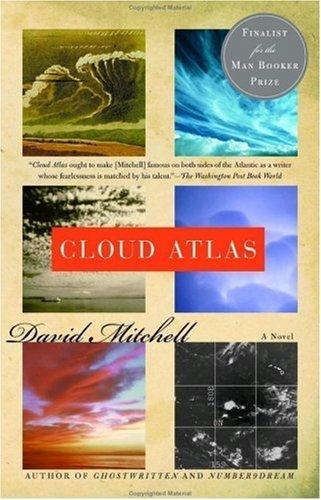
Cloud Atlas
by David Mitchell
★ Top 25 book of 2004 · #15 on Best Books of 2004
Six narrators, spread across very different eras and places, sense echoes of one another through history, and their fates shift in large and small ways. The novel reflects on humanity's dangerous will to power.
Best for: Adventurous readers who like inventive books that cross genres, eras and voices
Cloud Atlas is #15 on BookWard's Best Books of 2004, out of 48 2004 books that cleared our data bar.
What Cloud Atlas is about
Six stories, each told in a different voice and style, are nested inside one another across centuries. A lawyer keeps a sea journal in the 19th-century Pacific, a penniless English musician works for a composer in 1931 Belgium, a journalist in 1975 California investigates a nuclear plant, and a publisher in modern London finds himself trapped in a nursing home. Further on, a clone gives testimony in a future society, and a far-off island community lives in the aftermath of collapse.
The first five stories break off at a decisive moment and are picked up again in reverse order once the sixth is done. David Mitchell plays with genre as he goes, from journal to thriller to science fiction, while asking how power, exploitation and human choices echo through time. It is inventive and demanding, and rewards readers who enjoy patterns.
Cloud Atlas on the Best Books of 2004
Cloud Atlas came out in 2004. Of the 48 books first published in 2004 that met BookWard's data bar, it ranks #15 on our Best Books of 2004 list.
Why it made the list: 395 readers have shelved it on Open Library; readers rate it 4 out of 5 (87 ratings). The list ranks each year’s books on how many readers have picked them up, how highly readers rate them, and how many are reading them right now.
Nearby on the 2004 list
- The Definitive Book of Body Language Allan Pease, #13
- The Darkest Hour Erin Hunter, #14
- The Enemy Lee Child, #16
- The Spook's Apprentice Joseph Delaney, #17
See all Best Books of 2004 Best books by year
More years: Best Books of 2003 Best Books of 2005.
The numbers behind it
- Readers: 277 want to read it, 4 are reading it now and 114 have read it, according to Open Library.
- Ratings: 4 out of 5 from 87 Open Library ratings.
| Signal | This book (0 to 100) | Weight |
|---|---|---|
| Reach | 83 | 55% |
| Reader love | 54 | 25% |
| Being read right now | 15 | 20% |
Questions about Cloud Atlas
When was Cloud Atlas published?
Cloud Atlas by David Mitchell was first published in 2004.
Was Cloud Atlas one of the best books of 2004?
Cloud Atlas is #15 on BookWard's Best Books of 2004, out of 48 2004 books that cleared our data bar. 395 readers have shelved it on Open Library; readers rate it 4 out of 5 (87 ratings).
Why is Cloud Atlas on the Best Books of 2004 list?
395 readers have shelved it on Open Library; readers rate it 4 out of 5 (87 ratings).
More of the best books of 2004
- Darkly Dreaming Dexter Jeffry P. Lindsay, #1
- Rich Dad, Poor Dad for Teens Robert T. Kiyosaki, #2
- The Ruins of Gorlan John Flanagan, #3
- Blink Malcolm Gladwell, #4
- Alexander Hamilton Ron Chernow, #5
- She Comes First Ian Kerner, #6
See the full Best Books of 2004, the Top 100, or new books on Rising.
How we know
This page uses public data: Open Library reader counts and ratings, and Wikipedia page views for recent years. The description is paraphrased from real source text. Rankings reflect reading interest, not quality or sales, and can be affected by data gaps. Lists update monthly.
Best suited to confident adult readers who enjoy demanding fiction.
Depends on the edition you pick.
Six nested stories across centuries, each one reshaping the last. 56% taste match
 BookWard’s take
Six nested stories across centuries, each one reshaping the last
Cloud Atlas is built like a set of Russian dolls: six stories in six styles, each read or observed by the protagonist of the next, broken at a pivotal moment and resolved in reverse after the central sixth. That structure is a genuine risk, and it mostly pays off. Originality is the headline: few novels move from a 19th-century Pacific journal to a post-apocalyptic Hawaii without losing their footing. Authorial voice is distinctive, since Mitchell shifts register convincingly in every section. Structure is where it parts ways with BookWard's middle ground, because the nesting asks for patience before it rewards you. The ideas about power and consumption are real, but they ride on story rather than replacing it. Expect a long, demanding, rewarding read.
Six full narratives with a mirrored structure make this a substantial book, longer than BookWard's taste for tight, short reads.
Momentum varies by section, with brisk thriller stretches and slower period ones, a little under BookWard's preference for speed.
Nested stories spanning a 19th-century journal to a post-apocalyptic future make this about as original as mainstream fiction gets.
Styles shift deliberately from period diction to invented dialect, giving the language a richer texture than plain prose.
Plot machinery and structure take the lead, with each narrator mainly serving the larger design.
The book weighs humanity's will to power against moments of decency, ending more open-eyed than despairing.
Six nested stories interrupted and resolved in reverse is among the most distinctive structures in popular fiction.
Wit surfaces in places, especially in the more comic sections, but the book is not primarily a funny one.
Slavery, exploitation and a collapsed future give it real darkness, tempered by moments of humanity.
Feeling runs fairly strong in places but is filtered through the book's shifting forms.
See all 50 dialsEvery position, side by side with this book
Where it lines up
- OriginalityBookWard 9 · book 10
- EndingBookWard 8 · book 7
- Authorial voiceBookWard 9 · book 10
Where it pulls apart
- LengthBookWard 1 · book 7
- OpeningBookWard 10 · book 6
- Familiar tropesBookWard 10 · book 8
Six full narratives with a mirrored structure make this a substantial book, longer than BookWard's taste for tight, short reads.
Each section opens a new voice and world, so the hook resets six times rather than grabbing you once and holding.
Six genres are handled with enough invention that familiar forms rarely feel like tired templates, which suits BookWard well.
The nesting is carefully engineered, each story read or observed by the next, so the architecture holds together tightly.
Momentum varies by section, with brisk thriller stretches and slower period ones, a little under BookWard's preference for speed.
Nested stories spanning a 19th-century journal to a post-apocalyptic future make this about as original as mainstream fiction gets.
Each narrator is vivid within a short span, though six leads in one book means less depth than a single sustained portrait.
The stories resolve in reverse order after the sixth, giving a deliberate, satisfying closure that matches BookWard's liking for resolution.
Feeling is present but kept mostly in check by the shifting styles, close to BookWard's restrained side.
Cruelty and menace appear in several strands but serve the book's argument about power rather than existing for effect.
Mitchell writes six convincingly different registers, which is the defining strength of the book and a strong match for BookWard.
Themes of power and appetite carry real weight, but they are delivered through narrative, so it leans toward story.
Most information arrives through journals, letters and scenes rather than lecture, which BookWard prefers.
Individual sections vary in energy, so some stretches feel stronger than others across the long run.
Styles shift deliberately from period diction to invented dialect, giving the language a richer texture than plain prose.
Plot machinery and structure take the lead, with each narrator mainly serving the larger design.
The book weighs humanity's will to power against moments of decency, ending more open-eyed than despairing.
Six nested stories interrupted and resolved in reverse is among the most distinctive structures in popular fiction.
Wit surfaces in places, especially in the more comic sections, but the book is not primarily a funny one.
Shifting styles, period language and the nested design ask real concentration, more than BookWard's middle setting.
Six narrators across six eras give this a genuinely wide spread of perspectives.
Stories jump across centuries and the narrative moves forward then backward through them, making time highly shifting.
Most strands are grounded, but the far-future section moves into speculative territory, giving a mixed picture.
Six protagonists plus supporting figures in each story make for a fairly large cast overall.
Spanning the 19th century to a distant future, the book works on a sweeping, civilisation-wide scale.
The balance falls roughly even between private reflection in journals and letters and external events.
Conversation carries a fair share of each story without dominating the pages.
Love appears in some strands, notably the letters of a musician, but is never the central engine.
Settings range from the Chatham Islands to a post-apocalyptic Hawaii, so most readers meet unfamiliar ground.
Most strands are set in the past or the future, with the nearest to our own time only partly present-day.
Concerns about power and exploitation keep it relevant, and its reputation has lasted well beyond 2004.
Journals and letters are largely trustworthy accounts, so the narrators read as mostly reliable.
The book clearly opposes domination, but it lets individual characters remain compromised and complicated.
Period and invented worlds are drawn with generous detail across all six sections.
Cloud Atlas stands alone as a single, self-contained novel.
Interrupted narratives and links between the stories supply regular surprises along the way.
Its structure and themes of exploitation challenge the reader more than they comfort.
Slavery, exploitation and a collapsed future give it real darkness, tempered by moments of humanity.
Feeling runs fairly strong in places but is filtered through the book's shifting forms.
Humor sits in the middle, with comic touches that are neither broad slapstick nor bone dry.
Floggings and other brutality appear in several strands, though not constantly.
Affairs and intimacy feature in some stories without dominating the book.
Questions of power, exploitation and corporate wrongdoing run through the book without turning it into a tract.
The far-future section uses an invented dialect, which makes parts of the book notably dense to read.
The narration is mostly in character voices, with the author's concerns coming through the design more than direct comment.
The book moves into a distant future while also looking back, leaning slightly forward overall.
A belief in individual acts of decency survives against an unsparing view of power.
Review written by BookWard, dial version 1, November 2026.
Who is Cloud Atlas right for?
Best suited to confident adult readers who enjoy demanding fiction. It contains slavery, brutality and sexual content, along with a dense invented dialect in its later sections.
Shifting styles, period language and the nested design ask real concentration, more than BookWard's middle setting.
Slavery, exploitation and a collapsed future give it real darkness, tempered by moments of humanity.
Feeling runs fairly strong in places but is filtered through the book's shifting forms.
Floggings and other brutality appear in several strands, though not constantly.
Book CompanionCloud Atlas: ideas, characters, themes
Six stories, each read or observed by the next narrator, build a chain across centuries that asks what human appetite for power leads to.
- Nested design. Each story is read or observed by the protagonist of the next, then broken off at a pivotal moment until the sixth story is done.
- Reverse resolution. After the central sixth story, the others are resolved in reverse chronological order, closing the structure like a mirror.
- Many genres. Journal, letters, thriller and science fiction all appear, each in a writing style suited to its own era.
- Echoes across time. Characters hear each other's echoes down history, and their destinies change in ways great and small.
- Title and music. The title references a piece of music by Toshi Ichiyanagi, and music runs through one of the strands.
Characters
Adam Ewing
American lawyer keeping a journal in the Chatham Islands
His diary opens the book and is later read by a character in another story.
Robert Frobisher
Disinherited English musician in 1931
He writes to his lover Rufus Sixsmith while working as assistant to an aging composer.
Luisa Rey
Journalist in 1975 California
She meets Rufus Sixsmith in a stalled elevator and begins investigating a nuclear plant.
Rufus Sixsmith
Scientist connected to two stories
He appears as Frobisher's lover and later warns Luisa Rey about the plant.
Autua
Enslaved Moriori man
He stows away in Ewing's cabin and proves himself a skilled seaman.
Themes
The strong consuming the weak, in forms from slavery to corporate cover-ups.
Lives separated by centuries still shape one another.
Each tale is itself a journal, letter or manuscript passed forward.
Art and music are made, borrowed and sometimes stolen.
Progress can be undone, as the far-future strand suggests.
Discussion questions
- Why might Mitchell break each story at a pivotal moment instead of finishing it?
- How does the change of writing style in each section affect your sympathy for the narrator?
- Which story felt strongest, and did the structure help or hinder it?
- How do the stories comment on who holds power and who pays for it?
- Does reading the stories in reverse order change how you judge the earlier ones?
Personalize your Book Companion
This is the general edition. In BookWard, the Companion is written for you: your reading profile, your notes, and spoiler-safe to the page you are on.
Buy, listen or borrow Cloud Atlas
Each link opens a search for this book on that store, in a new tab.
Read on a device
Borrow
Reviews and community
If you liked Cloud Atlas
A nanotech Victorian future, a girl, and a book that teaches her
Infinite JestDavid Foster WallaceA huge, funny, difficult novel that rewards patience with something rare
Sacred GamesVikram ChandraA sprawling Mumbai epic that earns every one of its pages
World War ZMax BrooksA zombie war told as a mosaic of survivor interviews
Find your own best books
Add what you have read, rate it, and BookWard will recommend what to read next.
Free to start. No credit card needed.