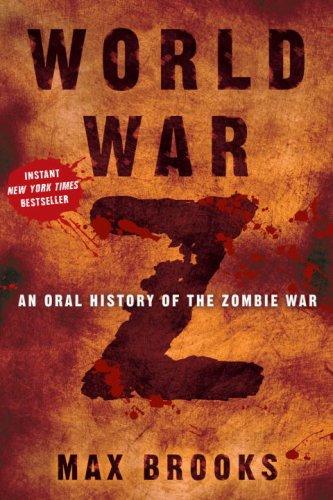
World War Z
by Max Brooks
★ Top 25 book of 2006 · #11 on Best Books of 2006
Max Brooks gathers first-hand accounts from survivors of the Zombie War, which nearly wiped out humanity. Traveling across the world, he records testimony that captures both the fear of the plague years and the human spirit of resistance.
Best for: Fans of zombie apocalypse stories told through survivors' personal testimonies
World War Z is #11 on BookWard's Best Books of 2006, out of 47 2006 books that cleared our data bar.
What World War Z is about
Told as a collection of interviews, World War Z looks back on a worldwide zombie war from about ten years after it ended. A fictional Max Brooks, working for the United Nations Postwar Commission, gathers accounts from survivors of every background, from people across the globe to those in Antarctica and even outer space. The chapters follow the whole arc of the crisis, from the first warnings and the blame that followed to the panic, the fight back and the long reckoning.
The outbreak starts with a single infected boy in a village in China, and what follows is less about monsters than about how people and governments behave when everything is at stake. Cover-ups, false comfort and cold strategy all play a part. It suits readers who like their horror sweeping, documentary in feel and thoughtful about human resilience.
World War Z on the Best Books of 2006
World War Z came out in 2006. Of the 47 books first published in 2006 that met BookWard's data bar, it ranks #11 on our Best Books of 2006 list.
Why it made the list: 749 readers have shelved it on Open Library; readers rate it 3.9 out of 5 (139 ratings); 38 are reading it right now. The list ranks each year’s books on how many readers have picked them up, how highly readers rate them, and how many are reading them right now.
Nearby on the 2006 list
- Pretty Little Liars Sara Shepard, #9
- Naruto 33 Masashi Kishimoto, #10
- Horus Rising Dan Abnett, #12
- The Road Cormac McCarthy, #13
See all Best Books of 2006 Best books by year
More years: Best Books of 2005 Best Books of 2007.
The numbers behind it
- Readers: 527 want to read it, 38 are reading it now and 184 have read it, according to Open Library.
- Ratings: 3.9 out of 5 from 139 Open Library ratings.
| Signal | This book (0 to 100) | Weight |
|---|---|---|
| Reach | 83 | 55% |
| Reader love | 43 | 25% |
| Being read right now | 83 | 20% |
Questions about World War Z
When was World War Z published?
World War Z by Max Brooks was first published in 2006.
Was World War Z one of the best books of 2006?
World War Z is #11 on BookWard's Best Books of 2006, out of 47 2006 books that cleared our data bar. 749 readers have shelved it on Open Library; readers rate it 3.9 out of 5 (139 ratings); 38 are reading it right now.
Why is World War Z on the Best Books of 2006 list?
749 readers have shelved it on Open Library; readers rate it 3.9 out of 5 (139 ratings); 38 are reading it right now.
More of the best books of 2006
- The Sea of Monsters Rick Riordan, #1
- The Book Thief Markus Zusak, #2
- Half of a Yellow Sun Chimamanda Ngozi Adichie, #3
- The Boy in the Striped Pyjamas John Boyne, #4
- The Secret Rhonda Byrne, #5
- Mindset Carol S. Dweck, #6
See the full Best Books of 2006, the Top 100, or new books on Rising.
How we know
This page uses public data: Open Library reader counts and ratings, and Wikipedia page views for recent years. The description is paraphrased from real source text. Rankings reflect reading interest, not quality or sales, and can be affected by data gaps. Lists update monthly.
It suits mature teens and adults who are comfortable with horror themes and a serious tone.
Depends on the edition you pick.
A zombie war told as a mosaic of survivor interviews. 59% taste match
 BookWard’s take
A zombie war told as a mosaic of survivor interviews
Max Brooks frames the zombie apocalypse as an oral history, collected a decade after the war by an agent of the United Nations Postwar Commission. That choice is what makes it special. The chorus of voices, from soldiers to civilians, spans the globe, so the book reads as geopolitics and human behavior far more than gore. It is strikingly original, and its internal logic holds firm, because the outbreak's spread, the governments' failures and the recovery all follow from one another with a worldbuilder's care. The range of viewpoints is the book's great strength, and each speaker comes through with a distinct voice. The hook is not immediate, since the book builds gradually across eight chapters, and its episodic shape means less depth of character than a single protagonist would give.
Eight chapters of accounts add up to a substantial book, though each interview is short and self-contained rather than sprawling.
Each interview moves briskly, though the survey structure slows the book from one chapter to the next.
Telling a zombie war as postwar interviews, inspired by Studs Terkel's oral history of World War Two, is a distinctive angle.
The language is mostly plain and conversational, suited to people recounting what happened.
The structure follows the course of a global war more than any one person's arc.
Humanity survives and rebuilds, but at terrible cost, leaving a mixed rather than cheering outlook.
A framed collection of interviews rather than a continuous narrative is an unusual form for a novel.
It is serious in tone, with little room for comedy beyond dry observations from survivors.
The subject is mass death, collapse and desperate survival, handled with a serious hand.
Grief, fear and resolve come through in many accounts without tipping into melodrama.
See all 50 dialsEvery position, side by side with this book
Where it lines up
- OriginalityBookWard 9 · book 9
- Authorial voiceBookWard 9 · book 9
- Internal logicBookWard 10 · book 9
Where it pulls apart
- LengthBookWard 1 · book 5
- OpeningBookWard 10 · book 6
- Story or ideasBookWard 3 · book 7
Eight chapters of accounts add up to a substantial book, though each interview is short and self-contained rather than sprawling.
It opens in the aftermath and works up through warnings and blame, so the pull is steady rather than instant, which sits a little off BookWard's taste.
Zombies are a familiar monster, but the oral-history frame and global lens keep it clear of stock apocalypse beats.
The outbreak, the official denial and the later recovery chain together convincingly across continents, which BookWard rewards.
Each interview moves briskly, though the survey structure slows the book from one chapter to the next.
Telling a zombie war as postwar interviews, inspired by Studs Terkel's oral history of World War Two, is a distinctive angle.
Each speaker is sketched vividly in a few pages, though none is developed at novel length.
The final chapter, Good-Byes, brings the testimony to a settled close rather than leaving things dangling.
The accounts are mostly matter-of-fact and weighty rather than sentimental, in line with BookWard's restrained preference.
The horror serves the larger picture of collapse and recovery, so the darkness feels purposeful rather than gratuitous.
This is a novel, so the nonfiction rigor dial does not apply.
Brooks gives each interviewee a distinct manner of speaking, from soldiers to civilians, which keeps the voices sharply varied.
The book is built around ideas about government failure, isolationism and survivalism, expressed through individual stories.
Speakers explain events in their own words, so much is told outright, though framed as testimony rather than lecture.
The varied settings and speakers keep momentum from flagging across the eight chapters.
The language is mostly plain and conversational, suited to people recounting what happened.
The structure follows the course of a global war more than any one person's arc.
Humanity survives and rebuilds, but at terrible cost, leaving a mixed rather than cheering outlook.
A framed collection of interviews rather than a continuous narrative is an unusual form for a novel.
It is serious in tone, with little room for comedy beyond dry observations from survivors.
The prose is accessible, though the many names, places and political threads ask for some attention.
Survivors from many walks of life and countries, even Antarctica and outer space, each tell their own part.
Accounts jump between the outbreak, the war and the aftermath, so time shifts as the interviews do.
Undead aside, it presents itself as a real, grounded postwar record of world events.
Dozens of interviewees across the world make for a very large cast.
It covers a global conflict across continents, from the first outbreak through the war's end.
Speakers recount what they did and saw, leaning toward events with some reflection on how it felt.
The whole book is people speaking in interview, so talk carries nearly everything.
Love plays no real part in this chronicle of war and survival.
The settings range from remote and unfamiliar regions to places the reader may know, spread across the globe.
Set in the near future, it is looking back on a war of the early 21st century.
Its themes of institutional failure and survival keep it relevant beyond its 2006 publication.
The interviewer simply records what survivors say, and the book presents them as sincere witnesses.
Governments and individuals make hard choices, and the book often leaves their rights and wrongs for the reader.
Speakers evoke scenes through memory and specifics without extended passages of scenery.
This is a novel, so the nonfiction style dial does not apply.
Every account is first-person and intimate, though the interviewer stays largely in the background.
It stands alone, though it follows Brooks' Zombie Survival Guide as a companion in setting.
Revelations arrive as different speakers fill in what happened, though less through plot reversals.
It asks hard questions about preparation, denial and political failure rather than offering comfort.
The subject is mass death, collapse and desperate survival, handled with a serious hand.
Grief, fear and resolve come through in many accounts without tipping into melodrama.
Any humor is dry and incidental, never the point of a scene.
The zombie war involves a great deal of killing and bloodshed, though it is reported in retrospect.
Sexual content is essentially absent from these war testimonies.
Government ineptitude, isolationism and international relations drive much of the book.
The language is plain speech from many speakers, with only occasional terminology to follow.
Speakers voice strong views on blame and failure, though the frame itself stays measured.
It looks back on the war from a decade later, with an eye on what the survivors rebuild.
It shows both resilience and institutional failure, landing between hope and hard-eyed realism.
Review written by BookWard, dial version 1, November 2026.
Who is World War Z right for?
It suits mature teens and adults who are comfortable with horror themes and a serious tone. It contains graphic violence, scenes of mass death and moments of despair.
The prose is accessible, though the many names, places and political threads ask for some attention.
The subject is mass death, collapse and desperate survival, handled with a serious hand.
Grief, fear and resolve come through in many accounts without tipping into melodrama.
The zombie war involves a great deal of killing and bloodshed, though it is reported in retrospect.
Book CompanionWorld War Z: ideas, characters, themes
A postwar interviewer collects firsthand testimony from survivors of a global zombie war to record how humanity nearly fell and began to recover.
- The frame. The book is presented as interviews gathered by a UN Postwar Commission agent a decade after the Zombie War ended.
- Eight chapters. Warnings, Blame, The Great Panic, Turning the Tide, Home Front USA, Around the World and Above, Total War and Good-Byes trace the war's arc.
- Global voices. Survivors from different walks of life speak, from many countries and even Antarctica and outer space.
- Social consequences. The accounts explain the political, religious, economic and environmental changes that followed the crisis.
- Inspiration. Brooks drew on Studs Terkel's oral history of World War Two and on George A. Romero's zombie films.
Characters
The interviewer
Frame narrator
A fictionalized Max Brooks, an agent of the UN Postwar Commission, travels the world gathering survivors' accounts.
Themes
How denial and incompetence let a crisis grow.
The cost of nations looking after only themselves.
What people do and become to stay alive.
Living and deciding without knowing what comes next.
Why preserving firsthand accounts matters.
Discussion questions
- Why might the author tell this story as interviews rather than a single narrative?
- Which early warnings were ignored, and why do you think they were?
- How do different countries' responses reflect their politics and culture?
- What does the book suggest about how societies cope with unthinkable threats?
- Did any account stay with you more than the others, and why?
Personalize your Book Companion
This is the general edition. In BookWard, the Companion is written for you: your reading profile, your notes, and spoiler-safe to the page you are on.
Buy, listen or borrow World War Z
Each link opens a search for this book on that store, in a new tab.
Read on a device
Borrow
Reviews and community
If you liked World War Z
A party, a vanished host, and an America that has come apart
Cloud AtlasDavid MitchellSix nested stories across centuries, each one reshaping the last
Children of TimeAdrian TchaikovskySpiders build a civilization while humanity's last ark ship closes in
Blood of the Old KingsSung-Il KimAn empire that mines its dead sorcerers, seen through several fighters
Find your own best books
Add what you have read, rate it, and BookWard will recommend what to read next.
Free to start. No credit card needed.