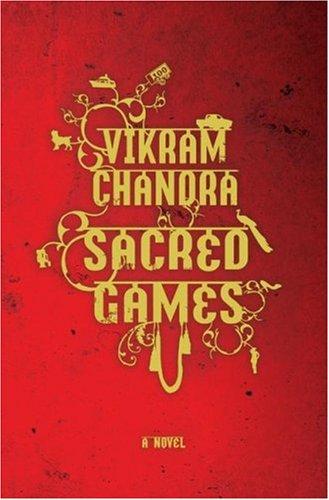
Sacred Games
by Vikram Chandra
Sikh police inspector Sartaj Singh, whose career and marriage are faltering, gets a tip about the hideout of India's most wanted gangster. The sprawling story explores friendship, betrayal, violence and Mumbai's dark side.
Best for: Readers who enjoy long, rich crime epics set in modern Mumbai
Sacred Games ranked #23 on BookWard's Best Books of 2006 when we last measured it, in October 2026.
What Sacred Games is about
Sacred Games is a sprawling crime novel set in Mumbai, written by Vikram Chandra and published in 2006. It runs on two tracks. One moves through the city's criminal underworld in the 1980s and 1990s. The other is set in the present, where Inspector Sartaj Singh, one of very few Sikhs on the Mumbai police force, is trying to make sense of the strange last words of Ganesh Gaitonde, a legendary crime boss and one of India's most wanted men. Sartaj is past forty, his marriage is over and his career is slipping, so when an anonymous tip arrives about a hide-out, he has a lot riding on it. The novel was seven years in the making, and draws inspiration from the classics of nineteenth-century fiction, mystery novels, Bollywood movies and Chandra's own life and research on the streets of Mumbai. It won the Vodafone Crossword Book Award.
Sacred Games on the Best Books of 2006
Sacred Games came out in 2006. When we last measured it, in October 2026, it ranked #23 on our Best Books of 2006 list. It is not among the top books of 2006 on this month’s list, and the numbers on this page are the latest we have.
The numbers behind it
- Readers: 239 want to read it, 12 are reading it now and 6 have read it, according to Open Library.
| Signal | This book (0 to 100) | Weight |
|---|---|---|
| Reach | 60 | 55% |
| Reader love | 21 | 25% |
| Being read right now | 49 | 20% |
Questions about Sacred Games
When was Sacred Games published?
Sacred Games by Vikram Chandra was first published in 2006.
Was Sacred Games one of the best books of 2006?
Sacred Games ranked #23 on BookWard's Best Books of 2006 when we last measured it, in October 2026. 257 readers have shelved it on Open Library.
Why is Sacred Games on the Best Books of 2006 list?
257 readers have shelved it on Open Library.
More of the best books of 2006
- The Sea of Monsters Rick Riordan, #1
- The Book Thief Markus Zusak, #2
- Half of a Yellow Sun Chimamanda Ngozi Adichie, #3
- The Boy in the Striped Pyjamas John Boyne, #4
- The Secret Rhonda Byrne, #5
- Mindset Carol S. Dweck, #6
See the full Best Books of 2006, the Top 100, or new books on Rising.
How we know
This page uses public data: Open Library reader counts and ratings, and Wikipedia page views for recent years. The description is paraphrased from real source text. Rankings reflect reading interest, not quality or sales, and can be affected by data gaps. Lists update monthly.
Suited to adult readers comfortable with a long, demanding crime novel.
Depends on the edition you pick.
A sprawling Mumbai epic that earns every one of its pages. 56% taste match
 BookWard’s take
A sprawling Mumbai epic that earns every one of its pages
Sacred Games is a mystery and a city portrait in one, built on two tracks: a police inspector's present-day hunt and a gangster's own account of the underworld. It is long and sprawling, and a tighter book would usually suit me better, yet the momentum holds and the middle never sags because the two strands keep pulling against each other. Chandra's voice is distinctive, and the Mumbai he builds will feel unfamiliar to many readers while still seeming deeply lived in. The characters have real depth: Sartaj Singh is a tired, funny, believable cop. I would normally want to trim a book this size, but I wouldn't cut a page here, and the logic of the investigation rewards patience. A big book that justifies its size.
A very long novel with a huge cast and many threads, the opposite of BookWard's preference for tight, so it must justify its size.
Pairing a cop's hunt with a gangster's own narration over decades gives it a fresh frame inside a known genre.
Rich, textured and sometimes lavish, more ornate than BookWard's plainer leaning.
Plot drives the hunt, but character and history carry equal weight, leaning slightly to people.
A bleak, morally compromised world with only small flickers of decency or redemption.
Two parallel tracks across decades give a layered, non-conventional shape, more adventurous than BookWard's norm.
Wry humor runs through the cop's voice, but the overall tone stays serious.
Crime, killing and corruption are central and the mood is grim.
Feeling is present and sometimes sharp, but it is delivered with restraint.
See all 50 dialsEvery position, side by side with this book
Where it lines up
- Authorial voiceBookWard 9 · book 9
- Character depthBookWard 8 · book 9
- SentimentBookWard 8 · book 7
Where it pulls apart
- LengthBookWard 1 · book 10
- Familiar tropesBookWard 10 · book 6
- OpeningBookWard 10 · book 7
A very long novel with a huge cast and many threads, the opposite of BookWard's preference for tight, so it must justify its size.
The dead gangster's strange final words and the tip-off give a strong pull, though the book takes time to widen out.
Crime-boss and cop-story shapes are familiar, but the Mumbai detail and structure keep them from feeling stock.
The investigation and the underworld history are built to connect, and the pieces fit together with care.
Pairing a cop's hunt with a gangster's own narration over decades gives it a fresh frame inside a known genre.
Sartaj and Gaitonde are drawn with history, flaws and contradiction, well past types, close to BookWard's taste.
Chandra avoids easy comfort and keeps feeling understated, in line with BookWard's restraint.
The violence belongs to the world being shown, rather than being used for cheap effect.
Chandra's voice is unmistakable, mixing street talk, wit and long sweeping description in a way few others manage.
Plot and people carry it, though ideas about faith, power and the modern city run underneath.
Much is shown through scene and talk, but the sprawling world needs some explaining along the way.
The size invites slack stretches, yet the two interwoven tracks keep most of the book moving.
Rich, textured and sometimes lavish, more ornate than BookWard's plainer leaning.
Plot drives the hunt, but character and history carry equal weight, leaning slightly to people.
A bleak, morally compromised world with only small flickers of decency or redemption.
Two parallel tracks across decades give a layered, non-conventional shape, more adventurous than BookWard's norm.
Wry humor runs through the cop's voice, but the overall tone stays serious.
Length, a huge cast and thick local texture ask a lot from the reader, more than BookWard usually likes.
The cop and the gangster narrate, and many other voices cut in, matching BookWard's taste for several perspectives.
It moves between the 1980s and 1990s underworld and the present-day hunt, so time shifts often.
Firmly grounded in real Mumbai crime and policing.
A very large cast of cops, gangsters, fixers and families fills the pages.
It covers a whole city, decades of crime and wider national forces, so it reads as epic.
Roughly balanced between action in the streets and the inner lives of its leads.
Talk carries a great deal of the story, with a mix of slang and languages.
Relationships matter, but love is not the engine of the story.
The Mumbai underworld and police will be unfamiliar territory for most readers, and it is shown in vivid detail.
Split between the late twentieth century and a more recent present, so it sits just behind today.
Its portrait of power, crime and the city should hold up well beyond its moment.
Gaitonde tells his own story, which invites doubt, but the framing is mostly straightforward.
Cops and criminals alike act in gray areas, and the book resists clean judgments.
Dense, sensory depiction of Mumbai fills page after page.
A standalone novel.
Plenty of reveals and connections surface across the long investigation.
It asks readers to hold many strands and face hard truths about power and violence.
Crime, killing and corruption are central and the mood is grim.
Feeling is present and sometimes sharp, but it is delivered with restraint.
The wit is dry and observational, not broad.
The underworld story includes frequent and serious violence.
Sex appears as part of the lives depicted but is not the focus.
Religion, communal tension and corruption weigh on events and shape the stakes.
Indian-language words and street slang run thick and can slow the unaccustomed reader.
The narration mostly lets scenes speak, with some pointed commentary.
It looks back into the past to explain the present, with little eye on the future.
Deep cynicism about power and institutions, with only a few decent figures.
Review written by BookWard, dial version 1, November 2026.
Who is Sacred Games right for?
Suited to adult readers comfortable with a long, demanding crime novel. It contains frequent violence and dark subject matter.
Length, a huge cast and thick local texture ask a lot from the reader, more than BookWard usually likes.
Crime, killing and corruption are central and the mood is grim.
Feeling is present and sometimes sharp, but it is delivered with restraint.
The underworld story includes frequent and serious violence.
Book CompanionSacred Games: ideas, characters, themes
A police inspector's hunt for a dead gangster's secret opens onto a decades-long portrait of Mumbai's criminal underworld.
- Two tracks. One strand follows Sartaj Singh in the present while another follows the gangster's rise across the 1980s and 1990s.
- The tip-off. An anonymous tip sends Sartaj after Ganesh Gaitonde, the most wanted man in the city.
- The last words. Gaitonde's strange final words drive the modern investigation to find what lay behind them.
- A city as character. Mumbai, then Bombay, is drawn in rich, specific detail and shapes everything that happens.
- Crime and the law. The line between the cop and the criminal is thin, and the book keeps probing it.
Characters
Sartaj Singh
Police inspector
One of the few Sikhs on the Mumbai force, past forty, with a failed marriage and a career on the slide.
Ganesh Gaitonde
Crime boss
The legendary head of G-Company and India's most wanted gangster.
Themes
How authority, legal or criminal, bends the people around it.
How religion, background and appearance mark a person in a crowded city.
Loyalty tested by ambition, fear and violence.
Mumbai as a place of money, danger and constant change.
The idea of sacred games played out on human lives.
Discussion questions
- Why might Chandra pair a cop's story with a gangster's own account?
- How does the book treat the line between law and crime?
- What does the setting add that a different city could not?
- Do you find Sartaj or Gaitonde the more compelling figure, and why?
- Does the book's length feel earned by the story it tells?
Personalize your Book Companion
This is the general edition. In BookWard, the Companion is written for you: your reading profile, your notes, and spoiler-safe to the page you are on.
Buy, listen or borrow Sacred Games
Each link opens a search for this book on that store, in a new tab.
Read on a device
Borrow
Reviews and community
If you liked Sacred Games
Six nested stories across centuries, each one reshaping the last
A Fine BalanceRohinton MistryFour lives, one flat, and the Emergency pressing in
Infinite JestDavid Foster WallaceA huge, funny, difficult novel that rewards patience with something rare
ShōgunJames ClavellA thousand-page plunge into feudal Japan, pulled along by intrigue
Find your own best books
Add what you have read, rate it, and BookWard will recommend what to read next.
Free to start. No credit card needed.