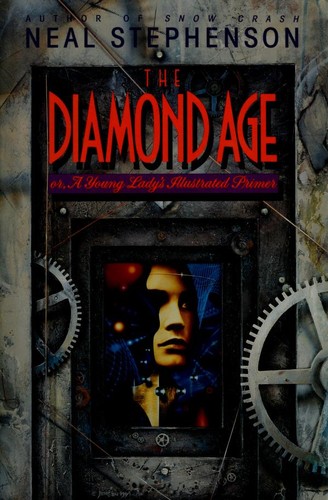
The Diamond Age
by Neal Stephenson
★ Top 10 book of 1995 · #9 on Best Books of 1995
An engineer designs a device meant to raise a girl who can think independently. When a young girl from the poor underclass ends up with it, the consequences unfold.
Best for: Sci-fi fans interested in technology, education, and class
The Diamond Age is #9 on BookWard's Best Books of 1995, out of 28 1995 books that cleared our data bar.
What The Diamond Age is about
In a future shaped by nanotechnology, a girl named Nell grows up as a thete, a person without a tribe, in the Leased Territories slum of the artificial island of New Chusan. When she is four, her brother Harv gives her a stolen copy of the Young Lady's Illustrated Primer. It was commissioned for a lord's granddaughter and is designed to nudge its reader toward a more interesting life, responding to her surroundings and teaching what she needs to survive and grow. Its stories echo Nell's own experiences, including her four toy friends, within old folk tales. The engineer who designed it, John Percival Hackworth, makes an unauthorized copy for his own daughter, and the consequences ripple outward.
Neal Stephenson's inventive, satirical novel is part coming-of-age story, part look at education, class and culture. It won the Hugo and Locus Awards in 1996 and was shortlisted for the Nebula. It will appeal to readers who like their science fiction full of ideas.
The Diamond Age on the Best Books of 1995
The Diamond Age came out in 1995. Of the 28 books first published in 1995 that met BookWard's data bar, it ranks #9 on our Best Books of 1995 list.
Why it made the list: 322 readers have shelved it on Open Library; readers rate it 4.1 out of 5 (94 ratings). The list ranks each year’s books on how many readers have picked them up, how highly readers rate them, and how many are reading them right now.
Nearby on the 1995 list
- The Demon-Haunted World Carl Sagan, #7
- The Rainmaker John Grisham, #8
- Kiss the Girls James Patterson, #10
- Assassin's Apprentice Robin Hobb, #11
See all Best Books of 1995 Best books by year
More years: Best Books of 1994 Best Books of 1996.
The numbers behind it
- Readers: 189 want to read it, 11 are reading it now and 122 have read it, according to Open Library.
- Ratings: 4.1 out of 5 from 94 Open Library ratings.
| Signal | This book (0 to 100) | Weight |
|---|---|---|
| Reach | 64 | 55% |
| Reader love | 82 | 25% |
| Being read right now | 39 | 20% |
Questions about The Diamond Age
When was The Diamond Age published?
The Diamond Age by Neal Stephenson was first published in 1995.
Was The Diamond Age one of the best books of 1995?
The Diamond Age is #9 on BookWard's Best Books of 1995, out of 28 1995 books that cleared our data bar. 322 readers have shelved it on Open Library; readers rate it 4.1 out of 5 (94 ratings).
Why is The Diamond Age on the Best Books of 1995 list?
322 readers have shelved it on Open Library; readers rate it 4.1 out of 5 (94 ratings).
More of the best books of 1995
- The Lost World Michael Crichton, #1
- Emotional Intelligence Daniel Goleman, #2
- Northern Lights Philip Pullman, #3
- Rose Madder Stephen King, #4
- Mindhunter John E. Douglas, #5
- Wicked Gregory Maguire, #6
See the full Best Books of 1995, the Top 100, or new books on Rising.
How we know
This page uses public data: Open Library reader counts and ratings, and Wikipedia page views for recent years. The description is paraphrased from real source text. Rankings reflect reading interest, not quality or sales, and can be affected by data gaps. Lists update monthly.
Best suited to adult readers and mature teens who enjoy ideas-heavy science fiction.
Depends on the edition you pick.
A nanotech Victorian future, a girl, and a book that teaches her. 55% taste match
 BookWard’s take
A nanotech Victorian future, a girl, and a book that teaches her
Neal Stephenson sets a coming-of-age story in a world remade by nanotechnology, where a stolen interactive book lands in the hands of Nell, a four-year-old from the lowest class. Originality is where it shines: the Primer, a book that reacts to its reader and teaches what she needs to survive, is an idea few novels match, and it avoids the usual chosen-one script. The internal logic is strong, since the technology and the class structure around it hold together. The voice is unmistakable, wry and digressive. Where I part ways with it is the exposition and the length: Stephenson explains his world generously, and the book is long and idea-heavy, tilting further toward ideas than toward story than I usually like.
A big, expansive novel with several storylines to carry, which pulls away from BookWard's liking for tight books.
Several threads keep things moving, but the book pauses often to explain its world, so it runs slower than BookWard prefers.
An interactive book that raises a child, set in a neo-Victorian nanotech future, is about as original as premises get.
Clear and crisp with a playful, pastiche-flavored Victorian edge, ornate in places but never purple.
Nell's development and the plot around the Primer share the driving seat fairly evenly.
Nell's growth is hopeful, set against a stratified and often cold society.
Intersecting storylines across several characters make this more structurally ambitious than a standard novel.
Dry wit runs through the narration, though the book is serious about its subjects.
Slum life and class cruelty give it a serious edge without making it relentlessly grim.
Feeling is present, especially in Nell's story, but filtered through a cool, analytical tone.
See all 50 dialsEvery position, side by side with this book
Where it lines up
- Authorial voiceBookWard 9 · book 9
- OriginalityBookWard 9 · book 10
- Character depthBookWard 8 · book 7
Where it pulls apart
- LengthBookWard 1 · book 8
- OpeningBookWard 10 · book 6
- ExpositionBookWard 2 · book 7
A big, expansive novel with several storylines to carry, which pulls away from BookWard's liking for tight books.
The stolen Primer and Nell's slum start give it a strong premise, though the opening takes time to set up its world.
It sidesteps stock coming-of-age and chosen-one patterns, which BookWard rewards.
Its nanotech, class tribes and the Primer's design hang together as a coherent system, matching BookWard's taste for airtight worlds.
Several threads keep things moving, but the book pauses often to explain its world, so it runs slower than BookWard prefers.
An interactive book that raises a child, set in a neo-Victorian nanotech future, is about as original as premises get.
Nell's growth under the Primer gives the book real character weight, though the ideas sometimes crowd the people.
Its threads reach a fairly conclusive point, though it leaves more room for interpretation than BookWard likes.
The story of a girl and her teaching book risks warmth, but it stays dry and analytical rather than sentimental.
Its harder moments serve the themes of class and power rather than existing to jolt the reader.
Stephenson's wry, digressive, intellectual voice is unmistakable and a clear match for BookWard's taste for distinctive authors.
Education, class and artificial intelligence drive the book as much as plot, leaning it further toward ideas than BookWard does.
The world is often explained outright, a real departure from BookWard's preference for showing in scene.
With multiple storylines and long explanatory stretches, momentum is not even from start to finish.
Clear and crisp with a playful, pastiche-flavored Victorian edge, ornate in places but never purple.
Nell's development and the plot around the Primer share the driving seat fairly evenly.
Nell's growth is hopeful, set against a stratified and often cold society.
Intersecting storylines across several characters make this more structurally ambitious than a standard novel.
Dry wit runs through the narration, though the book is serious about its subjects.
Dense ideas and a heavily built world ask real attention from the reader.
The story follows Nell alongside Hackworth and other figures, so it moves between several perspectives.
The story advances in a basically linear way, with Nell growing up over its course.
Nanotechnology makes the world strange enough that daily life feels close to the fantastical, though it stays science fiction.
Nell, the Hackworths, the Finkle-McGraws and many others make for a sizable cast.
Nell's personal story plays out against a whole reordered society, so the stakes are wide.
Nell's mental growth and the world's mechanics get roughly equal attention.
Conversation carries a fair share of the ideas without dominating the page.
Romance is not a driving concern here.
Its offshore diamond-island setting and neo-Victorian tribes are highly unfamiliar and richly invented.
It looks forward to a nanotech future, though it was written in 1995.
Its concerns of education, class and AI have kept the book relevant long after its award wins.
The narration is a steady, reliable guide to its world.
Questions of class, culture and power are left without easy answers.
Its invented world gets full, inventive description.
A self-contained novel.
The Primer's reach and the converging storylines bring some turns, though it is not built on twists.
It poses real questions about education and society rather than offering comfort.
Slum life and class cruelty give it a serious edge without making it relentlessly grim.
Feeling is present, especially in Nell's story, but filtered through a cool, analytical tone.
Its humor is dry and ironic rather than broad.
Some violence appears in the story, but it is not the focus.
Some sexual material appears, but it is not central.
Class, culture and power are central subjects.
The invented vocabulary and dense technical talk add some difficulty.
The narration has clear attitudes toward the culture it describes.
It is set in a speculative future and thinks hard about where society might go.
Its belief in education and a subversive mind is idealistic, tempered by clear-eyed social observation.
Review written by BookWard, dial version 1, November 2026.
Who is The Diamond Age right for?
Best suited to adult readers and mature teens who enjoy ideas-heavy science fiction. It includes class cruelty, some violence and some sexual material.
Dense ideas and a heavily built world ask real attention from the reader.
Slum life and class cruelty give it a serious edge without making it relentlessly grim.
Feeling is present, especially in Nell's story, but filtered through a cool, analytical tone.
Some violence appears in the story, but it is not the focus.
Book CompanionThe Diamond Age: ideas, characters, themes
A girl from the lowest class gets a book that teaches her to think for herself, and her life diverges from the elites who meant it for someone else.
- The Primer. An interactive book that reacts to its reader and teaches what she needs to survive and grow.
- Nell's education. Given the stolen Primer at four, Nell grows up learning through it rather than through ordinary schooling.
- The neo-Victorian tribes. Society is divided into tribes, and Nell begins as a thete, a person without one.
- The Hackworth thread. Engineer John Percival Hackworth, who helped create the Primer, makes an unauthorized copy for his own daughter.
- New Chusan. The story unfolds on an artificial diamondoid island offshore from the mouth of the Yangtze.
Characters
Nell
Protagonist
A young thete in the Leased Territories whose life is shaped by the Primer.
John Percival Hackworth
Engineer
The nanotech designer whose copy of the Primer sets events in motion.
Harv
Nell's brother
He gives Nell the stolen copy of the Primer.
Lord Finkle-McGraw
Equity Lord
The wealthy neo-Victorian who commissions the Primer for his granddaughter.
Fiona Hackworth
Engineer's daughter
A neo-Victorian girl who receives another copy of the Primer.
Themes
What it takes to shape a mind that can think independently.
How tribe and wealth set the paths open to a child.
How nanotechnology reshapes daily life and society.
What it means for a machine to teach and respond to a person.
The value the book places on questioning the status quo.
Discussion questions
- Should an education aim to produce an interesting life, and who gets to define that?
- How does Nell's start as a thete shape what the Primer can do for her?
- What does the book suggest about the limits of teaching delivered by a machine?
- Why might a society prize subversion in a few while keeping most in place?
- How does the neo-Victorian setting comment on our own attitudes to class and manners?
Personalize your Book Companion
This is the general edition. In BookWard, the Companion is written for you: your reading profile, your notes, and spoiler-safe to the page you are on.
Buy, listen or borrow The Diamond Age
Each link opens a search for this book on that store, in a new tab.
Read on a device
Borrow
Reviews and community
If you liked The Diamond Age
Six nested stories across centuries, each one reshaping the last
A Fire Upon the DeepVernor VingeVinge's space opera where the laws of thought bend with location
AnathemNeal StephensonA monastery of mathematicians, an alien ship, and a vast invented world
The Windup GirlPaolo BacigalupiA brutal, brilliant future Bangkok where calories are the currency
Find your own best books
Add what you have read, rate it, and BookWard will recommend what to read next.
Free to start. No credit card needed.