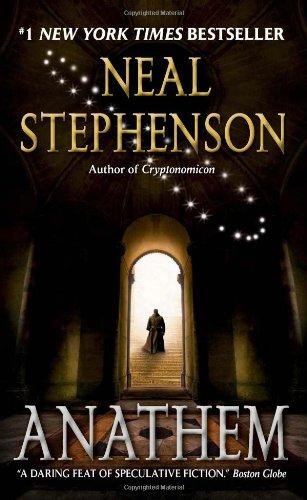
Anathem
by Neal Stephenson
★ Top 25 book of 2008 · #18 on Best Books of 2008
Fraa Erasmas is a young avout living in a sanctuary for mathematicians, scientists and philosophers, walled off from the outside world. As the once-in-a-decade Apert opens the gates, he looks forward to seeing family and landmarks he has not seen since being collected.
Best for: Readers who enjoy ambitious, idea-rich novels set in a strangely inverted world
Anathem is #18 on BookWard's Best Books of 2008, out of 46 2008 books that cleared our data bar.
What Anathem is about
On the planet Arbre, thinkers long ago withdrew into walled monastic communities called concents, hoping to keep knowledge safe if society fell apart. Their descendants, the avout, live apart from the Sæcular world, barred from most advanced technology and watched over by the Inquisition. Fraa Erasmas, who narrates, is an avout at the Concent of Saunt Edhar, where his quiet routine of study is upended when his teacher, Fraa Orolo, spots an alien spacecraft in orbit. The authorities try to bury the discovery, and Orolo pays dearly for looking too closely.
From there the story follows Erasmas and his companions on a long journey across the frozen pole in search of Orolo. Along the way, Stephenson turns big ideas into live questions: the many-worlds interpretation of quantum mechanics, the old dispute between Platonic realism and nominalism, and what happens when scholars are kept apart from the people who hold power. It suits readers who enjoy science fiction that asks them to think.
Anathem on the Best Books of 2008
Anathem came out in 2008. Of the 46 books first published in 2008 that met BookWard's data bar, it ranks #18 on our Best Books of 2008 list.
Why it made the list: 298 readers have shelved it on Open Library; readers rate it 4.3 out of 5 (75 ratings). The list ranks each year’s books on how many readers have picked them up, how highly readers rate them, and how many are reading them right now.
Nearby on the 2008 list
- The Tales of Beedle the Bard J. K. Rowling, #16
- Duma Key Stephen King, #17
- I Love My New Toy! (Elephant and Piggie) Mo Willems, #19
- Fast Food Nation Eric Schlosser, #20
See all Best Books of 2008 Best books by year
More years: Best Books of 2007 Best Books of 2009.
The numbers behind it
- Readers: 196 want to read it, 5 are reading it now and 97 have read it, according to Open Library.
- Ratings: 4.3 out of 5 from 75 Open Library ratings.
| Signal | This book (0 to 100) | Weight |
|---|---|---|
| Reach | 59 | 55% |
| Reader love | 87 | 25% |
| Being read right now | 13 | 20% |
Questions about Anathem
When was Anathem published?
Anathem by Neal Stephenson was first published in 2008.
Was Anathem one of the best books of 2008?
Anathem is #18 on BookWard's Best Books of 2008, out of 46 2008 books that cleared our data bar. 298 readers have shelved it on Open Library; readers rate it 4.3 out of 5 (75 ratings).
Why is Anathem on the Best Books of 2008 list?
298 readers have shelved it on Open Library; readers rate it 4.3 out of 5 (75 ratings).
More of the best books of 2008
- The Hunger Games Suzanne Collins, #1
- End of Days Sylvia Browne, #2
- The Last Straw Jeff Kinney, #3
- Amulet Kazu Kibuishi, #4
- Outliers Malcolm Gladwell, #5
- Michelle Obama in Her Own Words Michelle Obama, #6
See the full Best Books of 2008, the Top 100, or new books on Rising.
How we know
This page uses public data: Open Library reader counts and ratings, and Wikipedia page views for recent years. The description is paraphrased from real source text. Rankings reflect reading interest, not quality or sales, and can be affected by data gaps. Lists update monthly.
Best suited to confident adult readers, and to older teens who enjoy challenging science fiction.
Depends on the edition you pick.
A monastery of mathematicians, an alien ship, and a vast invented world. 53% taste match
 BookWard’s take
A monastery of mathematicians, an alien ship, and a vast invented world
Anathem drops you into the Concent of Saunt Edhar, where Fraa Erasmas lives among avout cut off from the outside world, and the strangeness is the point. Stephenson builds a whole planet, Arbre, with its own vocabulary, history and rules, then makes you earn your footing. It is demanding reading, and it puts ideas ahead of story, which is a tension for anyone who wants plot to lead. Originality is where it shines: few novels turn Platonic realism versus nominalism and the many-worlds interpretation into a plot that moves. The internal logic is tight, and the book explains much of its world outright, sometimes at length. If you enjoy learning a new language as you read, this rewards the patience.
A large, dense novel with an entire world to build, far from BookWard's preference for tight and short.
Long stretches of discussion and world-building slow it down, though events accelerate once the alien ship is revealed.
Few novels dramatize Platonic realism, nominalism and many-worlds physics inside an invented monastic society, which fits BookWard's taste well.
The prose is clear and exact, with invented terms adding texture without becoming ornate.
The ideas and the events set the course, with Erasmas's growth tucked inside them rather than steering the book.
It carries real stakes and some darkness but leans toward belief in the value of thinking.
Told in a conventional frame with appended calendars and notes, it is more inventive in setting than in form.
Wry humour surfaces in the dialogue and the invented jargon, but the tone stays mostly earnest.
There are real dangers and violence, but the tone is thoughtful more than grim.
Feeling stays subdued beneath the intellectual weight of the book.
See all 50 dialsEvery position, side by side with this book
Where it lines up
- OriginalityBookWard 9 · book 9
- Familiar tropesBookWard 10 · book 9
- Internal logicBookWard 10 · book 9
Where it pulls apart
- LengthBookWard 1 · book 10
- OpeningBookWard 10 · book 5
- ExpositionBookWard 2 · book 8
A large, dense novel with an entire world to build, far from BookWard's preference for tight and short.
It opens inside the concent with unfamiliar terms to absorb, so the pull builds gradually rather than grabbing at once.
A monastic order of scientists on a parallel planet avoids stock fantasy and science fiction furniture, which BookWard values.
Arbre's institutions, history and rules hold together carefully, and the ideas are argued rather than waved through.
Long stretches of discussion and world-building slow it down, though events accelerate once the alien ship is revealed.
Few novels dramatize Platonic realism, nominalism and many-worlds physics inside an invented monastic society, which fits BookWard's taste well.
Erasmas and his companions are well drawn, though the book gives equal weight to the ideas they carry.
The central questions are brought to a conclusion rather than left hanging, which suits BookWard.
Feeling is present but kept in check by the book's cerebral register, which BookWard likes.
The darker turns grow out of the premise and its stakes instead of being there for effect.
The scientific and philosophical material is handled with real care and consistency, though it is a novel and not a treatise.
Stephenson's invented vocabulary and wry, explanatory narration make it unmistakably his own.
The ideas drive the book as much as the plot does, which pulls away from BookWard's story-led preference.
The reader is guided through the world by explanation and Socratic dialogue, well beyond what BookWard prefers.
The long discursive passages can slacken the momentum before the plot gathers force again.
The prose is clear and exact, with invented terms adding texture without becoming ornate.
The ideas and the events set the course, with Erasmas's growth tucked inside them rather than steering the book.
It carries real stakes and some darkness but leans toward belief in the value of thinking.
Told in a conventional frame with appended calendars and notes, it is more inventive in setting than in form.
Wry humour surfaces in the dialogue and the invented jargon, but the tone stays mostly earnest.
The invented vocabulary and philosophical debate ask a great deal of the reader, more than BookWard usually seeks.
Erasmas narrates throughout, which keeps the viewpoint close and singular.
The story moves forward in order without time shifts.
An alien spacecraft and a parallel planet put it firmly in speculative territory.
A sizeable group of avout, officials and companions populates the book, many with their own roles in the plot.
What begins in a cloister expands to the fate of a world and beyond.
Thought and debate matter as much as the journeys and confrontations that carry the plot.
Long conversations carry much of the intellectual work and fill a large share of the pages.
Relationships matter, but love is not what the book is about.
Arbre is a fully invented world with its own institutions, language and history, as unfamiliar as a setting gets.
Set on another planet in an invented timeline, it stands apart from any present day.
Its concerns with knowledge, truth and the place of thinkers in society age well.
Erasmas reports honestly what he sees and understands, with no deception.
The book weighs competing ways of living and thinking without handing down easy verdicts.
Concents, landscapes and rituals are drawn in careful, abundant detail.
This is a novel, so the nonfiction dial does not apply.
This is a novel, so the nonfiction dial does not apply.
It stands alone as a complete novel.
Revelations about the alien ship and the avout reshape the story at several points.
It asks the reader to work through unfamiliar language and abstract argument, which BookWard welcomes.
There are real dangers and violence, but the tone is thoughtful more than grim.
Feeling stays subdued beneath the intellectual weight of the book.
Where humour appears it is dry and knowing rather than broad.
Violence arrives at moments of crisis and is not dwelt on.
Sexual content is minimal and not a focus.
Tension between the cloistered thinkers and the worldly powers, including an Inquisition, is a recurring thread.
Invented terms and dense philosophical talk make the language demanding at first.
Erasmas is a curious, engaged narrator, though he leaves the larger arguments for others to make.
The book looks both to the deep past of Arbre's history and to what its future holds.
It believes in the worth of inquiry and reasoned thought while staying clear-eyed about institutions.
Review written by BookWard, dial version 1, November 2026.
Who is Anathem right for?
Best suited to confident adult readers, and to older teens who enjoy challenging science fiction. It contains some danger and violence but little else that is sensitive.
The invented vocabulary and philosophical debate ask a great deal of the reader, more than BookWard usually seeks.
There are real dangers and violence, but the tone is thoughtful more than grim.
Feeling stays subdued beneath the intellectual weight of the book.
Violence arrives at moments of crisis and is not dwelt on.
Book CompanionAnathem: ideas, characters, themes
In a world where intellectuals live apart in monastic communities, the discovery of an alien ship forces them back into the affairs of a society that has long feared and used them.
- The concents. The avout live behind walls under vows that limit contact with the outside world, and the length of a vow decides how often they may speak to outsiders.
- An alien discovery. Fraa Orolo finds a spacecraft orbiting Arbre, a fact the Sæcular Power tries to hide.
- Anathem. Orolo is banished from the concent for using forbidden technology to watch the ship, a rite that gives the book its name.
- The Convox. The Sæcular Power summons avout from Saunt Edhar to a joint conference with the avout at Saunt Tredegarh.
- A journey north. Erasmas and his companions travel over the frozen pole to find Orolo, setting the story's central expedition in motion.
Characters
Fraa Erasmas
Narrator and protagonist
A young avout at the Concent of Saunt Edhar whose first Apert as a fraa opens the story.
Fraa Orolo
Erasmas's teacher
The first to discover the alien ship, and banished for the camera he used to watch it.
Fraa Jad
Millenarian
An avout with a thousand-year vow who is summoned along with Erasmas and quietly assents to the search for Orolo.
Themes
The old argument over whether ideas exist in themselves or are only names we give to things.
The idea that every possible outcome plays out in a branching set of realities.
What is gained and lost when thinkers separate themselves from the society they serve.
How governments manage what ordinary people are allowed to know.
The tension between ritual, restraint and the pull of new tools.
Discussion questions
- Is the avout's separation from the world a form of protection or a form of escape?
- Why might the Sæcular Power want to hide the alien ship?
- How does learning the book's invented words change the way you read?
- Which side of the realism versus nominalism debate felt more convincing to you?
- What does the rite of Anathem say about how a community treats those who break its rules?
Personalize your Book Companion
This is the general edition. In BookWard, the Companion is written for you: your reading profile, your notes, and spoiler-safe to the page you are on.
Buy, listen or borrow Anathem
Each link opens a search for this book on that store, in a new tab.
Read on a device
Borrow
Reviews and community
If you liked Anathem
A nanotech Victorian future, a girl, and a book that teaches her
A Memory Called EmpireArkady MartineA murder mystery wrapped in an empire that devours its neighbors
Il pendolo di FoucaultUmberto EcoEco's vast, learned game of conspiracy that turns on its makers
A Fire Upon the DeepVernor VingeVinge's space opera where the laws of thought bend with location
Find your own best books
Add what you have read, rate it, and BookWard will recommend what to read next.
Free to start. No credit card needed.