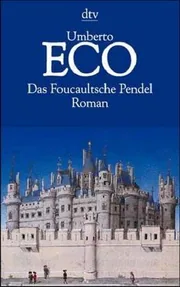
Il pendolo di Foucault
by Umberto Eco · 1988
Best suited to adult readers who enjoy long, demanding novels.
656 pages, about 10.5 to 15.5 hours.
Eco's vast, learned game of conspiracy that turns on its makers. 52% taste match
The story
Il pendolo di Foucault is a novel by the Italian writer and semiotician Umberto Eco, first published in 1988. It is Eco's second novel, and William Weaver's English translation followed a year later. The book runs to about 656 pages and has appeared in 81 editions.
It belongs to the mystery and thriller category and draws on conspiracy, occultism, and the history of the Templars. Alchemists, idolatry, voodooism, and a wide range of religions all feature in its pages, alongside reflections on semiotics, medieval history, and how people think. The narrative opens with the narrator's sight of the Pendulum. Jacopo Belbo and De Angelis are among its characters, and the settings include Italy and Brasil.
The novel is divided into ten segments, one for each of the ten Sephirot. It is set across the decades of the author's own lifetime, running up to the early 1980s, and it is filled with esoteric references, from the Cabala to alchemy and conspiracy theory. Anthony Burgess remarked that an index would have been useful for readers.
That was when I saw the Pendulum.
Characters
Jacopo BelboDe Angelis
Setting
ItalyBrasilLa bahia
Themes
Verschwo rungBelletristische DarstellungTemplarssemioticsmedieval historyVoodooismFoucault's pendulumThought and thinking
- Want to read 260
- Reading now 8
- Read 75
Most people shelving it are saving it for later.
Of 343 readers who put it on a shelf, 76% want to read it, 2% are reading it now, 22% have finished it and 0% stopped before the end.
By the numbers
- The median edition runs 656 pages. Counting about 275 words a page and an adult reading pace of 250 words a minute, that is about 12 hours of reading.
- Open Library tracks 81 editions from 57 publishers, the earliest dated 1988 and the latest 2023, across 15 languages.
- On reader demand it ranks in the top 2% of the modern books in our catalog (15,152 of them).
- Libraries shelve it under Dewey 853.91 and Library of Congress class PQ-4865.00000000.C6 P46158 2016.
 BookWard’s take
Eco's vast, learned game of conspiracy that turns on its makers
Foucault's Pendulum is a long book that rewards patience. At 656 pages it sits high on Length, and it leans hard toward Story or ideas on the idea side, since the plot exists to carry Eco's play with esoteric lore, from the Templars to the Cabala. It scores well on Originality and Authorial voice: few novels sound like this one. Exposition is heavy, with ideas explained outright, which runs against BookWard's taste for scenes that show. It is demanding to read, and the opening hook is more atmospheric than urgent. The reward is a structure built on the ten Sephirot and a mind-bending study of how conspiracy thinking works. Come for the intellectual puzzle rather than for pace.
At 656 pages it is a long, dense novel, far from the tight and short end of BookWard's taste.
Eco lingers over lore and digression, so the pace is measured rather than quick.
A novel built from the Cabala, the Templars and semiotics is unlike almost anything else, which BookWard prizes.
The prose is rich, allusive and elaborate, well toward the ornate end.
The ideas and the intellectual game drive the book more than any character's arc.
The book is wry and unsettling about human credulity, with little warmth.
Its ten parts follow the ten Sephirot, a deliberate and unusual design.
Irony and satire run through it, though it never plays as a comedy.
The mood is sinister and uneasy, though not graphic.
The register is intellectual and ironic rather than emotionally intense.
See all 50 dialsEvery position, side by side with this book
Where it lines up
- OriginalityBookWard 9 · book 9
- EndingBookWard 8 · book 7
- SentimentBookWard 8 · book 9
Where it pulls apart
- LengthBookWard 1 · book 9
- ExpositionBookWard 2 · book 9
- OpeningBookWard 10 · book 6
At 656 pages it is a long, dense novel, far from the tight and short end of BookWard's taste.
It opens on the narrator's sight of the Pendulum, an atmospheric start more than an instant grab.
It works with familiar conspiracy and occult material but treats it in a knowing, inventive way that mostly avoids cliche.
Its web of esoteric connections is built with deliberate care, and the mechanics of the plot hold together.
Eco lingers over lore and digression, so the pace is measured rather than quick.
A novel built from the Cabala, the Templars and semiotics is unlike almost anything else, which BookWard prizes.
Characters such as Jacopo Belbo are present, but the book cares more for ideas than for deep portraits.
The story reaches a firm close, though its meaning stays open to argument.
Eco keeps feeling at a cool, ironic distance, which suits BookWard's liking for restraint.
Darkness comes out of the plot's logic and its theme of obsession, not from cheap shock.
The learning behind its history and occult references is deep, even though it is used for fiction.
Eco's erudite, playful, ironic voice is unmistakable and a real strength.
Ideas lead here, with story serving as the frame for Eco's meditation on conspiracy and interpretation.
Eco often explains history and symbolism outright, which pulls against BookWard's preference for showing in scene.
The long stretches of lore can slow the middle, though the central conceit keeps pulling you on.
The prose is rich, allusive and elaborate, well toward the ornate end.
The ideas and the intellectual game drive the book more than any character's arc.
The book is wry and unsettling about human credulity, with little warmth.
Its ten parts follow the ten Sephirot, a deliberate and unusual design.
Irony and satire run through it, though it never plays as a comedy.
Its density of allusion and information makes it one of the more demanding reads around.
It is anchored mainly in one narrator's perspective rather than many voices.
It moves back and forth between present and past in ways that need close tracking.
Set in the real world, it plays with occult ideas without fully leaving reality behind.
A modest circle of principals sits within a broad historical and esoteric field of names.
It ranges across centuries of history and belief, giving it wide intellectual scope.
Most of the action is thought, research and talk, not physical event.
Conversation carries much of the exchange of ideas, but long passages of narration balance it.
Romance is a minor thread beside the intellectual plot.
The worlds of esoteric lore, secret societies and publishing will be unfamiliar to many readers.
It moves between earlier history and the decades up to the early 1980s, not the present day.
Its subject of conspiratorial thinking has only grown more relevant since 1988.
The narrator's account is shaped by what he comes to believe, so it deserves some scepticism.
The book questions interpretation and belief without handing out easy judgments.
Eco describes places, texts and ideas lavishly and in detail.
It is a standalone novel, not part of a series.
Turns come from the unfolding of the plot and its revelations, more than from sudden shocks.
It asks a great deal of the reader and unsettles easy ideas about knowledge.
The mood is sinister and uneasy, though not graphic.
The register is intellectual and ironic rather than emotionally intense.
The humor is dry, learned and ironic.
Violence is not a central feature of the book.
Sexual content is limited and incidental.
Conspiracy thinking carries political implications, but the book is not a political tract.
Dense vocabulary and heavy allusion make the language demanding.
Eco's ironic stance colors the telling, yet the narration stays largely observational.
Its fixation on old traditions and hidden histories turns the reader toward the past.
The book is skeptical of grand systems and the people who believe in them.
Review written by BookWard, dial version 1, November 2026.
Who is Il pendolo di Foucault right for?
Best suited to adult readers who enjoy long, demanding novels. The material is more intellectual than graphic, though its occult themes and bleak outlook may unsettle some.
Its density of allusion and information makes it one of the more demanding reads around.
The mood is sinister and uneasy, though not graphic.
The register is intellectual and ironic rather than emotionally intense.
Violence is not a central feature of the book.
Book CompanionIl pendolo di Foucault: ideas, characters, themes
A novel about how obsessive pattern-seeking can turn a game of invented conspiracy into something dangerous.
- A story built from lore. Eco weaves the Templars, the Cabala, alchemy and occultism into a single narrative about hidden history.
- Ten-part design. The book is divided into ten segments that stand for the ten Sephirot, giving it a symbolic backbone.
- The Pendulum. The narrator's sight of the Pendulum opens the book and sets its mood of fixed point and endless motion.
- Reading as interpretation. Eco is a semiotician, and the novel keeps asking how signs and texts are read and misread.
- A dense reading experience. Anthony Burgess suggested the book needed an index, which shows how thick its allusions are.
Characters
Jacopo Belbo
Central figure
One of the principal characters, tied to the book's play with occult ideas and conspiracy.
De Angelis
Named figure
Another character who appears in the book's web of secrets and hidden histories.
Themes
How the urge to find hidden patterns can shape belief and action.
How meaning is made, and made up, from signs and texts.
The pull of hidden pasts, especially around the Templars.
The lure and danger of esoteric systems such as the Cabala and alchemy.
How people reason, and how reasoning can mislead them.
Discussion questions
- Why does Eco organize the novel around the ten Sephirot?
- What does the Pendulum stand for at the book's opening?
- How does the book treat the pleasure of finding patterns?
- Is the dense erudition a strength or a barrier?
- What makes conspiracy thinking so persuasive in this story?
Personalize your Book Companion
This is the general edition. In BookWard, the Companion is written for you: your reading profile, your notes, and spoiler-safe to the page you are on.
Buy, listen or borrow Il pendolo di Foucault
Each link opens a search for this book on that store, in a new tab.
Read on a device
Borrow
Reviews and community
If you liked Il pendolo di Foucault
A monastery of mathematicians, an alien ship, and a vast invented world
Midnight's ChildrenSalman RushdieA nation's birth told through one voice, huge and unruly
Moby DickHerman MelvilleA whaling voyage bent into obsession, famously digressive and enormous in ambition
Invisible ManRalph EllisonA restless, original classic about identity, race, and being unseen
Sources: Open Library.
Track Il pendolo di Foucault and find your next favorite
Add it to your shelf, rate what you have read, and BookWard will recommend what fits you.
Free to start. No credit card needed.