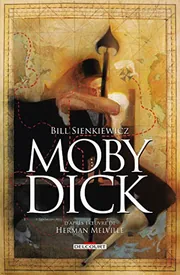
Moby Dick
by Herman Melville · 1851
Best suited to mature teens and adults ready for dense, nineteenth-century prose and a long read.
453 pages, about 7 to 10.5 hours.
A whaling voyage bent into obsession, famously digressive and enormous in ambition. 46% taste match
What is inside
Moby Dick is a novel by Herman Melville, first published in 1851. It belongs to the tradition of American sea stories and adventure fiction, set in the nineteenth century and centered on the whaling trade. The narrator introduces himself as Ishmael, and the voyage he joins takes in the Atlantic, Pacific and Indian Oceans, with passages around Cape Horn and the Cape of Good Hope. The story begins in Massachusetts, with Nantucket and New Bedford among the places named along the way.
The ship is the Pequod, and its captain is Ahab, a man driven by a fixed purpose that turns a commercial whaling mission into a pursuit of one great white whale. Among the crew are Starbuck, Stubb, Flask, Queequeg, Tashtego, Daggoo, Fedallah and Pip. The book also deals with sailors, whales and the business of whaling, and with a captain whose state of mind shapes the course of the voyage. It runs to roughly 453 pages in the median edition, and it has appeared in well over a thousand editions, including translations into French.
Call me Ishmael.
Characters
IshmaelAhabStarbuckStubbFlaskQueequeg
Setting
MassachusettsNantucketNew BedfordCape HornCape of Good Hope
Period
19th century
Themes
American Sea storiesMentally illWhalingWhalesLiteratureCaptain Ahab (Fictitious character)American Adventure storiesSailors
- Want to read 1,769
- Reading now 134
- Read 292
Most people shelving it are saving it for later.
Of 2195 readers who put it on a shelf, 81% want to read it, 6% are reading it now, 13% have finished it and 0% stopped before the end.
By the numbers
- The median edition runs 453 pages. Counting about 275 words a page and an adult reading pace of 250 words a minute, that is about 8.3 hours of reading.
- Open Library tracks 1129 editions from 510 publishers, the earliest dated 1851 and the latest 2024, across 20 languages.
- On reader demand it ranks in the top 1% of the classic books in our catalog (8,749 of them).
- Libraries shelve it under Dewey 813.3 and Library of Congress class PS-2384.00000000.M6 Mo69.
 BookWard’s take
A whaling voyage bent into obsession, famously digressive and enormous in ambition
Moby Dick is the rare classic that rewards patience and punishes impatience in equal measure. The Pequod's mission turns into Ahab's private crusade, and that pull gives the book its force. But Melville keeps stopping the ship to talk about whales, rope, and the trade itself, so the pace is far slower than I'd choose, and the book often explains outright what I'd rather see played out in scene. Where it wins is voice: Ishmael's narration is unmistakable, and the book still feels original after a century and a half of imitators. It is also demanding and long, with a sagging middle that depends on your appetite for digression. Come for the voice and the dread, not for speed.
At 453 pages, with digressions that swell it further, it is a long book, the opposite of BookWard's tight preference.
The chase is slowed by long stretches on whaling craft, well below the brisk pace BookWard likes.
Few novels before or since mix adventure, sermon, and cetology like this, a strong match for BookWard's taste.
The language is rich, rhythmic, and often biblical in cadence, far more ornate than BookWard's middling taste.
The hunt gives it a spine, yet Ahab's psychology drives events, leaving the balance slightly toward character.
Obsession steers the ship toward doom, and the book offers little consolation along the way.
Chapters shift between narrative, essay, and drama-like scenes, a more experimental shape than BookWard usually seeks.
There is wry humor in Ishmael's asides, but the dominant register is solemn and fateful.
Obsession, doom, and a captain's troubled mind give it a heavy tone, a bit darker than BookWard's midpoint.
The feeling runs high, but as awe and dread rather than tears, so intensity lands slightly above BookWard's level.
See all 50 dialsEvery position, side by side with this book
Where it lines up
- OriginalityBookWard 9 · book 9
- SentimentBookWard 8 · book 8
- OpeningBookWard 10 · book 9
Where it pulls apart
- LengthBookWard 1 · book 9
- ExpositionBookWard 2 · book 9
- Internal logicBookWard 10 · book 6
At 453 pages, with digressions that swell it further, it is a long book, the opposite of BookWard's tight preference.
Its famous first line announces a narrator and a mood immediately, which suits BookWard's taste for openings that grab at once.
It helped define the sea story rather than lean on its conventions, which BookWard values highly.
The voyage follows its own fixed logic of obsession, though its tangents loosen the sense of a tightly built machine.
The chase is slowed by long stretches on whaling craft, well below the brisk pace BookWard likes.
Few novels before or since mix adventure, sermon, and cetology like this, a strong match for BookWard's taste.
Ahab is drawn with fierce intensity, though much of the crew works more as vivid presences than full interior portraits.
The pursuit builds toward a decisive confrontation rather than a vague fade, which fits BookWard's liking for resolution.
Melville favors grandeur and dread over tenderness, so the book stays far from sentimental, in line with BookWard.
The darkness grows out of Ahab's fixation and the hunt itself, so it feels earned rather than inserted for effect.
Whaling detail is presented with authority, though the book is a novel and not a study, so rigor is partial.
Ishmael's voice, by turns exuberant, brooding, and philosophical, is among the most distinctive in fiction.
The voyage is a vehicle for large questions about obsession and meaning, putting ideas well ahead of plot, unlike BookWard's story lean.
Melville frequently stops to explain whales and whaling outright, much more than BookWard's show-in-scene preference.
The middle drifts through chapters of lore and reflection, so momentum is not sustained the way BookWard wants.
The language is rich, rhythmic, and often biblical in cadence, far more ornate than BookWard's middling taste.
The hunt gives it a spine, yet Ahab's psychology drives events, leaving the balance slightly toward character.
Obsession steers the ship toward doom, and the book offers little consolation along the way.
Chapters shift between narrative, essay, and drama-like scenes, a more experimental shape than BookWard usually seeks.
There is wry humor in Ishmael's asides, but the dominant register is solemn and fateful.
Dense sentences, nautical vocabulary, and digressions make this a demanding read compared with BookWard's easier leaning.
Ishmael narrates throughout, so the perspective is essentially single, narrower than BookWard's taste for many viewpoints.
The voyage unfolds in a largely forward line, more linear than BookWard's comfort with shifting time.
The world is grounded in the real whaling trade, with only a mythic aura around the white whale.
A named crew of harpooners and mates gives a moderately large cast, bigger than BookWard's usual small one.
A ship, an ocean, and a monstrous quarry make the story feel epic in reach compared with BookWard's intimate lean.
Voyage action and Ishmael's reflection share the stage fairly evenly, close to BookWard's inner-leaning balance.
Scenes of speech punctuate the book, but long expository and descriptive passages keep it lighter on dialogue.
Romance plays no real part in a story about men at sea and a single obsession.
The whaling ship and its trade will feel unfamiliar to most readers, a strength for BookWard's taste for the unfamiliar.
Set and written in the nineteenth century, it sits firmly in the past, away from BookWard's present-day lean.
Its themes of obsession and meaning have kept it alive for well over a century and more than a thousand editions.
Ishmael is mostly a trustworthy witness, so the book sits on the reliable side of BookWard's unreliable preference.
Ahab's crusade invites sympathy and judgment together, leaving moral questions open in a way BookWard enjoys.
Ships, seas, and whales are rendered in lavish, sustained detail, richer than BookWard's usual middle.
A single self-contained novel with no sequels.
The path is driven by Ahab's fixed purpose, so surprise is less a feature than inevitability.
It asks for patience and offers unsettling ideas, matching BookWard's lean toward challenge over comfort.
Obsession, doom, and a captain's troubled mind give it a heavy tone, a bit darker than BookWard's midpoint.
The feeling runs high, but as awe and dread rather than tears, so intensity lands slightly above BookWard's level.
Humor, when present, is wry and understated, on the drier side of BookWard's midpoint.
Whaling scenes are physical and bloody, a moderate amount of violence on the page.
There is essentially no sexual content in this seafaring story.
Questions of authority and power aboard ship appear, but politics is not the book's focus.
Archaic phrasing, nautical terms, and elaborate syntax make the language notably dense.
Ishmael freely interprets, preaches, and philosophizes, so the narration is strongly opinionated.
The book is rooted in a vanishing trade and an older world, looking backward rather than forward.
A fatalistic, brooding outlook leaves little room for idealism, pointing toward the cynical end.
Review written by BookWard, dial version 1, November 2026.
Who is Moby Dick right for?
Best suited to mature teens and adults ready for dense, nineteenth-century prose and a long read. It contains hunting and killing of whales and the dangers of life at sea.
Dense sentences, nautical vocabulary, and digressions make this a demanding read compared with BookWard's easier leaning.
Obsession, doom, and a captain's troubled mind give it a heavy tone, a bit darker than BookWard's midpoint.
The feeling runs high, but as awe and dread rather than tears, so intensity lands slightly above BookWard's level.
Whaling scenes are physical and bloody, a moderate amount of violence on the page.
Book CompanionMoby Dick: ideas, characters, themes
A captain turns a commercial whaling voyage into a personal crusade against one white whale, and the crew is dragged along.
- A voyage with a hidden aim. The Pequod sails as a whaling ship, but Ahab's real purpose is destroying the great white whale.
- Ishmael as guide. The narrator introduces himself as Ishmael and brings readers aboard, shaping everything through his voice.
- Obsession as symbol. To Ahab, the whale is not just an animal but a symbol of some unknown but still reasoning thing.
- The business of whaling. The book keeps returning to the trade itself, setting the quest against everyday work at sea.
- A wide geography. The ship's path runs through the Atlantic, Pacific, and Indian Oceans, past Cape Horn and the Cape of Good Hope.
Characters
Ishmael
Narrator
The voice through which the voyage is told, joining the crew and observing the hunt.
Ahab
Captain of the Pequod
A lordly and driven commander whose fixation redirects the ship's purpose.
Starbuck
Crew member
One of the Pequod's officers, part of the crew bound to Ahab's mission.
Queequeg
Harpooner
One of the harpooners aboard, among the crew who swear to the hunt.
Themes
A single fixed purpose can bend a whole enterprise and everyone in it.
The wish to repay a wound can replace every other aim.
The ocean and its creatures resist human will and ambition.
A captain's state of mind can steer the fate of those under him.
Ahab reads a whale as a sign of something larger, and the book asks what is truly there.
Discussion questions
- Is Ahab a tragic figure, a villain, or both?
- How do the long passages on whaling change the way the story feels?
- What does the white whale stand for, and does it need to stand for anything?
- Why might Melville have chosen Ishmael as narrator instead of Ahab?
- How does the crew's loyalty to Ahab reflect on the men themselves?
Personalize your Book Companion
This is the general edition. In BookWard, the Companion is written for you: your reading profile, your notes, and spoiler-safe to the page you are on.
Buy, listen or borrow Moby Dick
Each link opens a search for this book on that store, in a new tab.
Read on a device
Borrow
Reviews and community
If you liked Moby Dick
Eco's vast, learned game of conspiracy that turns on its makers
DispatchesMichael HerrVietnam as one reporter lived it, in prose that burns
Invisible ManRalph EllisonA restless, original classic about identity, race, and being unseen
The Last ManMary ShelleyShelley's grand, grieving vision of humanity's slow extinction by plague
Sources: Open Library.
Track Moby Dick and find your next favorite
Add it to your shelf, rate what you have read, and BookWard will recommend what fits you.
Free to start. No credit card needed.