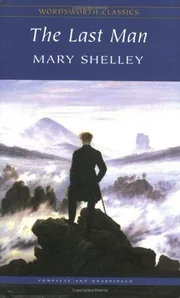
Best suited to mature teens and adults comfortable with long, formal period prose.
411 pages, about 6.5 to 9.5 hours.
Shelley's grand, grieving vision of humanity's slow extinction by plague. 42% taste match
The story
The Last Man is a science fiction novel by Mary Shelley, who also wrote Frankenstein. It first appeared in 1826 and belongs to the apocalyptic strand of the genre. The story is told in the first person and looks ahead to the end of the twenty-first century, when a plague spreads across the globe and brings humanity close to extinction. The narrator begins with a visit to Naples in 1818, and the tale is framed as having been put together from prophetic writings found in a cave near that city.
Much of the action centers on Europe, and the book also takes in the workings of the British state, imagined as a republic. To understand the government of her own day, Shelley sat in on meetings of the House of Commons. Several characters echo people close to her, including her husband Percy Bysshe Shelley, who drowned four years before publication, and their friend Lord Byron, who had died two years earlier. The novel runs to roughly 411 pages in a typical edition, has appeared in some 430 editions, and was adapted as a film in 2008.
I VISITED Naples in the year 1818.
Period
21st Century
Themes
PlagueTwenty-first centuryEnd of the worldEnglish literatureLong Now Manual for Civilization
- Want to read 232
- Reading now 23
- Read 15
Most people shelving it are saving it for later.
Of 270 readers who put it on a shelf, 86% want to read it, 9% are reading it now, 6% have finished it and 0% stopped before the end.
By the numbers
- The median edition runs 411 pages. Counting about 275 words a page and an adult reading pace of 250 words a minute, that is about 7.5 hours of reading.
- Open Library tracks 430 editions from 58 publishers, the earliest dated 1826 and the latest 2025, across 3 languages.
- On reader demand it ranks in the top 7% of the classic books in our catalog (8,749 of them).
- Libraries shelve it under Dewey 823.7 and Library of Congress class PR-5397.00000000.L3 2024.
 BookWard’s take
Shelley's grand, grieving vision of humanity's slow extinction by plague
Mary Shelley's 1826 novel looks ahead to the end of the twenty-first century and follows a plague as it spreads from Europe across the whole world. It is told in the first person and framed as prophetic writings found in a cave near Naples. At about 411 pages, it sprawls, and readers who like their fiction tight will feel that. The opening is gentler than a modern thriller, since the book builds its world patiently. Where it earns its keep is in its originality: an apocalypse written two centuries ago, with a British republic imagined in detail and loved ones from Shelley's own life echoed in the cast. Expect ornate prose and a bleak outlook, with grief at its center. It rewards patience more than it rewards speed.
At roughly 411 pages in a typical edition, it is a long book, well away from the short end BookWard prefers.
The narration is measured and reflective, far slower than BookWard's taste for momentum.
A global plague apocalypse set in the late twenty-first century was a bold idea for 1826.
The language is elevated and Romantic, richly ornate compared with plain modern storytelling.
Relationships and loss drive the story more than events, even as the plague advances.
With humanity heading for near-extinction, the outlook is bleak, with only faint consolation.
It is framed as writings found in a cave, but the telling inside the frame is largely conventional.
This is a solemn, mournful book with essentially no comic relief.
Humanity's near-end is the subject, so the content is dark throughout.
Grief and longing run intense across the book.
See all 50 dialsEvery position, side by side with this book
Where it lines up
- EndingBookWard 8 · book 8
- OriginalityBookWard 9 · book 8
- Character depthBookWard 8 · book 7
Where it pulls apart
- LengthBookWard 1 · book 8
- OpeningBookWard 10 · book 4
- Internal logicBookWard 10 · book 6
At roughly 411 pages in a typical edition, it is a long book, well away from the short end BookWard prefers.
It opens with a reflective visit to Naples and a framing device, so the story takes its time to start.
Plague-ends-the-world is a familiar shape now, though here it reads as a founding example rather than a copy.
The slow spread of the plague and its social effects hold together, though the prophetic frame asks for some acceptance.
The narration is measured and reflective, far slower than BookWard's taste for momentum.
A global plague apocalypse set in the late twenty-first century was a bold idea for 1826.
Characters echo real people close to Shelley, which gives them weight and feeling beyond types.
A tale of humanity's near-extinction told by its last witness builds toward a firm, final close.
Grief runs deep and the book leans into it openly rather than holding back.
The darkness comes from a plague's real toll on a whole civilization, not from shock for its own sake.
This is a novel, so the dial does not apply.
Shelley's romantic, elegiac voice is unmistakably her own.
It is driven by a story of loss, but the vision of an ending world carries much of the weight.
The narrator often explains politics and feeling directly rather than leaving everything to scene.
A book of this length and reflective mood can slow in stretches before the pull returns.
The language is elevated and Romantic, richly ornate compared with plain modern storytelling.
Relationships and loss drive the story more than events, even as the plague advances.
With humanity heading for near-extinction, the outlook is bleak, with only faint consolation.
It is framed as writings found in a cave, but the telling inside the frame is largely conventional.
This is a solemn, mournful book with essentially no comic relief.
Dense period prose and a long reflective stretch make it a demanding read.
A single first-person narrator tells the whole story.
The tale moves forward in order, apart from the framing device at Naples.
The plague is plausible, but the future setting and prophetic cave frame add a fantastical layer.
A moderate circle of central figures sits against a world population dwindling away.
The whole of humanity is at stake, which makes this epic in reach.
The narrator's feelings and reflections matter more than outward action.
Conversation is present but the narration carries most of the book.
Love and friendship sit alongside politics and survival, a real thread but not the sole focus.
A future Europe imagined from the 1820s, with a British republic, is an unfamiliar setting.
Written in 1826, it is firmly a book from the past, though set in the future.
Its themes of loss, plague and survival still speak to readers today.
The narrator tells a loss he lived through plainly and sincerely, with little reason to doubt him.
Questions of duty, ambition and grief are weighed with nuance rather than simple verdicts.
Landscape, society and emotion are painted in rich, lingering detail.
Not nonfiction, so the dial does not apply.
Not nonfiction, so the dial does not apply.
It is a standalone novel.
The plague's path is its own sort of fate, with few plot surprises.
Its sorrow and scale ask the reader to sit with extinction and loss.
Humanity's near-end is the subject, so the content is dark throughout.
Grief and longing run intense across the book.
There is no humor to place here.
Death from plague is constant, though it is not shown through graphic violence.
The book has little sexual content.
The workings of a British republic are imagined in notable detail, a clear strand of the book.
Period syntax and elevated diction make the language dense in places.
The narrator openly reflects, mourns and judges as he tells the story.
It projects forward to the end of the twenty-first century, a vision of the future.
Ideals of republic and fellowship are tested and largely overturned by loss.
Review written by BookWard, dial version 1, November 2026.
Who is The Last Man right for?
Best suited to mature teens and adults comfortable with long, formal period prose. It deals throughout with death, grief and the end of the human race.
Dense period prose and a long reflective stretch make it a demanding read.
Humanity's near-end is the subject, so the content is dark throughout.
Grief and longing run intense across the book.
Death from plague is constant, though it is not shown through graphic violence.
Book CompanionThe Last Man: ideas, characters, themes
A lone survivor recounts how a plague swept the globe and ended humanity, in a story framed as prophecy found near Naples.
- A frame of prophecy. The tale is presented as writings found in a cave near Naples, set down by the narrator.
- A future Europe. The action looks ahead to the end of the twenty-first century and centers on Europe.
- The British republic. Shelley imagined the British state as a republic, having sat in on House of Commons meetings to understand government.
- Echoes of real lives. Characters recall her husband Percy Bysshe Shelley and her friend Lord Byron.
- Plague and extinction. A pandemic spreads worldwide and brings humanity close to extinction.
Themes
Grief for people and for a whole way of life drives the book.
What it means to endure when everyone else is gone.
How a republic copes, or fails to, when crisis strikes.
Bonds between people, some drawn from Shelley's own circle.
The idea that the future can be glimpsed and written down.
Discussion questions
- Why might Shelley frame the story as prophecy found in a cave?
- How does imagining Britain as a republic shape the story?
- What does the book gain from a single narrator telling it all?
- How do the echoes of Shelley's own loved ones change how you read it?
- Does the book offer any hope, or only mourning?
Personalize your Book Companion
This is the general edition. In BookWard, the Companion is written for you: your reading profile, your notes, and spoiler-safe to the page you are on.
Buy, listen or borrow The Last Man
Each link opens a search for this book on that store, in a new tab.
Read on a device
Borrow
Reviews and community
If you liked The Last Man
Hardy's heath novel of a bad marriage and slow ruin
The Book ThiefMarkus ZusakDeath narrates a foster girl's war, and the book earns it
Abraham LincolnCarl SandburgSandburg's one-volume Lincoln: a poet's long march from prairie to presidency
Narziss und GoldmundHermann HesseTwo opposite men, one friendship, and a debate Hesse refuses to settle
Sources: Open Library.
Track The Last Man and find your next favorite
Add it to your shelf, rate what you have read, and BookWard will recommend what fits you.
Free to start. No credit card needed.