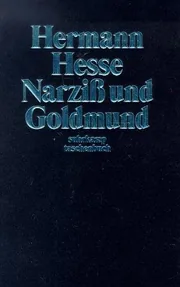
It suits mature teens and adults who enjoy philosophical fiction.
321 pages, about 5 to 7.5 hours.
Two opposite men, one friendship, and a debate Hesse refuses to settle. 52% taste match
The story
Narziss und Goldmund, by Hermann Hesse, is a historical novel set in medieval Germany and first issued in 1930. It opens at the Mariabronn cloister, where a chestnut tree stands near the road by the entrance arch. The story follows two men who could hardly be more unlike each other. One is a monk devoted to the religious life and committed to a life of discipline. The other is a young man drawn toward worldly experience and the pleasures and risks that come with it.
Their relationship begins in a teacher and student setting, and the book is shaped by the contrast between their paths. Questions of body and spirit, art and religious or scientific thought, and action and contemplation run through the narrative. Hesse wrote it after Steppenwolf, and it appeared in English under the title Death and the Lover as well as Narcissus and Goldmund. The novel has been translated from German into English and has gone through many editions, with a typical printing running to about 321 pages.
OUTSIDE the entrance of the Mariabronn cloister, whose rounded arch rested on slim double columns, a chestnut tree stood close to the road.
Setting
Germany
Themes
Teacher-student relationshipsRomanceLiteratura alemãMiddle AgesMoyen ÂgeRomans, nouvellesAnnäherungFreundschaft
- Want to read 109
- Reading now 5
- Read 32
Most people shelving it are saving it for later.
Of 146 readers who put it on a shelf, 75% want to read it, 3% are reading it now, 22% have finished it and 0% stopped before the end.
By the numbers
- The median edition runs 321 pages. Counting about 275 words a page and an adult reading pace of 250 words a minute, that is about 5.9 hours of reading.
- Open Library tracks 41 editions from 22 publishers, the earliest dated 1930 and the latest 2003, across 4 languages.
- On reader demand it ranks in the top 8% of the classic books in our catalog (8,749 of them).
- Libraries shelve it under Dewey 833.912 and Library of Congress class PT-2617.00000000.E85 N39 1975.
 BookWard’s take
Two opposite men, one friendship, and a debate Hesse refuses to settle
Hesse's 1930 novel opens at the Mariabronn cloister and sets a disciplined monk against a young man hungry for the world. It is short for how much it holds. The book cares more about character than plot, and it is closer to a novel of ideas than I usually enjoy. The central argument between body and spirit, art and contemplation is never resolved, so readers who want a fully settled ending will come away unsatisfied. Hesse's voice is unmistakable, and the premise of a lifelong pairing of opposites still feels fresh. The opening is quiet and scene-setting rather than an instant hook. Read it for the questions, not the momentum.
At 321 pages it is compact for its ambitions, though not as lean as BookWard prefers.
It moves at a contemplative, episodic pace that favors reflection over speed.
Pairing two opposed lives as a lifelong dialogue was distinctive in its time and still reads as its own thing.
The language is lyrical and measured, more ornate than plain without being showy.
It is driven by who these two men are and what each needs, far more than by plot mechanics.
It balances loss and mortality with a sense that both paths hold meaning, landing in the middle.
The structure is a fairly conventional life-story arc with a parting and a return.
The tone is earnest and serious, with little room for comedy.
Mortality and desire give it weight, though it is not relentlessly grim.
Longing and loss run strong beneath a controlled surface.
See all 50 dialsEvery position, side by side with this book
Where it lines up
- Character depthBookWard 8 · book 8
- Authorial voiceBookWard 9 · book 9
- LengthBookWard 1 · book 3
Where it pulls apart
- OpeningBookWard 10 · book 4
- Familiar tropesBookWard 10 · book 6
- Internal logicBookWard 10 · book 7
At 321 pages it is compact for its ambitions, though not as lean as BookWard prefers.
It begins in a quiet cloister setting and builds slowly, which is gentler than the instant grab BookWard likes.
The monk-and-wanderer contrast is archetypal, so it works with familiar figures even while using them freshly.
The two paths follow from each man's nature, so the story holds together by its own terms.
It moves at a contemplative, episodic pace that favors reflection over speed.
Pairing two opposed lives as a lifelong dialogue was distinctive in its time and still reads as its own thing.
The book is built around two fully considered temperaments, which fits BookWard's love of drawn characters.
The central debate is deliberately left unsettled, so it resolves less than BookWard would choose.
It feels deeply, with a lyrical warmth that sits a little on the sentimental side of BookWard's restraint.
Its darker turns are tied to the themes of mortality and desire rather than added for effect.
Hesse's reflective, allusive voice is unmistakable and carries the whole book.
The body-versus-spirit debate drives the book as much as events do, leaning toward ideas.
Much of the thinking is spoken or reasoned outright, more explained than BookWard's taste for showing.
The episodic travels can drift, though the central contrast keeps pulling the book back.
The language is lyrical and measured, more ornate than plain without being showy.
It is driven by who these two men are and what each needs, far more than by plot mechanics.
It balances loss and mortality with a sense that both paths hold meaning, landing in the middle.
The structure is a fairly conventional life-story arc with a parting and a return.
The tone is earnest and serious, with little room for comedy.
The ideas ask for attention, though the story itself stays readable.
The book stays close to its central pair, mostly tracking one man at a time.
Events unfold in order across the years, without time-shifting.
The medieval world is rendered realistically, with no fantasy element.
Two figures dominate, with others serving as passing encounters.
It spans years and roads, yet its real subject is two inner lives.
The weight falls on thought and temperament more than on action.
Their conversations carry the central argument but do not fill most pages.
Love and desire shape one man's path strongly, though the bond between the two men is the core.
Medieval Germany and the cloister are far from most readers' daily experience.
It is set in the Middle Ages, long before the present day.
Its questions about flesh and spirit have stayed alive for decades.
The narration is straightforward and trustworthy, guiding the reader plainly.
Neither way of life is declared right, so the moral picture stays open.
Settings and moods are painted with care, giving the book a rich texture.
It stands entirely on its own.
It unfolds as a life journey rather than a plot of reveals.
It poses real questions about how to live without handing out comfort.
Mortality and desire give it weight, though it is not relentlessly grim.
Longing and loss run strong beneath a controlled surface.
What humor exists is faint and dry.
Hardship and death appear, but violence is not the focus.
Desire is central to one man's journey and is treated openly but not luridly.
Its concerns are philosophical and personal rather than political.
The language is literary but not dense or dialect-heavy.
The narration carries a clear reflective stance on the questions it raises.
Set in a medieval past, it looks back more than forward.
It believes in the value of both devotion and lived experience, leaning idealistic.
Review written by BookWard, dial version 1, November 2026.
Who is Narziss und Goldmund right for?
It suits mature teens and adults who enjoy philosophical fiction. It treats desire and mortality openly, so some readers may want to be ready for that.
The ideas ask for attention, though the story itself stays readable.
Mortality and desire give it weight, though it is not relentlessly grim.
Longing and loss run strong beneath a controlled surface.
Hardship and death appear, but violence is not the focus.
Book CompanionNarziss und Goldmund: ideas, characters, themes
Two friends, a disciplined monk and a restless seeker of experience, embody the lasting tension between spirit and flesh.
- A cloister beginning. The story opens at Mariabronn, where a teacher-and-student bond sets the stage for everything after.
- Opposite natures. One man commits to religious discipline while the other is drawn toward worldly pleasures and risks.
- A debate left open. Hesse lets body and spirit, art and contemplation, action and thought argue without declaring a winner.
- Medieval setting. The novel unfolds in medieval Germany, giving the ideas a concrete historical backdrop.
- Following Steppenwolf. Written after Steppenwolf, it was seen at publication as a literary triumph and also appeared as Death and the Lover.
Characters
Narziss
The monk
A devoted, disciplined man committed to the religious life.
Goldmund
The seeker
A romantic young man hungry for worldly experience.
Themes
The pull between bodily life and the life of the mind or faith.
How creating, thinking, and devotion offer different routes to meaning.
Whether a life is better lived through doing or through thinking.
How two unlike people can shape each other over a lifetime.
Discussion questions
- Which of the two men's paths feels more persuasive to you, and why?
- Why might Hesse refuse to resolve the debate between flesh and spirit?
- How does the teacher-and-student start shape the later relationship?
- What does the medieval setting add to the questions the book asks?
- Can art bridge contemplation and worldly experience?
Personalize your Book Companion
This is the general edition. In BookWard, the Companion is written for you: your reading profile, your notes, and spoiler-safe to the page you are on.
Buy, listen or borrow Narziss und Goldmund
Each link opens a search for this book on that store, in a new tab.
Read on a device
Borrow
Reviews and community
If you liked Narziss und Goldmund
Hardy's pastoral love triangle, slow in the telling but sure-footed
SiddharthaHermann HesseA slim, musical parable of one man's search for wisdom
The Return of the NativeThomas HardyHardy's heath novel of a bad marriage and slow ruin
DemianHermann HesseA quiet boy, a mysterious classmate, and a search for self
Sources: Open Library.
Track Narziss und Goldmund and find your next favorite
Add it to your shelf, rate what you have read, and BookWard will recommend what fits you.
Free to start. No credit card needed.