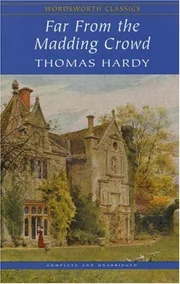
Far from the Madding Crowd
by Thomas Hardy · 1874
Suited to mature teens and adults comfortable with a slow, richly written Victorian novel.
424 pages, about 6.5 to 10 hours.
Hardy's pastoral love triangle, slow in the telling but sure-footed. 57% taste match
The story
Far from the Madding Crowd is a historical romance by Thomas Hardy, first published in 1874 and set in the rural English county of Wessex, with Dorset among its places. Its action unfolds in the 19th century and centers on farm life and the customs of a country community. It is the fourth novel Hardy published, and it first came out anonymously as a monthly serial in Cornhill Magazine before appearing as a book.
The story follows Bathsheba Everdene, a spirited and independent young woman who arrives at Weatherbury to run a farm on the largest estate in the area. Her presence attracts three suitors of very different character: the gentleman-farmer Boldwood, the soldier Sergeant Troy, and the shepherd Gabriel Oak. Each one complicates her choices in his own way, and the consequences reach beyond her personal life to affect the wider community. Women farming on their own, love triangles, and the rhythms of the countryside run through the book. It is also the first of Hardy's works set in Wessex. Editions typically run to around 424 pages.
Characters
Bathsheba EverdeneBoldwoodSergeant TroyGabriel Oak
Setting
Wessex (England)DorsetEnglandDorset (England)Wessex (England
Period
19th century
Themes
Social life and customsClassic LiteratureManners and customsRomans, nouvellesMœurs et coutumesRural conditionsLove storiesAgricultrices
- Want to read 337
- Reading now 26
- Read 34
Most people shelving it are saving it for later.
Of 397 readers who put it on a shelf, 85% want to read it, 7% are reading it now, 9% have finished it and 0% stopped before the end.
By the numbers
- The median edition runs 424 pages. Counting about 275 words a page and an adult reading pace of 250 words a minute, that is about 7.8 hours of reading.
- Open Library tracks 250 editions from 134 publishers, the earliest dated 1874 and the latest 2022, across 4 languages.
- On reader demand it ranks in the top 3% of the classic books in our catalog (8,749 of them).
- Libraries shelve it under Dewey 828.1 and Library of Congress class PR-4745.00000000.A1 1902.
 BookWard’s take
Hardy's pastoral love triangle, slow in the telling but sure-footed
Hardy's first Wessex novel puts a spirited woman in charge of her own farm and lets three very different men complicate her life. It is a story-led, character-driven book with a long, unhurried approach, and it opens gently rather than with a hook, so the pace is slower than I tend to like. Where it wins is in its people: Bathsheba is drawn with real contradiction, and the farm folk around her feel lived in. The voice is distinctive, with Hardy's ironic, observing narrator and rich description of the land and its work. The moral lines are looser than the genre suggests, and the book earns its darker turns rather than reaching for shock. Worth it for the people and the place, less so if you want speed.
At 424 pages it is a substantial Victorian novel, roomier than BookWard's taste for tight books.
The telling is unhurried and attentive to farm life, so it moves slower than BookWard's taste.
A woman running her own farm was unusual in its day, though the romance plot itself is traditional.
Hardy's sentences are rich and often elaborate, more ornate than plain.
What happens depends on who Bathsheba and the men around her are, so character leads.
The book holds both warmth and hardship, leaning neither toward comfort nor despair.
It runs as a conventional, serial-style novel told in order.
There is dry humor among the farm hands, but the book stays mostly serious.
It moves toward tragedy at points while keeping a measured, human tone.
Passion and loss run strong beneath a composed surface.
See all 50 dialsEvery position, side by side with this book
Where it lines up
- Character depthBookWard 8 · book 8
- EndingBookWard 8 · book 8
- Authorial voiceBookWard 9 · book 9
Where it pulls apart
- OpeningBookWard 10 · book 4
- LengthBookWard 1 · book 6
- Familiar tropesBookWard 10 · book 6
At 424 pages it is a substantial Victorian novel, roomier than BookWard's taste for tight books.
It opens by settling into character and place rather than grabbing you, which is slower than BookWard prefers.
A love triangle with three suitors is a familiar shape, though Hardy's handling keeps it from feeling stock.
Events follow from character choices and rural circumstance, which holds together well and suits BookWard.
The telling is unhurried and attentive to farm life, so it moves slower than BookWard's taste.
A woman running her own farm was unusual in its day, though the romance plot itself is traditional.
Bathsheba and her suitors are drawn with real contradiction, which matches what BookWard values.
The threads are drawn to a clear close, which sits well with BookWard's liking for resolution.
It feels warmly about its people but does not drown them in feeling, landing in the middle.
Its darker turns grow out of passion and consequence rather than being thrown in for effect, which BookWard likes.
Not applicable to a work of fiction.
Hardy's wry, observing narrator is unmistakable and gives the book a strong personality.
It is led by its story and its people, with ideas carried inside the plot.
Much is shown through scene and incident, though the narrator does comment on character and country life.
The long rural stretches can loosen the drive between the bigger turns of the plot.
Hardy's sentences are rich and often elaborate, more ornate than plain.
What happens depends on who Bathsheba and the men around her are, so character leads.
The book holds both warmth and hardship, leaning neither toward comfort nor despair.
It runs as a conventional, serial-style novel told in order.
There is dry humor among the farm hands, but the book stays mostly serious.
Victorian diction and long sentences ask for some patience but reward steady reading.
The story stays close to a few central figures through a single guiding narrator.
Events unfold in a straight line through the farming year.
It is firmly realistic, rooted in ordinary rural life.
A moderate community of farm workers and villagers surrounds the central figures.
The stakes are personal and local, centered on one farm and one community.
It balances what people think and feel with what they do on the land.
Conversation carries a fair share of the book, especially among the villagers.
Courtship and the three suitors sit at the heart of the plot.
Nineteenth-century Dorset farming is unfamiliar territory for most modern readers.
It is set well in the past and shows its age in setting and manners.
Its human concerns have kept it in print and on syllabi for a long time.
The narrator is a steady, trustworthy guide to events.
Hardy treats his characters' failings with understanding rather than neat judgment.
Landscape and rural labor are described with unusual richness and care.
Not applicable to a work of fiction.
Not applicable to a work of fiction.
It stands alone, though it is the first of Hardy's Wessex novels.
There are real reversals in love and fortune, but they grow out of character.
It asks more of the reader than a comfort read but does not push hard.
It moves toward tragedy at points while keeping a measured, human tone.
Passion and loss run strong beneath a composed surface.
The humor is dry and observational, often through the rustic characters.
There is some serious violence in the story, handled with restraint.
Sexual relationships are treated frankly but without explicit detail.
Class and gender matter in the background but are not argued outright.
Rustic speech and period language add some density for modern readers.
The narrator freely offers observations and judgments on the characters and their world.
It looks back, preserving a rural way of life already giving way.
It holds out for steadfast love and decency without ignoring how hard life is.
Review written by BookWard, dial version 1, November 2026.
Who is Far from the Madding Crowd right for?
Suited to mature teens and adults comfortable with a slow, richly written Victorian novel. It deals frankly with sexual relationships and includes tragedy and violence handled with restraint.
Victorian diction and long sentences ask for some patience but reward steady reading.
It moves toward tragedy at points while keeping a measured, human tone.
Passion and loss run strong beneath a composed surface.
There is some serious violence in the story, handled with restraint.
Book CompanionFar from the Madding Crowd: ideas, characters, themes
A spirited woman who runs her own farm draws three very different suitors, and her choices reshape both her life and her community.
- A woman in charge. Bathsheba Everdene arrives at Weatherbury to take up her position as farmer on the largest estate in the area.
- Three suitors. Boldwood, Sergeant Troy, and Gabriel Oak each approach her in contrasting ways and unsettle her decisions.
- A community at stake. The consequences of her entanglements reach beyond her own life and threaten the stability of the whole community.
- The first Wessex novel. It is the first of Hardy's works set in the fictional county of Wessex, grounding his later fiction.
- Serial origins. It first appeared anonymously as a monthly serial in Cornhill Magazine before being published as a book in 1874.
Characters
Bathsheba Everdene
Spirited young woman and farmer
She takes up her position as farmer at Weatherbury and finds her independence tested by those who court her.
Gabriel Oak
Devoted shepherd
One of her three suitors, marked in the pack as devoted.
Boldwood
Gentleman-farmer
A suitor whose pursuit complicates Bathsheba's decisions.
Sergeant Troy
Soldier and seducer
A suitor of a very different kind who unsettles her life.
Themes
A woman's wish to run her own affairs in a world that expects otherwise.
The contrast between swift passion and slow, steady devotion.
How one person's choices ripple through a close-knit farming world.
The customs and social positions that shape who can court whom.
How hasty decisions bring tragedy that spreads beyond the individual.
Discussion questions
- Why do you think Bathsheba is drawn to some suitors and not others?
- How does the farming setting shape the story as much as the people do?
- Which suitor do you find most convincing, and why?
- How does the book treat independence for a woman of its time?
- Does the narrator's tone make you more or less sympathetic to the characters?
Personalize your Book Companion
This is the general edition. In BookWard, the Companion is written for you: your reading profile, your notes, and spoiler-safe to the page you are on.
Buy, listen or borrow Far from the Madding Crowd
Each link opens a search for this book on that store, in a new tab.
Read on a device
Borrow
Reviews and community
If you liked Far from the Madding Crowd
Hardy's heath novel of a bad marriage and slow ruin
The HunterTana FrenchA slow-burning Irish thriller about a retired cop and a girl's revenge
Narziss und GoldmundHermann HesseTwo opposite men, one friendship, and a debate Hesse refuses to settle
Memoirs of a GeishaArthur GoldenA geisha's life told in a rich, immersive, hard-won voice
Sources: Open Library.
Track Far from the Madding Crowd and find your next favorite
Add it to your shelf, rate what you have read, and BookWard will recommend what fits you.
Free to start. No credit card needed.