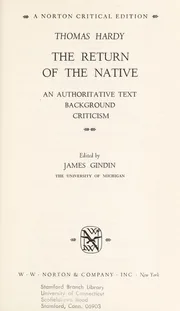
Suits mature teens and adults who enjoy classic literature and slower, descriptive novels.
470 pages, about 7.5 to 11 hours.
Hardy's heath novel of a bad marriage and slow ruin. 50% taste match
The story
Thomas Hardy's sixth published novel, The Return of the Native, appeared in 1878 and is set on the heathland of Wessex in nineteenth-century England. It was first issued in twelve monthly instalments in the magazine Belgravia, running from January to December of that year. The book belongs to the romance category and centers on love, marriage, and the choices people make in pairing off.
The title refers to Clym Yeobright, who comes back to his home district after living in Paris. Soon after his return he falls for Eustacia Vye and marries her, a union that brings hardship to those involved. The story also follows the bond between a mother and her son, along with questions of adultery and the strains placed on married people. A character with a visual disability figures in the narrative as well.
Hardy draws on country life, local manners and customs, and the social conditions of the period to portray a rural community and the people who live on its heath.
Setting
Wessex (England)Great BritainEngland
Period
19th century
Themes
Return of the native (HardyThomas)Social conditionsSocial life and customsCountry lifeManners and customsVillagesromance
- Want to read 129
- Reading now 8
- Read 13
Most people shelving it are saving it for later.
Of 150 readers who put it on a shelf, 86% want to read it, 5% are reading it now, 9% have finished it and 0% stopped before the end.
By the numbers
- The median edition runs 470 pages. Counting about 275 words a page and an adult reading pace of 250 words a minute, that is about 8.6 hours of reading.
- Open Library tracks 205 editions from 95 publishers, the earliest dated 1878 and the latest 2022, across 6 languages.
- On reader demand it ranks in the top 12% of the classic books in our catalog (8,749 of them).
- Libraries shelve it under Dewey 823.8 and Library of Congress class PR-4747.00000000 A1 1928.
 BookWard’s take
Hardy's heath novel of a bad marriage and slow ruin
The Return of the Native takes a long, patient look at what happens when Clym Yeobright comes back from Paris and marries Eustacia Vye on the heath of Wessex. It's a book that divides readers. Hardy builds slowly rather than hooking you at once, and at 470 pages it asks for a settled reader who isn't in a hurry. But the people are where it earns its place: they're drawn with weight, and what they do has consequences. The ending is more resolved than ambiguous, and the darkness comes from choices and character rather than shock for effect. The heath itself is described so richly that it becomes close to a character in its own right. It's a classic worth reading for the people, if you can accept the unhurried build.
At 470 pages it is a full, unhurried novel, much longer than BookWard's taste for tight books.
The telling is measured and deliberate, well short of the speed BookWard enjoys.
The heath setting and its fate-laden mood feel distinctive, even where the romance plot is familiar.
The writing is richly worked and literary, more ornate than BookWard's middle ground.
The drama grows out of who these people are and the choices they make.
Hardy leans toward hardship and consequence, with only a little relief at the close.
The book follows a conventional, linear course across its parts.
The tone is serious throughout, with little room for comedy.
It deals with hardship, adultery and loss, but without gratuitous grimness.
The suffering lands with feeling, though Hardy keeps a formal, measured hand.
See all 50 dialsEvery position, side by side with this book
Where it lines up
- Authorial voiceBookWard 9 · book 9
- Character depthBookWard 8 · book 9
- EndingBookWard 8 · book 7
Where it pulls apart
- LengthBookWard 1 · book 8
- OpeningBookWard 10 · book 3
- Familiar tropesBookWard 10 · book 6
At 470 pages it is a full, unhurried novel, much longer than BookWard's taste for tight books.
Hardy settles into his setting before the story pulls hard, a slower start than BookWard prefers.
Its pairing-off plot is a familiar romance shape, though Hardy's treatment gives it weight.
Events follow from character and circumstance, which suits BookWard's liking for causes that hold.
The telling is measured and deliberate, well short of the speed BookWard enjoys.
The heath setting and its fate-laden mood feel distinctive, even where the romance plot is familiar.
Clym and Eustacia are drawn with real weight, matching what BookWard values most in people on the page.
The story reaches a settled close that eases the suffering somewhat, closer to resolved than open.
Hardy feels deeply but keeps the telling serious, so it sits mid-way, a little warmer than BookWard prefers.
The hardship follows from the marriage and the choices people make, so the darkness is earned.
This is fiction, so the rigor dial does not apply.
Hardy's narration and landscape-heavy manner are unmistakably his, which BookWard rewards.
It is story-led, built on a marriage and a family, though its themes are never far away.
Hardy often explains setting and character outright, more than BookWard's love of showing in scene.
With such a measured pace the middle can slow, though the marriage keeps tension alive.
The writing is richly worked and literary, more ornate than BookWard's middle ground.
The drama grows out of who these people are and the choices they make.
Hardy leans toward hardship and consequence, with only a little relief at the close.
The book follows a conventional, linear course across its parts.
The tone is serious throughout, with little room for comedy.
Dense period prose and a long, slow build ask real effort of the reader.
The story moves between several central people, not a single viewpoint.
Events unfold in order, with no jumping around in time.
The world is grounded in real country life and a Wessex heath.
A small village circle is at the heart of it, not a sprawling crowd.
The story is intimate, centered on a family, a marriage and a single district.
Much of the weight lies in feelings and relationships, not in action.
Conversation carries a fair share of the drama, balanced by narration and description.
Love, marriage and its strains drive the plot, though it is a hard-edged romance.
The Victorian heath will feel distant, but it is rendered with enough detail to become familiar.
It is set in the nineteenth century and reads as historical to a modern reader.
It has lasted well, its questions of love and marriage still recognizable.
Hardy's narrator is direct and reliable, guiding you through events without tricking you.
Hardy asks you to sympathize with flawed people, which leaves blame unclear.
Hardy's picture of the heath is rich and central to the book's mood.
This is fiction, so the nonfiction style dial does not apply.
This is fiction, so the perspective dial does not apply.
It stands on its own as a single novel.
Events turn on fate and consequence, with some turns but few shocks of plot.
It does not comfort, asking you to sit with disappointment and loss.
It deals with hardship, adultery and loss, but without gratuitous grimness.
The suffering lands with feeling, though Hardy keeps a formal, measured hand.
Any humor is gentle and dry, with no broad comedy.
Violence is minimal, with the drama living in relationships and consequence.
Desire is present as a force but handled with Victorian restraint.
Social conditions sit in the background rather than driving the story.
Rustic speech and period diction make the language somewhat dense in places.
Hardy's narrator comments freely on his people and their fate.
The book is rooted in tradition and place, looking back more than forward.
Hardy's outlook is closer to cynical, as fate and temperament undo hopes.
Review written by BookWard, dial version 1, November 2026.
Who is The Return of the Native right for?
Suits mature teens and adults who enjoy classic literature and slower, descriptive novels. It deals with adultery, family conflict and loss, handled in a restrained Victorian manner.
Dense period prose and a long, slow build ask real effort of the reader.
It deals with hardship, adultery and loss, but without gratuitous grimness.
The suffering lands with feeling, though Hardy keeps a formal, measured hand.
Violence is minimal, with the drama living in relationships and consequence.
Book CompanionThe Return of the Native: ideas, characters, themes
A man returns to his home heath from Paris, marries the wrong woman, and the strain of that choice reaches his whole family.
- A return home. Clym Yeobright comes back to his home district after living in Paris, and the book is built on that return.
- The marriage. He quickly falls for Eustacia Vye and marries her, a union that brings hardship.
- Mother and son. The bond between a mother and her son is a central strand, tested by the marriage.
- Marriage under strain. Adultery and the pressures on married people are part of the story.
- The heath itself. Country life, customs and the Wessex landscape give the setting its force.
Characters
Clym Yeobright
The native who returns
He comes back to his home district from Paris and marries Eustacia Vye.
Eustacia Vye
Clym's wife
The woman Clym marries, whose union with him brings suffering.
Themes
What it costs to come back to a place and a life you once left.
How the choice of a partner shapes everyone around you.
The pull and strain between a mother and her son.
How place and temperament limit what people can do.
How a rural community's habits and judgments weigh on its people.
Discussion questions
- Why does Clym's return from Paris set so much in motion?
- Is the marriage doomed by character, by circumstance, or by both?
- How does the heath work as more than a backdrop?
- Do you sympathize more with Clym or with Eustacia, and why?
- Does the ending feel earned given the suffering before it?
Personalize your Book Companion
This is the general edition. In BookWard, the Companion is written for you: your reading profile, your notes, and spoiler-safe to the page you are on.
Buy, listen or borrow The Return of the Native
Each link opens a search for this book on that store, in a new tab.
Read on a device
Borrow
Reviews and community
If you liked The Return of the Native
Hardy's pastoral love triangle, slow in the telling but sure-footed
Lust for LifeIrving StoneA long, devoted life of Van Gogh, told as fiction
The Age of InnocenceEdith WhartonA quiet drawing-room tragedy that cuts deeper than it first appears
Narziss und GoldmundHermann HesseTwo opposite men, one friendship, and a debate Hesse refuses to settle
Sources: Open Library.
Track The Return of the Native and find your next favorite
Add it to your shelf, rate what you have read, and BookWard will recommend what fits you.
Free to start. No credit card needed.