Suited to mature teens and adults interested in spiritual and philosophical questions.
139 pages, about 2 to 3 hours.
A slim, musical parable of one man's search for wisdom. 57% taste match
What it covers
Siddhartha is a short novel by Hermann Hesse, first published in 1922 and written in German. Set in India during the time of Gautama Buddha, it follows a man named Siddhartha on a spiritual journey of self-discovery. The story opens with Siddhartha as a Brahmin's son growing up beside the river with his friend Govinda, and it traces his search for enlightenment from there. Hesse drew on his own travels to India in the 1910s, and the book is often read as an allegory about the finding of wisdom.
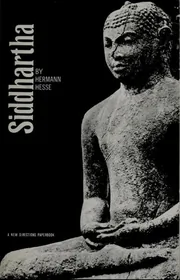
The novel was Hesse's ninth and is told in a plain, musical style. Its two parts carry separate dedications, the first to the French writer Romain Rolland and the second to Wilhelm Gundert, Hesse's cousin. New Directions Publishing brought it out in the United States in 1951, and it became influential during the 1960s. Classed as fiction with Buddhism and Buddhist philosophy at its center, it runs to about 139 pages in the typical edition.
In the shade of the house, in the sunshine on the river bank by the boats, in the shade of the sallow wood and the fig tree, Siddhartha, the handsome Brahmin's son, grew up with his friend Govinda.
Characters
Gautama BuddhaBuddha
Setting
IndiaInde
Period
Early period, to ca. 250 B.C.
Themes
AlegoríasBuddha (The concept)Buddha and BuddhismBuddhismBuddhist PhilosophyBudismoChrestomathies and readersClassic Literature
- Want to read 1,130
- Reading now 96
- Read 156
- Stopped 1
Most people shelving it are saving it for later.
Of 1383 readers who put it on a shelf, 82% want to read it, 7% are reading it now, 11% have finished it and 0% stopped before the end.
By the numbers
- The median edition runs 139 pages. Counting about 275 words a page and an adult reading pace of 250 words a minute, that is about 2.5 hours of reading.
- Open Library tracks 209 editions from 126 publishers, the earliest dated 1922 and the latest 2024, across 11 languages.
- On reader demand it ranks in the top 1% of the classic books in our catalog (8,749 of them).
- Libraries shelve it under Dewey 838 and Library of Congress class PT-2617.00000000.E85 Z459 2005eb.
 BookWard’s take
A slim, musical parable of one man's search for wisdom
Siddhartha is a short book that does a lot with a little. At about 139 pages, Hesse's 1922 novel stays tight and brief, which suits a reader who likes economy. The prose is plain and musical rather than ornate, and its staying power is real: a century on, it still reads as fresh as it did when it became influential in the 1960s. Where it loses some of its grip is in the exposition. This is a parable, so ideas are often stated outright rather than dramatized, and the book leans toward ideas more than story. Still, the pace is brisk and the characters gain depth through a single life traced across many stages. A compact classic that rewards a slow second look.
At about 139 pages it is among the shortest serious novels around, which matches BookWard's love of tight books exactly.
It moves briskly through years of one man's life in very few pages, rarely lingering.
A German novel set in ancient India, written after Hesse's own travels, it blends traditions in a way few books do.
The style is simple and lyrical, with enough music to lift it without becoming ornate.
A single seeker's inner growth carries the book, with events serving his development.
The search ends in a sense of peace, so the book leans hopeful even through its struggles.
It is built as two parts and a series of life stages, formal but not experimental.
This is a serious, contemplative book with very little comedy.
Its spiritual crises are real, but the book is more serene than grim.
The feeling runs deep but is expressed in a calm, measured way.
See all 50 dialsEvery position, side by side with this book
Where it lines up
- LengthBookWard 1 · book 1
- EndingBookWard 8 · book 8
- Authorial voiceBookWard 9 · book 9
Where it pulls apart
- OpeningBookWard 10 · book 6
- Familiar tropesBookWard 10 · book 6
- Story or ideasBookWard 3 · book 8
At about 139 pages it is among the shortest serious novels around, which matches BookWard's love of tight books exactly.
It opens quietly beside a river with a Brahmin's son and his friend, so the pull is gentle rather than immediate.
The spiritual-quest frame is old and familiar, but Hesse's treatment of it feels personal rather than formulaic.
Its allegorical structure holds together, each stage of the journey following naturally from the last.
It moves briskly through years of one man's life in very few pages, rarely lingering.
A German novel set in ancient India, written after Hesse's own travels, it blends traditions in a way few books do.
Siddhartha is drawn through change and searching, though the book works more as parable than psychological portrait.
The search reaches a clear arrival, which leaves the book feeling resolved rather than left hanging.
The tone leans toward gentle reverence, warmer than BookWard's restrained taste but never syrupy.
There is little shock for effect; the book's difficulties come from the search itself, not from provocation.
This is a novel, so the nonfiction rigor dial does not apply.
The plain, lyrical, musical style is unmistakably Hesse and hard to confuse with anyone else.
Ideas about wisdom and experience drive the book more than plot does, a step beyond BookWard's story-led preference.
The book often explains its meaning outright, which runs against BookWard's liking for showing in scene.
At this length there is no room to sag, and the momentum holds across both parts.
The style is simple and lyrical, with enough music to lift it without becoming ornate.
A single seeker's inner growth carries the book, with events serving his development.
The search ends in a sense of peace, so the book leans hopeful even through its struggles.
It is built as two parts and a series of life stages, formal but not experimental.
This is a serious, contemplative book with very little comedy.
The language is easy to read, though the ideas reward slow, careful attention.
The story stays close to one man's journey rather than shifting between perspectives.
It follows one life from youth onward in order, so the timeline is essentially linear.
Grounded in a realistic India, with an allegorical tone rather than anything supernatural.
A few key figures, among them Siddhartha and his friend Govinda, carry the story.
The setting spans a country and a lifetime, yet the focus stays close to one person.
The real action happens inside Siddhartha as he searches, more than in outward events.
Conversation matters in key moments, but the book is mostly narration and reflection.
Romance is a minor thread in a book mostly about spiritual searching.
Ancient India in the time of Gautama Buddha will feel unfamiliar to most readers.
It is set in the distant past, in the time of the Buddha.
Read widely after the 1960s, it has stayed in print for a century and still feels current.
The narration is steady and trustworthy, guiding the reader plainly through the journey.
The book has a clear spiritual direction, though it avoids simple lessons.
Rivers and landscapes are sketched with care, but the prose stays spare rather than lush.
A single self-contained novel with no sequels.
The path is a gradual unfolding of a life, not a string of reversals.
Its questions about suffering and wisdom invite real reflection rather than offering easy comfort.
Its spiritual crises are real, but the book is more serene than grim.
The feeling runs deep but is expressed in a calm, measured way.
Violence is almost absent from its pages.
Desire appears as part of Siddhartha's experience but is treated with restraint.
Political concerns stay in the background of a spiritual story.
The prose is clear and plain, easy on the reader.
The narration carries a clear spiritual outlook, guiding the reader toward its view of wisdom.
It looks back to the world of the Buddha, though its questions are timeless.
It believes in the possibility of wisdom and peace, an openly idealistic stance.
Review written by BookWard, dial version 1, November 2026.
Who is Siddhartha right for?
Suited to mature teens and adults interested in spiritual and philosophical questions. It touches on desire and suffering in a restrained way, with little graphic content.
The language is easy to read, though the ideas reward slow, careful attention.
Its spiritual crises are real, but the book is more serene than grim.
The feeling runs deep but is expressed in a calm, measured way.
Violence is almost absent from its pages.
Book CompanionSiddhartha: ideas, characters, themes
Wisdom cannot be handed over by teachers; each person must find it by living through experience.
- A journey told as allegory. Siddhartha's search through India works as a parable about finding wisdom, set in the time of Gautama Buddha.
- Two dedicated parts. Hesse dedicated the first part to Romain Rolland and the second to his cousin Wilhelm Gundert.
- Born of travel. Hesse wrote it after his travels to India in the 1910s, and that experience shapes its setting.
- A plain, musical style. The book is told in simple, lyrical language that keeps its big themes approachable.
- A 1960s favorite. After New Directions published it in the United States in 1951, it grew influential during the 1960s.
Characters
Siddhartha
Protagonist
A Brahmin's son who leaves home on a search for enlightenment.
Govinda
Friend
Siddhartha's friend from his youth beside the river.
Themes
Finding truth through one's own experience rather than through borrowed teaching.
The goal of the search, understood here through Buddhist ideas.
The bond between Siddhartha and Govinda, which frames the early journey.
The tension between what can be taught and what must be lived.
Discussion questions
- Why might Hesse present Siddhartha's search as an allegory rather than a realistic life story?
- Can wisdom be taught, or only discovered? What does the book suggest?
- How does the friendship with Govinda shape the opening of the story?
- What does the plain, musical style add to the book's themes?
- Why do you think this book became so influential in the 1960s?
Personalize your Book Companion
This is the general edition. In BookWard, the Companion is written for you: your reading profile, your notes, and spoiler-safe to the page you are on.
Buy, listen or borrow Siddhartha
Each link opens a search for this book on that store, in a new tab.
Read on a device
Borrow
Reviews and community
If you liked Siddhartha
Twenty-six short sermons on living, for a quiet afternoon
Paul KleePaul KleeA compact look at Klee, from Blaue Reiter to the Bauhaus
Narziss und GoldmundHermann HesseTwo opposite men, one friendship, and a debate Hesse refuses to settle
DemianHermann HesseA quiet boy, a mysterious classmate, and a search for self
Sources: Open Library.
Track Siddhartha and find your next favorite
Add it to your shelf, rate what you have read, and BookWard will recommend what fits you.
Free to start. No credit card needed.