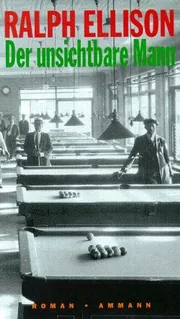
Invisible Man
by Ralph Ellison · 1952
It suits mature teens and adults who are ready for dense, demanding prose and serious themes.
480 pages, about 7.5 to 11 hours.
A restless, original classic about identity, race, and being unseen. 61% taste match
The story
Invisible Man is a novel by Ralph Ellison, first published in 1952 and opening with the line "I am an invisible man." It is Ellison's first novel and the only one released during his lifetime. The book won the National Book Award for fiction in 1953 and is counted among the classics of American literature. It runs to roughly 480 pages and has appeared in around 60 editions.
The narrator is a young Black man from the South who leaves for college full of hope, then ends up in Harlem, where he becomes a spokesman for a political organization called the Brotherhood. The story follows his encounters with racism, with questions of personal identity, and with the tensions of urban life in New York. It draws on issues faced by African Americans in the early twentieth century, including Black nationalism, Marxism, and the racial policies associated with Booker T. Washington. Told in psychological fiction mode, it is framed as the narrator's own written account, composed from a place of solitude.
I am an invisible man.
Setting
United StatesNew York (State)New YorkHarlem
Themes
African American menAfrican AmericansRace relationsLong Now Manual for CivilizationSocial conditionsMentally illScientistsClassics
- Want to read 437
- Reading now 22
- Read 30
Most people shelving it are saving it for later.
Of 489 readers who put it on a shelf, 89% want to read it, 4% are reading it now, 6% have finished it and 0% stopped before the end.
By the numbers
- The median edition runs 480 pages. Counting about 275 words a page and an adult reading pace of 250 words a minute, that is about 8.8 hours of reading.
- Open Library tracks 60 editions from 36 publishers, the earliest dated 1952 and the latest 2022, across 3 languages.
- On reader demand it ranks in the top 3% of the classic books in our catalog (8,749 of them).
- Libraries shelve it under Dewey 813.54 and Library of Congress class PS-3555.00000000.L625 I5 1952.
 BookWard’s take
A restless, original classic about identity, race, and being unseen
Invisible Man opens with its famous line, "I am an invisible man," and earns it within the first pages. The voice is unmistakable from the start: Ellison's narrator sounds like no one else. The book is just as original. It moves from a Southern college to Harlem politics and keeps surprising you, and it leans on familiar tropes hardly at all. It is driven by ideas, with Marxism, Black nationalism, and identity argued through scenes rather than lectures. The prose is richer and more ornate than I usually like, and the reading takes real effort, but the pace of events and a sustained middle hold it together. It won the National Book Award in 1953, and it remains demanding in the best sense.
At roughly 480 pages it is a long novel, well past BookWard's preference for tight and short.
Episodes move briskly but the book lingers in speeches and reflection, a notch slower than BookWard's fast preference.
Few novels read like this one, mixing realism, satire, and surreal set pieces, squarely what BookWard rewards.
Ellison's language is rich, rhythmic, and often ornate, more elaborate than BookWard's middle-leaning taste.
Events matter, but the narrator's changing understanding of himself drives the book, near BookWard's character-led leaning.
It faces bleak truths yet ends with the narrator vowing to re-enter the world, balanced between despair and hope.
A written account that moves episode to episode with dreamlike turns is somewhat more adventurous than conventional.
Bitter satire runs through the book, but the overall tone stays serious.
Racism, humiliation, and civil unrest give it a grim weight, though not unrelieved.
The narrator's anger, confusion, and longing run hot throughout.
See all 50 dialsEvery position, side by side with this book
Where it lines up
- Character depthBookWard 8 · book 8
- SentimentBookWard 8 · book 8
- OpeningBookWard 10 · book 9
Where it pulls apart
- LengthBookWard 1 · book 7
- Internal logicBookWard 10 · book 6
- Story or ideasBookWard 3 · book 7
At roughly 480 pages it is a long novel, well past BookWard's preference for tight and short.
It opens with the declaration "I am an invisible man," a first line that grabs at once, matching BookWard's taste.
It reworks the coming-of-age and political-awakening shapes into something strange and its own, which BookWard values highly.
The narrator's world runs on a dreamlike, symbolic logic rather than strict cause and effect, looser than BookWard's airtight ideal.
Episodes move briskly but the book lingers in speeches and reflection, a notch slower than BookWard's fast preference.
Few novels read like this one, mixing realism, satire, and surreal set pieces, squarely what BookWard rewards.
The narrator is drawn from the inside across his whole journey, close to BookWard's liking for deeply drawn people.
The framing of a written account ends with resolve rather than tidy closure, a little looser than BookWard prefers.
Ellison favors irony and hard edges over comfort, which suits BookWard's restrained taste.
The harshest scenes serve the argument about race and identity rather than existing for effect.
The narrator's voice is distinctive and commanding from line one, as BookWard loves.
Story carries the book, yet it is built to test ideas about identity and politics, more idea-led than BookWard's usual taste.
Ideas surface through scenes, encounters, and speeches more than direct explanation, close to BookWard's show-it preference.
The episodic structure keeps fresh incidents arriving, so the middle stays energized as BookWard likes.
Ellison's language is rich, rhythmic, and often ornate, more elaborate than BookWard's middle-leaning taste.
Events matter, but the narrator's changing understanding of himself drives the book, near BookWard's character-led leaning.
It faces bleak truths yet ends with the narrator vowing to re-enter the world, balanced between despair and hope.
A written account that moves episode to episode with dreamlike turns is somewhat more adventurous than conventional.
Bitter satire runs through the book, but the overall tone stays serious.
Dense ideas, symbolism, and long speeches ask real attention, more demanding than BookWard's usual taste.
Everything is filtered through one narrator, far from BookWard's liking for many viewpoints.
The story proceeds largely in order, framed by the narrator writing from his underground refuge.
Rooted in real American life but shaped by surreal, dreamlike episodes, it drifts beyond strict realism.
The narrator meets many figures from college to Harlem, a fairly broad cast around one center.
One man's life moves through institutions, politics, and a city, a wider canvas than a purely intimate story.
The narrator's self-examination matters more than any action, pulling it toward inner thoughts.
Speeches, arguments, and confrontations are central, though narration still carries a lot.
Romance is incidental to the larger story of identity and politics.
Southern college life, Harlem politics, and an underground refuge mix the real and the strange.
Set in the early twentieth century and published in 1952, it is firmly a period piece.
Its questions about identity and being unseen still land, making it a lasting classic.
The narrator tells his own story with force, yet he is a self-mythologizing, shifting witness, a bit unreliable.
It refuses easy answers about race, politics, and loyalty, leaving judgments openly contested.
Scenes are drawn with rich, vivid detail, from city streets to strange set pieces.
A standalone novel, and Ellison's only one published in his lifetime.
The narrator's path takes sharp, unexpected turns from one setting and role to the next.
It confronts racism and identity head-on and leaves the reader unsettled rather than comforted.
Racism, humiliation, and civil unrest give it a grim weight, though not unrelieved.
The narrator's anger, confusion, and longing run hot throughout.
Humor tends toward sharp irony and satire rather than slapstick.
There are scenes of brutality and a riot, but violence is not the focus.
Sexual content appears but is limited and not central.
The Brotherhood, Marxism, and Black nationalism put politics at the center.
Dense, allusive language and period speech make it harder going than plain prose.
The narrator argues, accuses, and reflects openly, so the voice is far from neutral.
It reckons with history and the narrator's past even as he resolves to re-enter the world.
Idealism is tested and often punished here, so the book leans cynical, though not wholly.
Review written by BookWard, dial version 1, November 2026.
Who is Invisible Man right for?
It suits mature teens and adults who are ready for dense, demanding prose and serious themes. It deals frankly with racism, humiliation, and violence, so some readers may want context first.
Dense ideas, symbolism, and long speeches ask real attention, more demanding than BookWard's usual taste.
Racism, humiliation, and civil unrest give it a grim weight, though not unrelieved.
The narrator's anger, confusion, and longing run hot throughout.
There are scenes of brutality and a riot, but violence is not the focus.
Book CompanionInvisible Man: ideas, characters, themes
A young Black man discovers that society sees only what it expects of him, and must find an identity of his own.
- The famous opening. The novel begins with the narrator announcing "I am an invisible man," setting up its central metaphor at once.
- From the South to Harlem. A hopeful young man leaves for college, is expelled, and moves to Harlem, where his understanding of the world keeps shifting.
- The Brotherhood. In Harlem he becomes a spokesman for a political organization called the Brotherhood, which tests his beliefs.
- A written account. The story is framed as the narrator's own account, written from a place of solitude.
- A landmark book. It won the National Book Award for fiction in 1953 and is counted among the classics of American literature.
Characters
The narrator
Protagonist
A young Black man from the South who is never named and searches for who he really is.
Themes
Being seen only through other people's expectations rather than as yourself.
The struggle to define who you are apart from the roles others assign.
How prejudice shapes opportunity, self-image, and daily life.
The pull and the cost of belonging to movements that promise answers.
The tension between personal freedom and the demands of a group.
Discussion questions
- What does the narrator mean when he says he is invisible, and is it his choice?
- How does his time in the Brotherhood change what he believes?
- Why might Ellison frame the book as a written account from solitude?
- Which scenes feel realistic and which feel dreamlike, and why does that mix matter?
- What does the narrator's vow to re-enter the world say about the book's outlook?
Personalize your Book Companion
This is the general edition. In BookWard, the Companion is written for you: your reading profile, your notes, and spoiler-safe to the page you are on.
Buy, listen or borrow Invisible Man
Each link opens a search for this book on that store, in a new tab.
Read on a device
Borrow
Reviews and community
If you liked Invisible Man
A nation's birth told through one voice, huge and unruly
V for VendettaAlan MooreA masked saboteur takes on a fascist Britain, with eyes open
Poor ThingsAlasdair GrayGray's Glasgow Frankenstein, where the narrator may be lying
The End of EverythingM. John HarrisonA strange Kent tideline, and an object that won't hold still
Sources: Open Library.
Track Invisible Man and find your next favorite
Add it to your shelf, rate what you have read, and BookWard will recommend what fits you.
Free to start. No credit card needed.