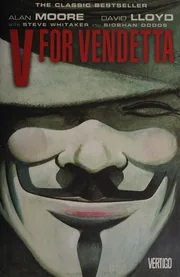
V for Vendetta
by Alan Moore, David Lloyd · 1988
Best suited to mature teens and adults.
296 pages, about 4.5 to 7 hours.
A masked saboteur takes on a fascist Britain, with eyes open. 62% taste match
The story
V for Vendetta is a graphic novel by Alan Moore, illustrated by David Lloyd, first published in 1988. It belongs to the crime and mystery side of comics and also sits within English science fiction, with politics and government at its center. The story is set in a near-future Britain of the 1990s, where a regime has taken control after a nuclear war that left much of the world in ruins. The ruling party, Norsefire, governs through police power and has put its opponents in camps.
Against this backdrop, a masked figure in a white porcelain face acts against the state, using terrorism and strange, theatrical stunts. The narrative opens with a radio broadcast addressed to London, and England is its main stage. Ideas of anarchism, totalitarianism, and the loss of personal freedom run through the book. It first appeared as a serial in the British anthology Warrior before DC Comics brought it out in the United States, and it has since been reissued in many editions, running to roughly 296 pages.
"Good evening, London. It's nine o'clock and this is the Voice of Fate broadcasting on 275 and 285 in the medium wave...it is the fifth of the eleventh, nineteen-ninety-seven."
Setting
Great BritainEngland
Period
1979-1997
Themes
Graphic novelsComic books, stripsPolitics and governmentAnarchismTotalitarianismComics & graphic novels, crime & mysteryLiteratureNew York Times bestseller
- Want to read 233
- Reading now 8
- Read 139
Readers are split between finishing it and saving it for later.
Of 380 readers who put it on a shelf, 61% want to read it, 2% are reading it now, 37% have finished it and 0% stopped before the end.
By the numbers
- The median edition runs 296 pages. Counting about 275 words a page and an adult reading pace of 250 words a minute, that is about 5.4 hours of reading.
- Open Library tracks 36 editions from 21 publishers, the earliest dated 1988 and the latest 2023, across 5 languages.
- On reader demand it ranks in the top 1% of the modern books in our catalog (15,152 of them).
- Libraries shelve it under Dewey 741.5942 and Library of Congress class PN-6737.00000000.M66 A64 2009.
 BookWard’s take
A masked saboteur takes on a fascist Britain, with eyes open
V for Vendetta pits a theatrical terrorist in a white porcelain mask against Norsefire, a police-state government built on camps and control. It opens with a radio broadcast to London and moves with real drive. It still feels original: Moore and Lloyd's anarchist-versus-state setup is very much its own thing. Morally, it refuses to settle, and that is to its credit, because the book keeps asking whether its hero is liberator or menace. The politics are front and center, yet the ideas are argued through scenes and images, not lectures. I'd have liked a tighter book, though. At about 296 pages, it asks for patience in its quieter stretches. It is dense, serious and morally uneasy, which is the point.
At 296 pages with illustrated panels, it is substantial but not sprawling, a little longer than BookWard's tight ideal.
Propulsive when V acts, slower when the book lingers on the regime and its people, a touch under BookWard's quick preference.
Its anarchist protagonist and political framing stood apart from standard comics, and BookWard rates that freshness highly.
Dialogue and captions lean literary and stylised, richer than plain, close to BookWard's mild preference.
Plot and character share the load, with V's schemes driving events and the cast giving them cost.
The world is oppressive and the book is grim, though resistance offers a thread of possibility.
A comics format with layered sequences and recurring motifs, somewhat more adventurous than conventional storytelling.
It is a serious book, with only occasional dark, theatrical wit.
See all 50 dialsEvery position, side by side with this book
Where it lines up
- OriginalityBookWard 9 · book 9
- SentimentBookWard 8 · book 8
- Authorial voiceBookWard 9 · book 9
Where it pulls apart
- LengthBookWard 1 · book 4
- Internal logicBookWard 10 · book 7
- Story or ideasBookWard 3 · book 7
At 296 pages with illustrated panels, it is substantial but not sprawling, a little longer than BookWard's tight ideal.
A radio broadcast to London opens the book and sets the stakes straight away, which suits BookWard's taste for an immediate pull.
A masked rebel against a regime is a known shape, but Moore avoids the usual hero beats, which BookWard values.
The regime's rise and methods hold together within the story's world, though some leaps ask for goodwill.
Propulsive when V acts, slower when the book lingers on the regime and its people, a touch under BookWard's quick preference.
Its anarchist protagonist and political framing stood apart from standard comics, and BookWard rates that freshness highly.
V stays deliberately masked, but the people around him are drawn with weight, close to what BookWard wants.
The central conflict reaches a firm conclusion, which fits BookWard's liking for resolution.
The book is cold-eyed and uninterested in easy comfort, which BookWard approves of.
Its brutality serves the argument about power instead of existing for effect, in line with BookWard's taste.
Moore's voice and Lloyd's stark visual style are unmistakable, a strong match for BookWard's love of distinct authorship.
Story carries the book, but it is built to provoke arguments about freedom and control, tilting it toward ideas.
The momentum mostly holds, with a few slower sequences that give the book room to think.
Dialogue and captions lean literary and stylised, richer than plain, close to BookWard's mild preference.
Plot and character share the load, with V's schemes driving events and the cast giving them cost.
The world is oppressive and the book is grim, though resistance offers a thread of possibility.
A comics format with layered sequences and recurring motifs, somewhat more adventurous than conventional storytelling.
It is a serious book, with only occasional dark, theatrical wit.
Dense political ideas and layered imagery ask for attention, more than the average graphic novel.
Several people inside the regime and outside it carry sections of the story, giving a broad view.
It is a grounded near-future England, with no supernatural machinery.
A sizable range of officials, citizens and resisters fills the book, more than an intimate tale would need.
The focus is one country and its people, with national stakes but a personal feel.
The book balances public action and private conflict about evenly.
A Britain under a police state is an unfamiliar version of a familiar place.
Written in the 1980s and set in a near-future 1990s, it belongs to its past, though the themes still read as current.
Its questions about power and freedom have kept it in print and in argument for decades.
V's methods and the regime's cruelty are both put in question, leaving the reader to judge.
Lloyd's stark, atmospheric panels deliver rich visual detail that sets the mood.
Review written by BookWard, dial version 1, November 2026.
Who is V for Vendetta right for?
Best suited to mature teens and adults. It contains state violence, camps, and brutality, and its political themes are serious and unsettling.
Dense political ideas and layered imagery ask for attention, more than the average graphic novel.
Book CompanionV for Vendetta: ideas, characters, themes
A masked figure's campaign against a police-state Britain asks whether freedom can be won by methods that look like the oppression it fights.
- A regime built on fear. The ruling party, Norsefire, governs through police power after a nuclear war, and has put its opponents in camps.
- The mask as symbol. V's white porcelain face makes him more idea than man, a figure others can project onto.
- Theatrical resistance. His attacks are staged, symbolic and strange, aimed at the regime's authority as much as its buildings.
- Voice of the state. The opening radio broadcast to London shows how the regime talks to its people, and how control is spoken aloud.
- Word and image together. Moore's writing and Lloyd's stark art work as one, with the visuals carrying mood and meaning.
Characters
V
masked figure
A man in a white porcelain mask who acts against the state through terrorism and theatrical stunts.
Themes
How a government can take control of a whole society and what that does to ordinary people.
The belief that people could live without rulers, and the book's testing of that idea.
What it costs when personal and political liberty are taken away.
Whether fighting oppression can be done without becoming a darker version of it.
The struggle to remain a person when the state wants conformity.
Discussion questions
- Is V a hero, a villain, or something the book refuses to settle?
- Why might the author keep V behind a mask?
- How does the regime's way of speaking to its people shape how it holds power?
- Do V's methods undercut the freedom he says he is fighting for?
- Which parts of this future feel closest to the world you know?
Personalize your Book Companion
This is the general edition. In BookWard, the Companion is written for you: your reading profile, your notes, and spoiler-safe to the page you are on.
Buy, listen or borrow V for Vendetta
Each link opens a search for this book on that store, in a new tab.
Read on a device
Borrow
Reviews and community
If you liked V for Vendetta
A hunted, drinking priest and the faith he cannot shed
The Windup GirlPaolo BacigalupiA brutal, brilliant future Bangkok where calories are the currency
The Spirit Catches You and You Fall DownAnne FadimanA child's illness becomes a study of two worlds colliding
EvictedMatthew DesmondEight Milwaukee households, and the profit made from their rent
Sources: Open Library.
Track V for Vendetta and find your next favorite
Add it to your shelf, rate what you have read, and BookWard will recommend what fits you.
Free to start. No credit card needed.