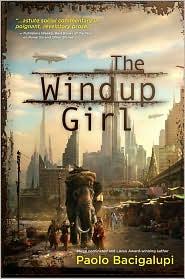
The Windup Girl
by Paolo Bacigalupi
★ Top 25 book of 2009 · #24 on Best Books of 2009
Set in a world where bio-terrorism serves corporate profit, this novel explores how such tactics might push humanity toward a post-human future. It returns to the universe of two earlier award-recognized short stories.
Best for: Science fiction fans interested in biotech, corporate power and human evolution
The Windup Girl is #24 on BookWard's Best Books of 2009, out of 42 2009 books that cleared our data bar.
What The Windup Girl is about
Bangkok in a future shaped by climate change and engineered biology is the setting for Bacigalupi's first novel. Thailand has kept its independence from the powerful calorie companies by guarding its seedbank, and outsiders are determined to find it. Anderson Lake works for AgriGen and runs a factory as cover for the search. His manager, Hock Seng, a refugee with his own scheme, plans to steal the factory's designs.
Emiko is a windup girl, a genetically modified human built to serve and then abandoned in the city. Meanwhile Jaidee, a zealous captain of the Environment Ministry's White Shirts, and his protégé Kanya enforce the country's defenses as a new plague begins to spread. Dark, gritty and richly atmospheric, it asks who controls food, who pays for progress and what becomes of those made to obey. It suits readers of thoughtful science fiction.
The Windup Girl on the Best Books of 2009
The Windup Girl came out in 2009. Of the 42 books first published in 2009 that met BookWard's data bar, it ranks #24 on our Best Books of 2009 list.
Why it made the list: 233 readers have shelved it on Open Library; readers rate it 4 out of 5 (50 ratings). The list ranks each year’s books on how many readers have picked them up, how highly readers rate them, and how many are reading them right now.
Nearby on the 2009 list
- The Gathering Storm Robert Jordan, #22
- Too Big to Fail Andrew Ross Sorkin, #23
See all Best Books of 2009 Best books by year
More years: Best Books of 2008 Best Books of 2010.
The numbers behind it
- Readers: 158 want to read it, 6 are reading it now and 69 have read it, according to Open Library.
- Ratings: 4 out of 5 from 50 Open Library ratings.
| Signal | This book (0 to 100) | Weight |
|---|---|---|
| Reach | 40 | 55% |
| Reader love | 62 | 25% |
| Being read right now | 19 | 20% |
Questions about The Windup Girl
When was The Windup Girl published?
The Windup Girl by Paolo Bacigalupi was first published in 2009.
Was The Windup Girl one of the best books of 2009?
The Windup Girl is #24 on BookWard's Best Books of 2009, out of 42 2009 books that cleared our data bar. 233 readers have shelved it on Open Library; readers rate it 4 out of 5 (50 ratings).
Why is The Windup Girl on the Best Books of 2009 list?
233 readers have shelved it on Open Library; readers rate it 4 out of 5 (50 ratings).
More of the best books of 2009
- The Last Olympian Rick Riordan, #1
- Catching Fire Suzanne Collins, #2
- The Maze Runner James Dashner, #3
- The Help Kathryn Stockett, #4
- Dork Diaries Rachel Renée Russell, #5
- I Will Teach You to Be Rich Ramit Sethi, #6
See the full Best Books of 2009, the Top 100, or new books on Rising.
How we know
This page uses public data: Open Library reader counts and ratings, and Wikipedia page views for recent years. The description is paraphrased from real source text. Rankings reflect reading interest, not quality or sales, and can be affected by data gaps. Lists update monthly.
Suits adult readers comfortable with dense, politically charged science fiction.
Depends on the edition you pick.
A brutal, brilliant future Bangkok where calories are the currency. 57% taste match
 BookWard’s take
A brutal, brilliant future Bangkok where calories are the currency
The Windup Girl drops you into a sweltering future Thailand and trusts you to keep up. The opening grabs at once, because the world arrives mid-motion: calorie companies, a fragile seedbank, a genetically engineered servant abandoned in the city. Its originality is the standout, and the internal logic holds together tightly, with biotechnology and energy economics driving the plot. The viewpoints are many, and the book is firmly driven by ideas, though the cast of schemers, officials and refugees is drawn with real depth of character. The prose is lush and the outlook bleak, with moral lines that blur rather than clarify. It earns its darkness more than it exploits it, and the shocks it delivers serve the argument rather than the spectacle.
A dense, full-bodied novel with several plotlines to carry, so it runs longer than BookWard's taste for tight books.
Plots build steadily and then accelerate, though the opening stretches are denser than BookWard's fast preference.
A future Thailand shaped by agribusiness and gene-hacked life is genuinely fresh, squarely what BookWard wants.
Sensory and heavy with heat and texture, but controlled and not showy, a little more ornate than BookWard's middle.
Plot machinery and character desperation pull about equally, leaning slightly toward plot.
The world is exploitative and decaying, far bleaker than BookWard's lean toward hope.
Alternating viewpoints add some shape, but the telling stays largely conventional.
This is a grim, serious book with almost no humor, well below BookWard's taste for wit.
Exploitation, plague and cruelty run throughout, darker than BookWard's mid-range comfort.
Fear, desperation and sorrow are felt but mostly held at a controlled distance.
See all 50 dialsEvery position, side by side with this book
Where it lines up
- Familiar tropesBookWard 10 · book 9
- Internal logicBookWard 10 · book 9
- OriginalityBookWard 9 · book 10
Where it pulls apart
- LengthBookWard 1 · book 7
- Story or ideasBookWard 3 · book 7
- OpeningBookWard 10 · book 8
A dense, full-bodied novel with several plotlines to carry, so it runs longer than BookWard's taste for tight books.
It starts inside a living, hostile Bangkok and never stops to explain itself, a strong match for BookWard.
Biopunk in a flooded, post-oil Thailand sidesteps the usual dystopian furniture, which BookWard rewards.
Calorie monopolies, engineered plagues and energy storage interlock cleanly, exactly the airtight worldbuilding BookWard prizes.
Plots build steadily and then accelerate, though the opening stretches are denser than BookWard's fast preference.
A future Thailand shaped by agribusiness and gene-hacked life is genuinely fresh, squarely what BookWard wants.
Schemers, officials and a manufactured servant all have compromised, believable motives, close to BookWard's preference.
The major threads close with real consequence, though not every fate is tied off neatly.
Cruelty and loss are presented plainly, with almost no sentimentality, which suits BookWard well.
The brutality connects to the book's argument about power and exploitation rather than existing for effect.
This is a novel, so the nonfiction rigor dial does not apply.
Hot, sensory, politically charged prose gives the book a recognizable identity that BookWard enjoys.
Ideas about food, energy and engineered life drive events, leaning more idea-led than BookWard's story-first habit.
The world is mostly shown through scenes, though some systems are explained outright, a bit more than BookWard likes.
Momentum mostly holds across interlocking plotlines, with a few slower patches in the middle.
Sensory and heavy with heat and texture, but controlled and not showy, a little more ornate than BookWard's middle.
Plot machinery and character desperation pull about equally, leaning slightly toward plot.
The world is exploitative and decaying, far bleaker than BookWard's lean toward hope.
Alternating viewpoints add some shape, but the telling stays largely conventional.
This is a grim, serious book with almost no humor, well below BookWard's taste for wit.
Invented terms and layered politics ask for attention, a bit more effort than BookWard's easy-to-moderate preference.
Several perspectives interleave across the city's factions, in line with BookWard's taste.
Events move forward in a straightforward sequence, more linear than BookWard's mixed preference.
Its science-fiction elements are speculative biotech rather than magic, so it sits between grounded and fantastical.
A handful of principals plus factory workers, officials and minor players give a mid-sized, readable cast.
It follows individuals but the stakes involve a nation's food supply, so it reaches for epic scope.
Intrigue, pursuit and politics drive more than reflection, though interior fear and longing matter.
Negotiations, threats and bargains carry much of the story, a moderate amount of talk.
Intimacy exists but is transactional and secondary, far from central.
A future Bangkok under sea walls and corporate pressure is deeply unfamiliar, exactly BookWard's appetite.
Set in a distant future, so it sits well away from the present day.
Its concerns about food, climate and corporate power keep gaining relevance, which BookWard values.
The narration stays close to characters and plainly reliable, unlike BookWard's lean toward unreliable voices.
Almost everyone is compromised, with no tidy heroes, matching BookWard's taste for ambiguity.
Heat, mold, markets and machinery are vividly rendered, richer than BookWard's usual preference.
This is fiction, so the nonfiction style dial does not apply.
This is fiction, so the nonfiction perspective dial does not apply.
It reads as a standalone novel set in a world seen in earlier stories, so it is not a series entry.
Betrayals, plagues and political reversals keep landing, close to BookWard's appetite.
Its moral bleakness and dense politics lean challenging, pleasing BookWard.
Exploitation, plague and cruelty run throughout, darker than BookWard's mid-range comfort.
Fear, desperation and sorrow are felt but mostly held at a controlled distance.
Humor is near-absent, so where it appears it is dry rather than broad.
Killings and cruelty are present and sometimes graphic, above BookWard's middle.
Sexual exploitation is part of the story and appears on the page, more than BookWard's middle.
Trade, corporate power and ministry rivalry sit at the center, well past BookWard's middle.
Foreign terms and invented vocabulary add density without becoming dialect, a little above BookWard's middle.
The narration is mostly neutral, though the book's views on power come through the events.
It extrapolates today's trends into a warning about what comes next, a forward-looking book.
It is cynical about corporations and governments, well below BookWard's more idealistic lean.
Review written by BookWard, dial version 1, November 2026.
Who is The Windup Girl right for?
Suits adult readers comfortable with dense, politically charged science fiction. It includes sexual exploitation, violence and a bleak view of power, so it is not for younger readers.
Invented terms and layered politics ask for attention, a bit more effort than BookWard's easy-to-moderate preference.
Exploitation, plague and cruelty run throughout, darker than BookWard's mid-range comfort.
Fear, desperation and sorrow are felt but mostly held at a controlled distance.
Killings and cruelty are present and sometimes graphic, above BookWard's middle.
Book CompanionThe Windup Girl: ideas, characters, themes
In a future Thailand where calorie companies control the food supply, survival depends on seeds, secrets and who can be exploited.
- A world run on calories. Food and energy, not oil or land, are what power and wealth are built on.
- Corporate subjugation. Calorie companies use engineered disease and economic pressure to bring nations under their control.
- The Thai seedbank. Thailand's resistance rests on a hidden store of genetic diversity that outsiders want to find.
- A manufactured person. Emiko, a genetically modified windup girl, was made to serve and abandoned in Bangkok.
- Rival factions in Bangkok. The Environment and Trade Ministries clash, and individuals are caught between them.
Characters
Anderson Lake
AgriGen economic hitman
Runs a factory as cover while searching for the location of the Thai seedbank.
Emiko
The windup girl
A genetically modified servant living in fear and bonded servitude in Bangkok.
Hock Seng
Factory manager and refugee
A Chinese refugee from Malaysia who plots to steal designs and rebuild his lost fortune.
Jaidee Rojjanasukchai
Captain of the White Shirts
A zealous Environment Ministry enforcer whose fate shapes events.
Kanya
Jaidee's protégé
Successor to Jaidee, she carries guilt over her ties to the Trade Ministry.
Themes
How companies can subjugate whole nations through control of essential resources.
Engineered life brings both new capability and new harm.
People are used as tools, whether as servants, workers or pawns.
Individuals and nations scramble to endure under pressure from larger forces.
A world remade by warming and lost resources shapes every choice.
Discussion questions
- Who in the book holds real power, and who only appears to?
- What does Emiko's treatment say about how we judge made versus born?
- Is anyone here a clear hero or villain?
- How plausible does the calorie-company future feel today?
- What does the seedbank stand for beyond its practical value?
Personalize your Book Companion
This is the general edition. In BookWard, the Companion is written for you: your reading profile, your notes, and spoiler-safe to the page you are on.
Buy, listen or borrow The Windup Girl
Each link opens a search for this book on that store, in a new tab.
Read on a device
Borrow
Reviews and community
If you liked The Windup Girl
A masked saboteur takes on a fascist Britain, with eyes open
A Memory Called EmpireArkady MartineA murder mystery wrapped in an empire that devours its neighbors
The Diamond AgeNeal StephensonA nanotech Victorian future, a girl, and a book that teaches her
DuneFrank HerbertA desert planet, a doomed duke, and a vast, patient epic
Find your own best books
Add what you have read, rate it, and BookWard will recommend what to read next.
Free to start. No credit card needed.