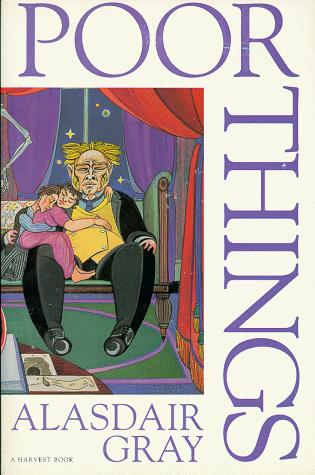
Poor Things
by Alasdair Gray
★ Top 25 book of 1992 · #16 on Best Books of 1992
Framed as a found manuscript and set in the nineteenth century, this inventive novel offers a tale in the spirit of Frankenstein. It won the Whitbread Novel Award in 1992.
Best for: Readers who enjoy Frankenstein-style stories told through discovered manuscripts
Poor Things is #16 on BookWard's Best Books of 1992, out of 43 1992 books that cleared our data bar.
What Poor Things is about
In late Victorian Glasgow, a young medical student named Archibald McCandless falls in with the eccentric surgeon Godwin Baxter. Baxter keeps a beautiful, childlike woman in his care. Her name is Bella, and she is said to have been made by implanting a baby's brain into the body of a drowned pregnant woman. When Bella sets off across Europe and the Middle East with the lawyer Duncan Wedderburn, her fresh, unguarded view of the world becomes a way to poke at marriage, class, and the rules society sets for women.
Alasdair Gray's postmodern retelling of Frankenstein won the Whitbread Award and the Guardian Fiction Prize. It is playful and darkly comic, and it arrives wrapped in letters, his own illustrations, an introduction, and critical notes, so the question of whose story you are reading stays gloriously open.
Poor Things on the Best Books of 1992
Poor Things came out in 1992. Of the 43 books first published in 1992 that met BookWard's data bar, it ranks #16 on our Best Books of 1992 list.
Why it made the list: 228 readers have shelved it on Open Library. The list ranks each year’s books on how many readers have picked them up, how highly readers rate them, and how many are reading them right now.
Nearby on the 1992 list
- Band of Brothers Stephen E. Ambrose, #14
- Diana, Her True Story Andrew Morton, #15
- All the Pretty Horses Cormac McCarthy, #17
- Red Mars Kim Stanley Robinson, #18
See all Best Books of 1992 Best books by year
More years: Best Books of 1991 Best Books of 1993.
The numbers behind it
- Readers: 204 want to read it, 15 are reading it now and 9 have read it, according to Open Library.
| Signal | This book (0 to 100) | Weight |
|---|---|---|
| Reach | 51 | 55% |
| Reader love | 51 | 25% |
| Being read right now | 74 | 20% |
Questions about Poor Things
When was Poor Things published?
Poor Things by Alasdair Gray was first published in 1992.
Was Poor Things one of the best books of 1992?
Poor Things is #16 on BookWard's Best Books of 1992, out of 43 1992 books that cleared our data bar. 228 readers have shelved it on Open Library.
Why is Poor Things on the Best Books of 1992 list?
228 readers have shelved it on Open Library.
More of the best books of 1992
- Welcome to Dead House Robert Lawrence Stine, #1
- The Secret History Donna Tartt, #2
- Snow Crash Neal Stephenson, #3
- The Indispensable Calvin and Hobbes Bill Watterson, #4
- The Shadow Rising Robert Jordan, #5
- The Artist's Way Julia Cameron, #6
See the full Best Books of 1992, the Top 100, or new books on Rising.
How we know
This page uses public data: Open Library reader counts and ratings, and Wikipedia page views for recent years. The description is paraphrased from real source text. Rankings reflect reading interest, not quality or sales, and can be affected by data gaps. Lists update monthly.
Best for adult readers and older teens comfortable with satire and layered storytelling.
Depends on the edition you pick.
Gray's Glasgow Frankenstein, where the narrator may be lying. 64% taste match
 BookWard’s take
Gray's Glasgow Frankenstein, where the narrator may be lying
Poor Things retells Frankenstein through Bella Baxter, a woman fabricated in late Victorian Glasgow, and wraps her story in a stack of documents: a memoir, letters, illustrations, an Introduction and Critical Notes. That framing is where the book really comes alive. The mock-scholarly apparatus is Gray's own invention, and it feels entirely fresh. His wit is audible on every page, and the voice is unmistakable. The narrator can't be trusted, since a later letter contradicts the memoir. The familiar gothic tropes are borrowed from Shelley on purpose, then turned over. The opening hooks quickly with Bella herself. The same layering that rewards you also makes the book more demanding than its plot suggests, and its politics are plainly stated rather than buried.
Bella's travels and returns keep events moving, though the interleaved letters and notes slow it at moments.
The fake-editor apparatus, false attributions and rival accounts make this one of a kind, which BookWard rewards.
Period-flavoured, witty and controlled without being ornate for its own sake.
Bella's development drives the book as much as its events do.
Bella's growth and the reform theme lean hopeful, though the contradicting letter complicates that.
A memoir, letters, illustrations, introduction and notes make this decidedly experimental.
Satire and mock-scholarly deadpan make the tone wry rather than solemn.
The creation premise is grotesque, yet the tone of the satire stays buoyant.
Feeling is present but filtered through irony.
See all 50 dialsEvery position, side by side with this book
Where it lines up
- Character depthBookWard 8 · book 8
- SentimentBookWard 8 · book 8
- OriginalityBookWard 9 · book 10
Where it pulls apart
- Rigor (nonfiction)BookWard 9 · book 1
- Internal logicBookWard 10 · book 6
- LengthBookWard 1 · book 4
A fabricated woman raised by an eccentric surgeon is an arresting premise that draws you in from the start.
It reworks Frankenstein knowingly, so the borrowed gothic frame is familiar but the handling is not.
The story holds together on its own terms, though its contradictory documents deliberately leave you weighing which account to trust.
Bella's travels and returns keep events moving, though the interleaved letters and notes slow it at moments.
The fake-editor apparatus, false attributions and rival accounts make this one of a kind, which BookWard rewards.
Bella grows from a childlike mind into an assertive, fully drawn woman, and the men around her are sharply characterized too.
A late letter reframes the memoir, so resolution comes through contradiction rather than a single tidy answer.
Gray's satire keeps feeling at arm's length, which suits BookWard's preference for restraint.
The grotesque premise serves the social satire instead of existing for effect.
Gray's playful, scholarly-mocking presence is unmistakable throughout, which BookWard values highly.
Ideas about gender and class carry real weight, but they are delivered through a story you want to follow.
The Introduction and Critical Notes explain openly, yet the main narrative still works through scene.
Bella's changing circumstances keep the middle moving and the structure gives it variety.
Period-flavoured, witty and controlled without being ornate for its own sake.
Bella's development drives the book as much as its events do.
Bella's growth and the reform theme lean hopeful, though the contradicting letter complicates that.
A memoir, letters, illustrations, introduction and notes make this decidedly experimental.
Satire and mock-scholarly deadpan make the tone wry rather than solemn.
Moderately demanding, because you must read the framing documents critically, though the story itself stays accessible.
Several documents and voices compete, giving more than one perspective without being a big ensemble.
The core narrative runs forward, with the framing documents adding some layering around it.
A surgically fabricated woman sets this in the fantastical, even as Victorian Glasgow stays grounded.
A tight circle of principals carries the story rather than a crowd.
Though it travels across Europe, it stays focused on a few lives and their social world.
Bella's experience and the events around her share the stage fairly evenly.
Letters and conversations carry much of the book, giving it a talky texture.
Relationships matter to Bella's story, but social critique is the centre.
Victorian Glasgow and Bella's journey abroad feel somewhat distant to a modern reader.
Set in the late nineteenth century, though written in 1992 with modern concerns.
Its questions about autonomy and institutions have kept it current long after 1992.
McCandless's memoir is directly contradicted by Bella's own letter, which makes the narration deliberately untrustworthy.
Which account to believe, and what Bella's creator owed her, stay open to argument.
Gray's illustrations and period detail give the setting a rich, textured feel.
Competing documents and a contradicting letter keep reframing what you thought you knew.
It pushes you to question authority, gender roles and how stories get told.
The creation premise is grotesque, yet the tone of the satire stays buoyant.
Feeling is present but filtered through irony.
The humor leans toward satire and mock pomposity rather than slapstick.
The body-horror premise is the main source, handled as background rather than dwelt on.
Bella's sexual awakening is a real part of the story and is treated frankly.
Patriarchy, class and public health are central concerns, stated openly.
Period English with a Scottish setting, readable with some attention.
Gray's satirical stance on society comes through strongly in the framing.
Bella's reform work looks toward change, even as the setting is the past.
Bella's reforming zeal is hopeful, while the framing keeps cynicism close.
Review written by BookWard, dial version 1, November 2026.
Who is Poor Things right for?
Best for adult readers and older teens comfortable with satire and layered storytelling. It includes frank treatment of sexuality, a grotesque creation premise and critiques of exploitation.
Moderately demanding, because you must read the framing documents critically, though the story itself stays accessible.
The creation premise is grotesque, yet the tone of the satire stays buoyant.
Feeling is present but filtered through irony.
The body-horror premise is the main source, handled as background rather than dwelt on.
Book CompanionPoor Things: ideas, characters, themes
A fabricated Victorian woman's story is told through competing documents, asking who controls a life and who gets to narrate it.
- A Frankenstein reworking. Gray reimagines Mary Shelley's gothic tale in late Victorian Glasgow, centred on Bella Baxter.
- Layered documents. The book combines a memoir, letters, illustrations, an Introduction and Critical Notes.
- Fictional framing. The Introduction and Critical Notes belong to the fictional world while credited to the real Alasdair Gray.
- Social commentary. Bella's passage through society is the lens for critique of patriarchy, inequality and sexual politics.
- Contradicting accounts. A letter from Bella directly challenges McCandless's memoir, so the reader must weigh the sources.
Characters
Bella Baxter
The surgically fabricated woman
Physically adult with a developing mind, she grows into an assertive and independent person.
Godwin Baxter
Eccentric surgeon
He creates and cares for Bella.
Archibald McCandless
Medical student and memoirist
His account frames the main narrative and falls in love with Bella.
Duncan Wedderburn
Decadent lawyer
He takes Bella on a trip across Europe and the Middle East.
Themes
Who decides how a person lives and who they become.
How men and institutions shape and constrain women's lives.
How the person telling a story shapes what we believe.
Social inequality and efforts to improve the lives of the poor.
What a maker owes the one made.
Discussion questions
- Which account of Bella do you trust, and why?
- How does the fake editorial apparatus change how you read the story?
- What does Gray gain by retelling Frankenstein in Glasgow?
- How does Bella's relationship to the men around her shift over the book?
- Why might Gray credit his own illustrations to another artist?
Personalize your Book Companion
This is the general edition. In BookWard, the Companion is written for you: your reading profile, your notes, and spoiler-safe to the page you are on.
Buy, listen or borrow Poor Things
Each link opens a search for this book on that store, in a new tab.
Read on a device
Borrow
Reviews and community
If you liked Poor Things
A lumberjack novel and three stories on gender and desire
Invisible ManRalph EllisonA restless, original classic about identity, race, and being unseen
The End of EverythingM. John HarrisonA strange Kent tideline, and an object that won't hold still
The Ministry of TimeKaliane BradleyA time-travel romance that argues with Britain's past and present
Find your own best books
Add what you have read, rate it, and BookWard will recommend what to read next.
Free to start. No credit card needed.