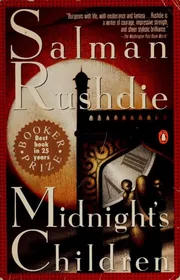
Midnight's Children
by Salman Rushdie · 1981
This is an adult literary novel, long and dense, best suited to confident readers.
580 pages, about 9 to 13.5 hours.
A nation's birth told through one voice, huge and unruly. 53% taste match
About the book
Midnight's Children is a novel by Salman Rushdie, first published in 1981. It belongs to the traditions of literary fiction, epic fiction and magical realism, and it carries elements of the paranormal, including telepathy. The narrator is Saleem Sinai, who tells the story of his own life alongside the story of a country. The book follows India from the end of British colonial rule through independence and partition, and it places its fictional events within real historical ones.
The story begins in Bombay and moves through Kashmir, Agra, Lahore and Dhaka, with 1947 as its central date. Saleem's family and those around him appear throughout, among them Aadam Aziz, Ahmed Sinai, Amina Sinai, Mary Pereira, Shiva, Parvati-The-Witch and Padma. Questions of religion and relations between faiths, including Hinduism, run through the setting. The novel weaves one person's biography together with the biography of a nation, a method it shares with Günter Grass's The Tin Drum. At about 580 pages, it is a long work, and it has appeared in many editions.
I was born in the city of Bombay . . . once upon a time.
Characters
Saleem SinaiAadam AzizAhmed SinaiAmina SinaiMary PereiraShiva
Setting
IndiaKashmirAgraBombayLahore
Period
19471947-
Themes
telepathyepic literatureNovelRushdie, Salman - Prose & CriticismrelationsHinduisminterfaith relationsNin os de los ricos
- Want to read 420
- Reading now 25
- Read 54
Most people shelving it are saving it for later.
Of 499 readers who put it on a shelf, 84% want to read it, 5% are reading it now, 11% have finished it and 0% stopped before the end.
By the numbers
- The median edition runs 580 pages. Counting about 275 words a page and an adult reading pace of 250 words a minute, that is about 11 hours of reading.
- Open Library tracks 86 editions from 59 publishers, the earliest dated 1981 and the latest 2023, across 16 languages.
- On reader demand it ranks in the top 1% of the modern books in our catalog (15,152 of them).
- Libraries shelve it under Dewey 823 and Library of Congress class PR-6068.00000000.U757 M5 1981.
 BookWard’s take
A nation's birth told through one voice, huge and unruly
Rushdie's 1981 novel ties one man's life to India's passage from British rule to independence and partition, and it does so in a voice nobody could mistake for anyone else's. Saleem Sinai narrates, and the book travels from Bombay through Kashmir, Agra, Lahore and Dhaka. Its originality is its greatest strength, and the magical realist thread keeps it a long way from familiar tropes. It is long, at about 580 pages, and it asks more effort of the reader than most books do. The telling is also playful and self-aware rather than plain, so the exposition and the structure can work against a reader who wants things laid out simply. If you want a big, ambitious novel that rewards patience and has real personality on every page, this is one of the landmark examples.
At about 580 pages it is a long, sprawling novel, well past the tight shape BookWard prefers.
The narration digresses and circles, so the pace is measured rather than quick, a little slower than BookWard's taste.
Fusing a personal biography with a national one in a magical realist frame is strikingly original, which BookWard rates highly.
The language is rich, inventive and heavily worked, more ornate than BookWard's usual preference.
Plot and character drive it about equally, since one life is bound to the course of a nation.
It balances grief and upheaval with wit and resilience, landing near the middle on outlook.
The self-reflexive telling and narrator's asides make it more experimental than conventional, beyond BookWard's usual comfort.
Satire and playfulness run through a serious subject, giving it more humor than a typical epic.
Partition and political upheaval give it real darkness, tempered by humor and invention.
Feeling is present throughout but often shaped by irony, so it is moderately intense.
See all 50 dialsEvery position, side by side with this book
Where it lines up
- Familiar tropesBookWard 10 · book 9
- OriginalityBookWard 9 · book 10
- Character depthBookWard 8 · book 7
Where it pulls apart
- LengthBookWard 1 · book 9
- Internal logicBookWard 10 · book 6
- OpeningBookWard 10 · book 7
At about 580 pages it is a long, sprawling novel, well past the tight shape BookWard prefers.
Saleem's voice pulls the reader in from the start, though the telling takes its time getting to the story.
Magical realism, telepathy and a nation's history woven into one life make it feel unlike familiar tropes, which BookWard values.
Its magical premises follow their own rules, but the playful, self-reflexive telling keeps the logic looser than BookWard likes.
The narration digresses and circles, so the pace is measured rather than quick, a little slower than BookWard's taste.
Fusing a personal biography with a national one in a magical realist frame is strikingly original, which BookWard rates highly.
Saleem and the families around him are drawn with real texture, close to the depth BookWard looks for.
The book brings its long arc to a considered close rather than leaving it hanging, broadly in line with BookWard.
The warmth is present but laced with irony and satire, so it leans somewhat toward feeling.
Its darker moments tie to historical upheaval and partition, so they carry weight rather than serving as mere effect.
Saleem's talkative, digressive narration is unmistakable and distinctive, exactly what BookWard prizes.
Story and ideas run together, with history and identity shaping the plot, so it sits near the middle.
The narrator often explains and comments directly, which pulls away from BookWard's preference for showing in scene.
Over so many pages the momentum can wander, though the voice usually carries the reader through.
The language is rich, inventive and heavily worked, more ornate than BookWard's usual preference.
Plot and character drive it about equally, since one life is bound to the course of a nation.
It balances grief and upheaval with wit and resilience, landing near the middle on outlook.
The self-reflexive telling and narrator's asides make it more experimental than conventional, beyond BookWard's usual comfort.
Satire and playfulness run through a serious subject, giving it more humor than a typical epic.
Its length, density and allusive style ask a lot of the reader, more than BookWard typically seeks.
Saleem tells everything, so the view stays largely single even as the cast widens.
Saleem's story loops back through earlier generations, so time shifts more than a straight line.
Telepathy and magical elements sit openly inside the historical frame, well beyond grounded realism.
A large family and many figures fill the story, a much bigger cast than BookWard usually favors.
One life carries the story of a whole country, giving it an epic sweep BookWard does not usually chase.
Saleem's inner voice and outward historical events share the stage fairly evenly.
Talk is part of the texture but narration dominates, leaving dialogue at a moderate level.
Relationships matter, but love is not the center, so romance stays a supporting thread.
Bombay, Kashmir, Agra, Lahore and Dhaka are vividly rendered and unfamiliar to many readers, which suits BookWard.
Set around 1947 and after, it reaches back well before the present day.
It has endured as a landmark of twentieth-century fiction, comfortably beyond its moment.
Saleem shapes his own story with a storyteller's license, so his reliability is open to question.
Partition and a nation's birth resist easy verdicts, so the moral picture is ambiguous, more than BookWard's usual taste.
Places, smells and scenes are described with abundance, richer than BookWard usually looks for.
It stands on its own as a single, self-contained novel.
Surprises arrive steadily across the long, winding story.
It asks readers to wrestle with history, identity and ambiguity rather than offering comfort.
Partition and political upheaval give it real darkness, tempered by humor and invention.
Feeling is present throughout but often shaped by irony, so it is moderately intense.
Its humor is playful and satirical, tilting somewhat broader than dry.
Historical turmoil brings violence into the story, though it is not the book's focus.
Sexual content appears occasionally but is not a central feature.
The novel is built on India's independence and partition, putting politics at the heart of it.
Dense, allusive language and Indian references make it harder than plain prose.
Saleem narrates with strong views and a vivid personality, clearly opinionated.
The story largely looks back at a past era, even as it speaks to what followed.
Hope for a new nation is shadowed by disillusion, leaving it balanced between idealism and cynicism.
Review written by BookWard, dial version 1, November 2026.
Who is Midnight's Children right for?
This is an adult literary novel, long and dense, best suited to confident readers. It deals with political upheaval, partition and violence, and touches on adult relationships.
Its length, density and allusive style ask a lot of the reader, more than BookWard typically seeks.
Partition and political upheaval give it real darkness, tempered by humor and invention.
Feeling is present throughout but often shaped by irony, so it is moderately intense.
Historical turmoil brings violence into the story, though it is not the book's focus.
Book CompanionMidnight's Children: ideas, characters, themes
One man's life is bound to the birth of a nation, told through a magical realist lens set against real history.
- A life and a country. Saleem tells his own story alongside the story of India, weaving a personal biography with a national one.
- History in fiction. The novel places invented events inside real ones, from independence through partition.
- Magical realism. Elements like telepathy sit openly within the historical frame, blurring fact and fantasy.
- Self-reflexive telling. The narrator is aware he is telling a story and shapes how history is preserved on the page.
- A sweeping geography. The action moves through Bombay, Kashmir, Agra, Lahore and Dhaka, with 1947 as its central date.
Characters
Saleem Sinai
Narrator and protagonist
He tells the story of his own life alongside the story of India.
Aadam Aziz
Family figure
One of the people in Saleem's family who appears across the novel.
Amina Sinai
Family figure
A member of Saleem's family who appears throughout the book.
Mary Pereira
Figure in Saleem's circle
One of the people around Saleem who appears in the story.
Shiva
Figure in the story
A character connected to Saleem's world.
Themes
How a country's story and a person's story shape each other.
How the past is preserved, retold and reshaped through fiction.
The upheaval of India's transition from colonial rule.
The coexistence and tension of communities within the setting.
How narration itself shapes truth.
Discussion questions
- How does tying Saleem's life to India's history change the way you read both?
- What does magical realism let the book do that straight realism could not?
- How far do you trust Saleem as a narrator, and why?
- Which places in the novel felt most vivid, and what did they add?
- What does the book suggest about how history gets remembered?
Personalize your Book Companion
This is the general edition. In BookWard, the Companion is written for you: your reading profile, your notes, and spoiler-safe to the page you are on.
Buy, listen or borrow Midnight's Children
Each link opens a search for this book on that store, in a new tab.
Read on a device
Borrow
Reviews and community
If you liked Midnight's Children
A restless, original classic about identity, race, and being unseen
MiddlesexJeffrey EugenidesA Greek-American family saga with a mutated gene at its center
Cloud AtlasDavid MitchellSix nested stories across centuries, each one reshaping the last
The End of EverythingM. John HarrisonA strange Kent tideline, and an object that won't hold still
Sources: Open Library.
Track Midnight's Children and find your next favorite
Add it to your shelf, rate what you have read, and BookWard will recommend what fits you.
Free to start. No credit card needed.