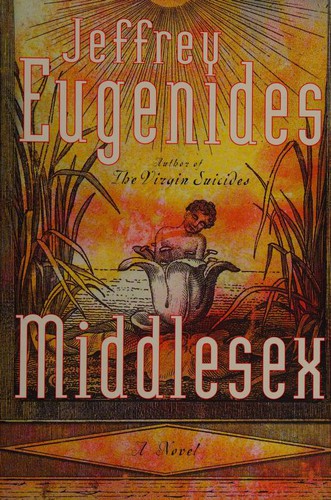
Middlesex
by Jeffrey Eugenides
★ Top 25 book of 2002 · #12 on Best Books of 2002
A coming of age story whose narrator wrestles with gender identity, yet whose real subject is the confusion everyone feels while becoming who they are meant to be. Readers praise its honest prose and its sense of shared human experience.
Best for: Readers who enjoy candid, symbolic coming of age stories about identity
Middlesex is #12 on BookWard's Best Books of 2002, out of 32 2002 books that cleared our data bar.
What Middlesex is about
Cal Stephanides tells the story of a family and of a body, starting well before birth. In 1922, two siblings in a village in Asia Minor flee war and marry aboard a ship bound for America. They settle in Detroit, where Lefty finds work at Ford and later opens a bar called the Zebra Room.
Born Calliope, Cal grows up in a house on Middlesex Boulevard in Grosse Pointe, a girl who slowly realizes she is not like other girls. Eugenides, who is not himself intersex, wrote the novel after reading a memoir from 1980. What emerges is a coming-of-age story and family saga, with wit and warmth. It will suit readers who like a big, humane narrative about identity, immigration and inheritance.
Middlesex on the Best Books of 2002
Middlesex came out in 2002. Of the 32 books first published in 2002 that met BookWard's data bar, it ranks #12 on our Best Books of 2002 list.
Why it made the list: 260 readers have shelved it on Open Library; readers rate it 4.2 out of 5 (52 ratings). The list ranks each year’s books on how many readers have picked them up, how highly readers rate them, and how many are reading them right now.
Nearby on the 2002 list
- Tithe Holly Black, #10
- Dragon Ball Z; Thank You 鳥山 明 [Akira Toriyama], #11
- Night Watch Terry Pratchett, #13
- Understanding Power Noam Chomsky, #14
See all Best Books of 2002 Best books by year
More years: Best Books of 2001 Best Books of 2003.
The numbers behind it
- Readers: 193 want to read it, 4 are reading it now and 63 have read it, according to Open Library.
- Ratings: 4.2 out of 5 from 52 Open Library ratings.
| Signal | This book (0 to 100) | Weight |
|---|---|---|
| Reach | 59 | 55% |
| Reader love | 84 | 25% |
| Being read right now | 16 | 20% |
Questions about Middlesex
When was Middlesex published?
Middlesex by Jeffrey Eugenides was first published in 2002.
Was Middlesex one of the best books of 2002?
Middlesex is #12 on BookWard's Best Books of 2002, out of 32 2002 books that cleared our data bar. 260 readers have shelved it on Open Library; readers rate it 4.2 out of 5 (52 ratings).
Why is Middlesex on the Best Books of 2002 list?
260 readers have shelved it on Open Library; readers rate it 4.2 out of 5 (52 ratings).
More of the best books of 2002
- Romancing Mister Bridgerton Julia Quinn, #1
- Coraline Neil Gaiman, #2
- Why Does He Do That? Lundy Bancroft, #3
- Room on the Broom Julia Donaldson, #4
- Stories of Your Life and Others Ted Chiang, #5
- Everything's Eventual. 14 Dark Tales Stephen King, #6
See the full Best Books of 2002, the Top 100, or new books on Rising.
How we know
This page uses public data: Open Library reader counts and ratings, and Wikipedia page views for recent years. The description is paraphrased from real source text. Rankings reflect reading interest, not quality or sales, and can be affected by data gaps. Lists update monthly.
Best suited to mature teens and adults.
Depends on the edition you pick.
A Greek-American family saga with a mutated gene at its center. 54% taste match
 BookWard’s take
A Greek-American family saga with a mutated gene at its center
Middlesex follows three generations of a Greek family, beginning with Lefty and Desdemona's flight from Asia Minor in 1922 and arriving at Cal, who narrates. It is a long, voice-driven novel, and the voice is the draw. Cal's storytelling is unmistakable and his character runs deep, and the settings of old Bursa and booming Detroit feel vivid and unfamiliar. It is also strikingly original, since few family sagas are built around 5-alpha-reductase deficiency and Greek myth. Where I part ways with it is length: it sprawls, and the first half spends a great deal of time on Cal's grandparents before Cal arrives. It is driven by ideas in places, with nature versus nurture running underneath, and the narrator is a storyteller looking back, shaping events as he sees fit.
A multi-generation saga that sprawls across decades and continents, which is the opposite of BookWard's preference for tight books.
The generational sweep moves steadily rather than quickly, with long stretches of family history before the story reaches Cal.
A gender novel told through a family saga, myth and a rare genetic condition is a combination few books attempt.
Rich, allusive and playful, with mythic references and long flowing sentences, a little more ornate than BookWard usually likes.
Events matter, but the book is mostly about who these people are and what they pass down.
Cal's story is bittersweet, but it ends with self-acceptance and a sense of having found a place.
It is a hindsight memoir-style narrative that moves around in time, but the shape stays recognizable.
Cal's narration is consistently wry and amused, even through painful material.
War, displacement, secrecy and bodily alienation are present but handled with humor and warmth.
The family bonds and Cal's search for self carry real feeling.
See all 50 dialsEvery position, side by side with this book
Where it lines up
- OriginalityBookWard 9 · book 9
- Character depthBookWard 8 · book 9
- EndingBookWard 8 · book 7
Where it pulls apart
- LengthBookWard 1 · book 9
- Familiar tropesBookWard 10 · book 3
- Internal logicBookWard 10 · book 7
A multi-generation saga that sprawls across decades and continents, which is the opposite of BookWard's preference for tight books.
Cal opens with a confident, intriguing narrating voice that pulls you in, though the family history that follows takes its time.
Immigrant-family sagas and coming-of-age stories are well-worn forms, but this one is built around unusual material that keeps it fresh.
The inherited-gene thread ties generations together cleanly, with myth and history used consistently, though Cal's hindsight shaping loosens it slightly.
The generational sweep moves steadily rather than quickly, with long stretches of family history before the story reaches Cal.
A gender novel told through a family saga, myth and a rare genetic condition is a combination few books attempt.
Lefty, Desdemona, Lina and Cal are all drawn at length and with real interiority, which suits BookWard well.
Cal narrates from later in life, so the story feels resolved even where questions about identity stay open.
It leans warm and affectionate toward its family, but the humor and candor keep it from turning syrupy.
The incest and intersex revelations are central to the story and serve the themes rather than existing for effect.
Cal's wry, self-aware narration is the book's signature, and it is as distinctive as narrators get.
Nature versus nurture and identity drive the design, but they work through a full family story rather than overtaking it.
Cal often explains history and biology outright as a narrator, a looser fit with BookWard's preference for scene.
The long run-up through the grandparents' years can feel slow before the book settles into Cal's own story.
Rich, allusive and playful, with mythic references and long flowing sentences, a little more ornate than BookWard usually likes.
Events matter, but the book is mostly about who these people are and what they pass down.
Cal's story is bittersweet, but it ends with self-acceptance and a sense of having found a place.
It is a hindsight memoir-style narrative that moves around in time, but the shape stays recognizable.
Cal's narration is consistently wry and amused, even through painful material.
Long, allusive and layered, but the voice keeps it readable rather than hard going.
Cal tells everything, including scenes he could not witness, so the viewpoint stays single even as the cast widens.
Cal moves between his own present and decades of family history, jumping back and forth.
The setting is realistic history, with Greek myth used as metaphor rather than as events.
Several generations, plus relatives and neighbors in Detroit, make for a sizable cast.
It covers migration, war, industrial Detroit and a century of change, but anchors it in one family.
Identity, desire and self-understanding sit at the heart of the book, more than action.
Scenes have talk in them, but narration carries much of the weight.
Lefty and Desdemona's bond and Cal's own romantic life take up a good share of the story.
Bursa in 1922 and Prohibition-era Detroit are vividly drawn and unfamiliar to most readers.
Most of it is set in the twentieth century, with a modern frame, rather than the present day.
Its questions about identity and family have kept it widely read and discussed well past its publication.
Cal is open about his version of events but reconstructs scenes he did not see, so he asks for some trust.
The book treats identity, family secrets and choices with nuance and refuses easy verdicts.
Places, rooms, food and bodies are rendered in generous, vivid detail.
A single self-contained novel.
Family secrets and the unfolding of Cal's condition drive several turns, though the book telegraphs some of them.
It asks readers to think hard about gender, heredity and belonging.
War, displacement, secrecy and bodily alienation are present but handled with humor and warmth.
The family bonds and Cal's search for self carry real feeling.
The humor is a rolling, storyteller's wit, closer to wry than broad.
War and riot scenes appear in the historical backdrop, without dwelling on gore.
Sexual awakening and the body are central themes, with frank passages.
Race, immigration and gender surface naturally in the history without the book turning didactic.
Mostly plain, with some Greek terms and mythic allusion to keep up with.
Cal narrates with strong asides, jokes and judgments throughout.
Cal looks back over his family's history to understand where he came from.
It acknowledges hardship but believes in the possibility of reinvention and belonging.
Review written by BookWard, dial version 1, November 2026.
Who is Middlesex right for?
Best suited to mature teens and adults. It includes frank discussion of sex, the body, incest and intersex anatomy, as well as war and civil unrest.
Long, allusive and layered, but the voice keeps it readable rather than hard going.
War, displacement, secrecy and bodily alienation are present but handled with humor and warmth.
The family bonds and Cal's search for self carry real feeling.
War and riot scenes appear in the historical backdrop, without dwelling on gore.
Book CompanionMiddlesex: ideas, characters, themes
Cal tells the story of how three generations of a Greek family, and one inherited gene, led to his unusual life.
- Family before Cal. The first half follows Cal's grandparents Lefty and Desdemona from a village near Bursa to Detroit in 1922.
- A hidden bond. Lefty and Desdemona's secret relationship and Lina's secret shape the family's earliest years in America.
- The mutated gene. A recessive condition, 5-alpha-reductase deficiency, passes through the family and shapes Cal's life.
- Detroit as backdrop. The story is set against real events like the 1967 Detroit riot and the rise of the Nation of Islam.
- Cal's two names. The narrator is known as both Calliope and Cal, reflecting a life lived across gender expectations.
Characters
Cal Stephanides
Narrator and protagonist
Born Calliope, Cal is an intersex man of Greek descent telling his family story in hindsight.
Lefty Stephanides
Paternal grandfather
He leaves Asia Minor in 1922, works at Ford, and gets drawn into bootlegging in Detroit.
Desdemona
Grandmother and Lefty's sister
She tends silkworm cocoons in Bithynios and marries Lefty aboard the ship to America.
Sourmelina (Lina) Zizmo
Cousin
A closeted lesbian in Detroit who alone knows the truth about Lefty and Desdemona.
Themes
How much of who we are comes from biology and how much from how we are raised.
How people understand themselves when society insists on fixed categories.
The costs and rewards of immigration and assimilation.
Greek stories like the Minotaur and Chimera used to frame bodies and family inheritance.
The chance to reinvent oneself and find a place to belong.
Discussion questions
- Why does Cal tell the story starting with his grandparents instead of with his own birth?
- How do the Greek myths shape the way you read Cal's experience?
- Does Cal feel like a reliable guide to events he did not witness?
- What does the book suggest about nature versus nurture?
- How does Detroit's history of boom and unrest echo Cal's own story?
Personalize your Book Companion
This is the general edition. In BookWard, the Companion is written for you: your reading profile, your notes, and spoiler-safe to the page you are on.
Buy, listen or borrow Middlesex
Each link opens a search for this book on that store, in a new tab.
Read on a device
Borrow
Reviews and community
If you liked Middlesex
A nation's birth told through one voice, huge and unruly
East of EdenJohn SteinbeckSteinbeck's sprawling Cain and Abel saga, built to outlast its length
Memoirs of a GeishaArthur GoldenA geisha's life told in a rich, immersive, hard-won voice
BuckeyePatrick RyanA small Ohio town, two families, and one buried secret
Find your own best books
Add what you have read, rate it, and BookWard will recommend what to read next.
Free to start. No credit card needed.