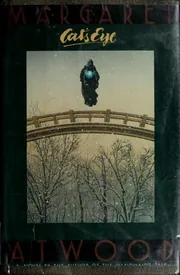
Cat's Eye
by Margaret Atwood · 1988
Suits adult readers and mature older teens who can handle sustained emotional cruelty among children.
446 pages, about 7 to 10.5 hours.
A painter's return to Toronto, and the girlhood that made her. 59% taste match
The story
Cat's Eye is a 1988 novel by Margaret Atwood, a work of psychological fiction rooted in Canadian life. Its central figure is Elaine Risley, a painter whose work has stirred controversy. She goes back to Toronto, where she grew up, to attend a retrospective of her art, and the visit sends her thoughts back to her early years in the city.
The story moves between the present and her memories of girlhood, centered on a close circle of three girls and the friendship, longing and betrayal that shaped her. Elaine thinks through what it has meant to be a daughter, a lover, an artist and a woman, and what she carries from those years into adulthood. The narrative covers the decades from World War II to the late 1980s, taking in feminism and the modern art movements of the period. The book was a finalist for the Governor General's Award in 1988 and for the Booker Prize in 1989. It runs to roughly 446 pages and has appeared in around 70 editions, and it sits among the notable titles in modern Canadian fiction by women writers.
Setting
Toronto (Ont.)TorontoOntario
Themes
adult literaturehuman relationschildrenwomen writersFriendshipGirlsWomen paintersPeintres
- Want to read 123
- Reading now 8
- Read 22
Most people shelving it are saving it for later.
Of 153 readers who put it on a shelf, 80% want to read it, 5% are reading it now, 14% have finished it and 0% stopped before the end.
By the numbers
- The median edition runs 446 pages. Counting about 275 words a page and an adult reading pace of 250 words a minute, that is about 8.2 hours of reading.
- Open Library tracks 70 editions from 48 publishers, the earliest dated 1988 and the latest 2022, across 14 languages.
- On reader demand it ranks in the top 9% of the modern books in our catalog (15,152 of them).
- Libraries shelve it under Dewey 813.54 and Library of Congress class PR-9199.30000000.A8 C38 1988.
 BookWard’s take
A painter's return to Toronto, and the girlhood that made her
Elaine Risley goes back to Toronto for a retrospective and the city drags her into her childhood, where a trio of girls taught her the brutal politics of friendship. At 446 pages it is long, but the mid-book stays sustained because the memories are specific and the stakes are personal. Character depth is the draw: Elaine and Cordelia are drawn with real complexity, and the book's moral clarity is deliberately ambiguous about who hurt whom. Atwood's authorial voice is distinctive, dry and funny even when the material is painful, and the prose stays precise rather than ornate. The shifting timeline moves between present and past without confusing the reader. It earns its darkness through psychology, not shock.
At 446 pages it is a substantial novel, longer than BookWard's taste for tight books.
The pace is measured and reflective, slower than BookWard's preference for momentum.
A painter's retrospective used as a way into childhood cruelty feels distinctive, which BookWard values.
The prose is precise and image-rich without turning ornate, near BookWard's plain-leaning middle.
Character-driven throughout, with Elaine's inner life rather than events steering the book.
It is mixed, honest about harm while moving toward some release, a bit less hopeful than BookWard's lean.
It alternates present and past but stays conventional in its overall shape.
Wry, observant humor sits alongside the painful material, a fit with BookWard's lighter tone.
The childhood cruelty is hard, though the book stays psychological rather than grim.
Strong feeling runs underneath, kept in check by Elaine's wry distance.
See all 50 dialsEvery position, side by side with this book
Where it lines up
- SentimentBookWard 8 · book 8
- Shock for effectBookWard 9 · book 9
- OriginalityBookWard 9 · book 8
Where it pulls apart
- LengthBookWard 1 · book 7
- OpeningBookWard 10 · book 6
- Familiar tropesBookWard 10 · book 8
At 446 pages it is a substantial novel, longer than BookWard's taste for tight books.
It opens on a return to Toronto and eases into memory, a steadier pull than an instant hook.
The girlhood-cruelty material is handled with fresh psychological precision, which suits BookWard's dislike of familiar tropes.
Elaine's memories and choices connect coherently, so the internal logic holds together well.
The pace is measured and reflective, slower than BookWard's preference for momentum.
A painter's retrospective used as a way into childhood cruelty feels distinctive, which BookWard values.
Elaine and Cordelia are drawn with exceptional depth, squarely what BookWard prizes in characters.
The ending resolves Elaine's emotional journey while leaving some feeling open, a little looser than BookWard prefers.
The book looks at cruelty and kindness without softening either, which is the restraint BookWard likes.
The darkness comes from the psychology of the friendships and is earned, not used for effect.
Atwood's voice is sharp, wry and unmistakable, a strong match for BookWard's taste.
Story-led, built on one woman's memories, though ideas about art and womanhood run underneath.
Meaning emerges through scenes and memory, with little explaining, as BookWard prefers.
The memory-driven structure holds interest across its length without a noticeable slump.
The prose is precise and image-rich without turning ornate, near BookWard's plain-leaning middle.
Character-driven throughout, with Elaine's inner life rather than events steering the book.
It is mixed, honest about harm while moving toward some release, a bit less hopeful than BookWard's lean.
It alternates present and past but stays conventional in its overall shape.
Wry, observant humor sits alongside the painful material, a fit with BookWard's lighter tone.
It is readable and clear, asking attention to its shifts in time but not much more.
Everything comes through Elaine alone, a single viewpoint, narrower than BookWard's taste for many.
It moves repeatedly between Elaine's present and her past, a more shifting timeline than BookWard's linear lean.
Entirely grounded in realistic Canadian life, with no fantastical element.
The focus stays on a small circle of girls and a few key figures around Elaine.
It is an intimate story of one life and its friendships, not an epic canvas.
Dominated by Elaine's thoughts and memories rather than outward action.
Conversation matters, but the book leans on narration and memory more than talk.
Romantic relationships are part of Elaine's life but not the center of the book.
Toronto and mid-century Canada are familiar and recognizable settings.
It spans World War II to the late 1980s, mostly the past rather than the present day.
Its themes of friendship, cruelty and identity give it staying power beyond its decade.
Elaine's recollection is vivid but colored by memory, making her a somewhat unreliable guide.
Cruelty and kindness are tangled together, which leaves the moral picture deliberately ambiguous.
Atwood's images, especially around painting and place, give the book rich description.
Intimate first-person reflection makes it a deeply personal book.
A standalone novel.
Driven more by revelation of memory than by plot twists.
It asks readers to sit with uncomfortable feelings about cruelty and identity.
The childhood cruelty is hard, though the book stays psychological rather than grim.
Strong feeling runs underneath, kept in check by Elaine's wry distance.
The humor is dry and observational, not broad.
Mostly emotional and social cruelty, with little graphic violence.
Sexual content is present as part of growing up, but not prominent.
Feminism and art movements come through the period, though not as a polemic.
The language is plain and clear, not dense or dialect-heavy.
Elaine's narration is pointed and opinionated about herself and others.
It looks backward, with memory driving nearly everything.
Honest about people's capacity for harm, with a measured rather than idealistic outlook.
Review written by BookWard, dial version 1, November 2026.
Who is Cat's Eye right for?
Suits adult readers and mature older teens who can handle sustained emotional cruelty among children. The childhood bullying is psychologically painful and may be hard for some readers.
It is readable and clear, asking attention to its shifts in time but not much more.
The childhood cruelty is hard, though the book stays psychological rather than grim.
Strong feeling runs underneath, kept in check by Elaine's wry distance.
Mostly emotional and social cruelty, with little graphic violence.
Book CompanionCat's Eye: ideas, characters, themes
A painter's return to Toronto unearths the childhood friendships that shaped her sense of herself and her art.
- The retrospective frame. Elaine returns to Toronto for a show of her work, and the city triggers her memories.
- A trio of girls. Her childhood circle taught her the fierce politics of friendship, with both cruelty and kindness.
- Past and present. The narrative shifts between her adult life and her memories of girlhood.
- Identity in many roles. Elaine considers what it means to be a daughter, a lover, an artist and a woman.
- A span of decades. The story runs from World War II to the late 1980s, touching feminism and modern art movements.
Characters
Elaine Risley
Narrator and painter
A controversial artist who revisits her past on returning to Toronto.
Cordelia
Childhood friend
The leader of the trio of girls, both cruel and kind to Elaine in ways that mark her for life.
Themes
How closeness between girls can carry both care and harm.
How the past persists and reshapes the present.
How Elaine's painting is tied to who she has become.
How expectations of being a woman shape Elaine across her life.
The effort to be free of haunting memories.
Discussion questions
- How does moving between present and past change the way you read Elaine's childhood?
- Why do you think Cordelia's mix of cruelty and kindness leaves such a mark?
- What does Elaine's painting reveal that her narration does not?
- How does the setting of Toronto shape the story?
- Does Elaine find release by the end, and what does that look like?
Personalize your Book Companion
This is the general edition. In BookWard, the Companion is written for you: your reading profile, your notes, and spoiler-safe to the page you are on.
Buy, listen or borrow Cat's Eye
Each link opens a search for this book on that store, in a new tab.
Read on a device
Borrow
Reviews and community
If you liked Cat's Eye
A son's memoir, and his mother's own voice breaking through it
Girl, InterruptedSusanna KaysenA short, sharp memoir that treats sanity as a question
The Remains of the DayKazuo IshiguroA butler's motoring trip becomes a quiet reckoning with a life
SwitzyEmma ClineA dying executive's last journey, told from inside a failing mind
Sources: Open Library.
Track Cat's Eye and find your next favorite
Add it to your shelf, rate what you have read, and BookWard will recommend what fits you.
Free to start. No credit card needed.