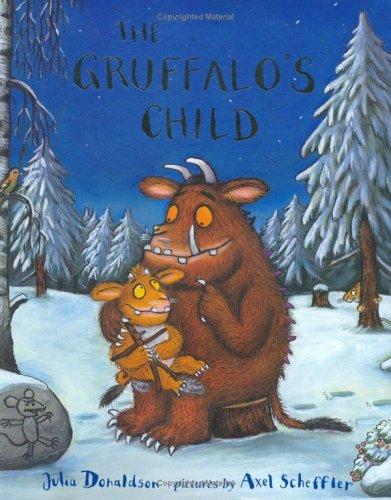
The Gruffalo's Child
by Julia Donaldson
★ Top 25 book of 2004 · #22 on Best Books of 2004
A young Gruffalo's child sets off to look for the Big Bad Mouse she has heard so much about. It is a brief, adventurous outing in the style of the original Gruffalo tale.
Best for: Young children and parents looking for a short story to read aloud
The Gruffalo's Child is #22 on BookWard's Best Books of 2004, out of 48 2004 books that cleared our data bar.
What The Gruffalo's Child is about
A small daughter of the Gruffalo is told to stay out of the wood. She goes anyway, wanting to find the 'big bad mouse' her father fears. He cannot recall what the mouse looks like and calls him a monster, so she sets off into the wood on a winter journey to see for herself.
Along the way she finds the tracks of the snake, owl and fox, and each one points her toward the mouse. When she meets him, he uses the moonlight to throw a vast, scary shadow. Julia Donaldson's rhyming text and Axel Scheffler's pictures give the sequel the same bouncy rhythm and the same cheerful lesson, that wit beats strength. It is a good fit for reading aloud to young children.
The Gruffalo's Child on the Best Books of 2004
The Gruffalo's Child came out in 2004. Of the 48 books first published in 2004 that met BookWard's data bar, it ranks #22 on our Best Books of 2004 list.
Why it made the list: 196 readers have shelved it on Open Library; readers rate it 4.9 out of 5 (11 ratings). The list ranks each year’s books on how many readers have picked them up, how highly readers rate them, and how many are reading them right now.
Nearby on the 2004 list
- Going Postal Terry Pratchett, #20
- Knuffle Bunny Mo Willems, #21
See all Best Books of 2004 Best books by year
More years: Best Books of 2003 Best Books of 2005.
The numbers behind it
- Readers: 162 want to read it, 4 are reading it now and 30 have read it, according to Open Library.
- Ratings: 4.9 out of 5 from 11 Open Library ratings.
| Signal | This book (0 to 100) | Weight |
|---|---|---|
| Reach | 42 | 55% |
| Reader love | 96 | 25% |
| Being read right now | 15 | 20% |
Questions about The Gruffalo's Child
When was The Gruffalo's Child published?
The Gruffalo's Child by Julia Donaldson was first published in 2004.
Was The Gruffalo's Child one of the best books of 2004?
The Gruffalo's Child is #22 on BookWard's Best Books of 2004, out of 48 2004 books that cleared our data bar. 196 readers have shelved it on Open Library; readers rate it 4.9 out of 5 (11 ratings).
Why is The Gruffalo's Child on the Best Books of 2004 list?
196 readers have shelved it on Open Library; readers rate it 4.9 out of 5 (11 ratings).
More of the best books of 2004
- Darkly Dreaming Dexter Jeffry P. Lindsay, #1
- Rich Dad, Poor Dad for Teens Robert T. Kiyosaki, #2
- The Ruins of Gorlan John Flanagan, #3
- Blink Malcolm Gladwell, #4
- Alexander Hamilton Ron Chernow, #5
- She Comes First Ian Kerner, #6
See the full Best Books of 2004, the Top 100, or new books on Rising.
How we know
This page uses public data: Open Library reader counts and ratings, and Wikipedia page views for recent years. The description is paraphrased from real source text. Rankings reflect reading interest, not quality or sales, and can be affected by data gaps. Lists update monthly.
Suits young children, especially as a rhyming read-aloud for preschoolers and early readers.
Depends on the edition you pick.
A winter-wood sequel where brains still beat brawn, in bouncing rhyme. 58% taste match
 BookWard’s take
A winter-wood sequel where brains still beat brawn, in bouncing rhyme
The Gruffalo's Child sends a young Gruffalo into the deep dark wood to find the big bad mouse her father fears. It hooks at once: one warning, one defiant daughter, and she is off. The rhyme runs in an easy tetrameter bounce, and the pace stays brisk with no sag, since each animal she meets passes her along to the next. It leans heavily on the structure of the first book, so the familiar beats outweigh the surprises, but the ending is fully resolved and the logic of the final trick holds together neatly. As a read-aloud, it is about as tight as a picture book gets. I admire the craft here more than the novelty.
A picture book that wraps up in a few minutes, as tight as books get, which suits BookWard's taste for brevity.
The meeting-and-moving-on structure keeps it brisk from page to page, close to BookWard's quick preference.
It reuses the predecessor's creatures and brains-over-brawn theme, so the novelty is modest, though the shadow trick adds a fresh turn.
The language is simple and musical rather than ornate, with the rhyme doing the decorating.
The quest structure drives events more than the daughter's inner growth.
It ends in safety and restored faith, a sunnier outlook than BookWard's already hopeful lean.
A straightforward quest with a repeating pattern, conventional by design.
Light comic touches come from the mixed-up descriptions of the big bad mouse and the animals' replies.
A cold wood and a scary mouse give it a faint shiver, nothing more.
A flicker of disappointment, then relief, kept mild and brief.
See all 50 dialsEvery position, side by side with this book
Where it lines up
- LengthBookWard 1 · book 1
- PaceBookWard 8 · book 8
- Shock for effectBookWard 9 · book 9
Where it pulls apart
- Familiar tropesBookWard 10 · book 4
- OriginalityBookWard 9 · book 4
- Character depthBookWard 8 · book 5
A picture book that wraps up in a few minutes, as tight as books get, which suits BookWard's taste for brevity.
The Gruffalo's warning and his daughter's defiance start the quest almost immediately, in line with BookWard's love of a fast start.
It deliberately repeats the first book's animals and rhyme pattern, so it is more familiar than fresh, a gap from BookWard's preference.
Each animal hands her on to the next, and the shadow trick at the end follows cleanly from what came before.
The meeting-and-moving-on structure keeps it brisk from page to page, close to BookWard's quick preference.
It reuses the predecessor's creatures and brains-over-brawn theme, so the novelty is modest, though the shadow trick adds a fresh turn.
The daughter's curiosity and shifting suspicion give her some shape, but she stays a simple picture-book heroine.
She returns to the cave and the mystery is settled, a full resolution that BookWard values.
Her restored faith in her father is gently warm without turning syrupy, a little softer than BookWard's restrained taste.
Nothing here relies on shock; the mild fright of the shadow is earned and quickly relieved.
This is a children's story, so rigor does not apply.
Julia Donaldson's bouncing rhyme is instantly recognizable and distinctive, fitting BookWard's liking for a strong voice.
The story leads, with the brains-over-brawn idea carried entirely by the quest rather than argued.
Everything is shown through the daughter's encounters and the rhyme, with almost nothing explained outright.
With so few pages and a new encounter in each, there is no middle to sag.
The language is simple and musical rather than ornate, with the rhyme doing the decorating.
The quest structure drives events more than the daughter's inner growth.
It ends in safety and restored faith, a sunnier outlook than BookWard's already hopeful lean.
A straightforward quest with a repeating pattern, conventional by design.
Light comic touches come from the mixed-up descriptions of the big bad mouse and the animals' replies.
Easy to follow and made for sharing aloud, far gentler than BookWard's moderate tolerance for effort.
The story follows the Gruffalo's child alone.
It moves in a straight line from the cave to the wood and back.
Talking monsters, owls and foxes in a monster-haunted wood make this thoroughly fantastical.
A handful of animals plus the daughter and her father keeps the cast small.
One child in one wood on one winter outing is as intimate as a story gets.
Mostly outward movement through the wood, with a little of her doubt coming through.
Conversations with each animal carry much of the rhyme, giving it a fair share of talk.
There is no romance in the story.
The deep dark wood is a storybook place and a touch unfamiliar, mostly known from the first book.
It has no real period, floating in a timeless woodland, with only its 2004 publication date to anchor it.
A rhyming fable with a classic shape and a winning predecessor feels built to last.
The rhyming narrator tells it plainly and can be trusted throughout.
Brains beat brawn and trust in a father is restored, which is about as clear as morals get.
Illustrations by Axel Scheffler carry the look, leaving the text itself spare.
It is a direct sequel to The Gruffalo and leans on that book's characters.
The shadow trick is a small satisfying reveal, but the story is otherwise easy to predict.
Comforting and safe, with only a mild scare at the shadow.
A cold wood and a scary mouse give it a faint shiver, nothing more.
A flicker of disappointment, then relief, kept mild and brief.
The humor is playful and a little broad, in the way of read-aloud comedy.
The threat of eating the mouse is spoken, never shown.
There is no sexual content.
There is no politics here.
The rhyme uses plain, simple words throughout.
The narrator stays mostly neutral and lets the animals do the talking.
The story is told in the moment, with no strong lean to past or future.
It trusts cleverness and family faith to win out, a mildly idealistic world.
Review written by BookWard, dial version 1, November 2026.
Who is The Gruffalo's Child right for?
Suits young children, especially as a rhyming read-aloud for preschoolers and early readers. The only sensitive moment is a mild scare when the giant shadow appears.
Easy to follow and made for sharing aloud, far gentler than BookWard's moderate tolerance for effort.
A cold wood and a scary mouse give it a faint shiver, nothing more.
A flicker of disappointment, then relief, kept mild and brief.
The threat of eating the mouse is spoken, never shown.
Book CompanionThe Gruffalo's Child: ideas, characters, themes
A curious young Gruffalo ignores her father's warning to hunt the big bad mouse and learns that cleverness can look like a monster.
- The warning. Her father tells her not to go into the deep dark wood, and she goes anyway.
- Animal trail. She finds tracks of the snake, the owl and the fox, each of whom points her toward the real mouse.
- Disbelief. Concluding she has been tricked, she sadly decides she doesn't believe in the big bad mouse.
- The mouse returns. She meets the little mouse from the first book, who invites her to meet the big bad mouse.
- The shadow. The mouse uses moonlight to throw a huge fearsome shadow, scaring her back home.
Characters
The Gruffalo's child
Protagonist
A curious young Gruffalo who sets off in winter to find the big bad mouse.
The Gruffalo
Father
Warns his daughter about the big bad mouse, the only thing he fears.
The little mouse
Trickster
The clever mouse from The Gruffalo who outwits her with a shadow.
The snake, owl and fox
Woodland animals
Each points her onward toward the big bad mouse.
Themes
Cleverness beats strength, repeating the first book's lesson.
Wanting to see for yourself drives the whole quest.
Her faith in her father is shaken and then restored.
A shadow is enough to make a monster.
Discussion questions
- Why does the Gruffalo's child ignore her father's warning?
- How does the mouse trick her this time?
- What did she believe when the animals sent her onward?
- How is this story like the first one, and how is it different?
- Is the big bad mouse real, or made up from a shadow?
Personalize your Book Companion
This is the general edition. In BookWard, the Companion is written for you: your reading profile, your notes, and spoiler-safe to the page you are on.
Buy, listen or borrow The Gruffalo's Child
Each link opens a search for this book on that store, in a new tab.
Read on a device
Borrow
Reviews and community
If you liked The Gruffalo's Child
A tiny mouse outwits the whole forest in rhyme
Room on the BroomJulia DonaldsonA rhyming broomstick tale where kindness gets crowded and then pays off
Dinosaurs Before DarkMary Pope OsborneA short, brisk first trip into time travel and dinosaurs
The Wild RobotPeter BrownA robot on a wild island, told with quiet nerve
Find your own best books
Add what you have read, rate it, and BookWard will recommend what to read next.
Free to start. No credit card needed.