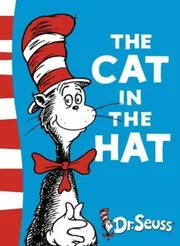
The Cat in the Hat
by Dr. Seuss, Simon Mugford · 1957
It suits early and beginning readers and is a staple for reading aloud to young children.
63 pages, about 1 to 1.5 hours.
A rainy-day romp in rhyme that still moves fast. 56% taste match
About the book
The Cat in the Hat is a children's picture book in rhyming verse, first published in 1957. Dr. Seuss, the pen name of the American author and illustrator Theodor Geisel, wrote it in nonsense verse for young readers, and it belongs to the early reader tradition of American children's literature. Its central figure is a tall cat in a red bow tie and a striped hat.
The action unfolds in a single house during a wet day while a mother is out. Sally and her brother are alone indoors when the Cat turns up uninvited. A fish voices disapproval again and again, yet the visitor goes on with his stunts and games, and two companions named Thing One and Thing Two join in, until the whole household is under their control.
The book has appeared in some 85 editions, typically running about 63 pages. Versions have been issued in several languages, including Spanish, French, and Latin. The Latin edition carries a glossary pairing Latin and English words, along with a note on the verse form and its rhythm.
Es gist nokh a regn.
Themes
Nonsense versesChildren's storiesAmericanReadersSpanish literaturePoetryChildren's literatureSpanish
- Want to read 1,220
- Reading now 86
- Read 212
- Stopped 1
Most people shelving it are saving it for later.
Of 1519 readers who put it on a shelf, 80% want to read it, 6% are reading it now, 14% have finished it and 0% stopped before the end.
By the numbers
- The median edition runs 63 pages. Counting about 275 words a page and an adult reading pace of 250 words a minute, that is about 70 minutes of reading.
- Open Library tracks 85 editions from 44 publishers, the earliest dated 1957 and the latest 2018, across 10 languages.
- On reader demand it ranks in the top 1% of the classic books in our catalog (8,749 of them).
- Libraries shelve it under Dewey 813.54 and Library of Congress class PZ-0090.00000000.Y5 S43 2003.
 BookWard’s take
A rainy-day romp in rhyme that still moves fast
The Cat in the Hat is 63 pages of rhyming nonsense verse, and it earns its reputation by getting going immediately. The hook is instant: two children alone on a wet day, and then a tall cat in a striped hat is simply there. It is short, bouncy, and quick on its feet, with no sagging middle to speak of. The cast stays small and the setting is one house, yet the chaos feels big. The voice is unmistakable, and the verse is built around rhythm, so the writing is playful rather than plain or ornate. It stays light in tone, and it never feels worn, because the premise is odd and original. A few brisk stunts and a fish who keeps objecting give the humor a gentle edge.
At 63 pages it is about as short as a book gets, which matches BookWard's love of tight reads.
Stunts and games tumble along on the rhythm of the verse, keeping it quick from start to finish.
The Cat, Thing One and Thing Two, and the rhyme-driven chaos feel inventive and still distinctive.
The verse is bouncy and rhythmic, but built from simple words, so it sits in the plain-to-middle range.
It is driven by events and stunts in the house, not by inner change in its characters.
The tone is upbeat and bright, though the trouble in the house adds a nervous note.
A straightforward rhymed story from arrival to cleanup, with little formal experiment.
Silliness and slapstick run through it, with a fish playing the worried straight man.
See all 50 dialsEvery position, side by side with this book
Where it lines up
- LengthBookWard 1 · book 1
- OpeningBookWard 10 · book 10
- EndingBookWard 8 · book 8
Where it pulls apart
- Internal logicBookWard 10 · book 4
- Character depthBookWard 8 · book 3
- Familiar tropesBookWard 10 · book 8
At 63 pages it is about as short as a book gets, which matches BookWard's love of tight reads.
A uninvited Cat shows up almost at once, so there is no slow warm-up, just the way BookWard likes it.
Its giddy premise and rhythms feel fresh rather than stock, though the visiting-stranger setup is a classic shape.
Nonsense verse runs on dream logic, so the rules bend freely; BookWard prizes airtight, and this plays loose on purpose.
Stunts and games tumble along on the rhythm of the verse, keeping it quick from start to finish.
The Cat, Thing One and Thing Two, and the rhyme-driven chaos feel inventive and still distinctive.
The characters are bold types, defined by a trick or a worry, not deeply drawn, which is fine for the form.
The disorder is dealt with and the story closes cleanly, which suits BookWard's liking for resolution.
It is cheerful and warm without leaning hard on tears or sweetness.
Nothing here is dark; the mischief is silly rather than shocking, so there is no cheap darkness to earn.
This is a children's story in verse, so rigor does not apply.
Dr. Seuss's rhythm and playful verse are instantly recognizable and unlike anything generic.
It is a story-led romp, driven by what the Cat does next rather than by an argument.
Everything happens in scene and rhyme, with nothing explained outright, just how BookWard prefers.
At this length, the energy holds from first rhyme to last without a dip.
The verse is bouncy and rhythmic, but built from simple words, so it sits in the plain-to-middle range.
It is driven by events and stunts in the house, not by inner change in its characters.
The tone is upbeat and bright, though the trouble in the house adds a nervous note.
A straightforward rhymed story from arrival to cleanup, with little formal experiment.
Silliness and slapstick run through it, with a fish playing the worried straight man.
Rhymes and short lines make this an easy read, even for early readers.
Events unfold in one steady telling, without switching perspectives.
It plays out in a single linear rainy day.
A tall talking cat and Thing One and Thing Two push it well beyond the ordinary, though the home is realistic.
Just the two children, the Cat, the fish, and the Things make for a very small cast.
One house on a rainy day keeps the stakes small and close.
The pages are given over to what the Cat does, not to what anyone thinks.
Spoken lines carry a good share of the rhyme, with the Cat and fish trading remarks.
There is no romance anywhere in it.
A familiar home on a wet day is the entire setting.
First published in 1957, so it reads as mid-century, even if the premise is evergreen.
The mischief of a bored, rainy day has stayed relevant across generations and editions.
The telling is straightforward and trustworthy, with nothing held back from the reader.
The lines between mischief and trouble are fairly plain, with a modest lesson about the guest.
Verse and imagery sketch the scene, but it leans on pictures and action more than detail.
Review written by BookWard, dial version 1, November 2026.
Who is The Cat in the Hat right for?
It suits early and beginning readers and is a staple for reading aloud to young children. The mischief is mild, though some parents may want to talk about the children being home alone with a stranger.
Rhymes and short lines make this an easy read, even for early readers.
Book CompanionThe Cat in the Hat: ideas, characters, themes
A bored rainy day turns chaotic when a mischievous Cat arrives to entertain two children.
- The setup. Two children are home alone on a rainy day while their mother is out.
- The visitor. The Cat in the Hat arrives uninvited and offers tricks and games.
- The objector. A fish repeatedly voices disapproval of what the Cat is doing.
- The helpers. Thing One and Thing Two join the Cat as the stunts grow.
- The form. It is told in rhyming nonsense verse, with a rhythm built for reading aloud.
Characters
The Cat in the Hat
The visitor
A tall cat in a red bow tie and striped hat who shows up to entertain.
Sally
One of the children
A young girl home with her brother on a rainy day.
Thing One and Thing Two
The Cat's companions
Two companions who join in and help take over the house.
The fish
The voice of caution
Objects again and again to the Cat's behavior.
Themes
What children do with an empty rainy day.
Fun that pushes against the rules of the house.
Who looks after things when a parent is away.
How quickly a calm home can be turned upside down.
Discussion questions
- What would you do on a rainy day with no one to tell you the rules?
- Why does the fish keep objecting, and is he right?
- How does the rhyme change the way the story feels when read aloud?
- Is the Cat a good guest or a bad one?
- What would happen if the mother came home at the wrong moment?
Personalize your Book Companion
This is the general edition. In BookWard, the Companion is written for you: your reading profile, your notes, and spoiler-safe to the page you are on.
Buy, listen or borrow The Cat in the Hat
Each link opens a search for this book on that store, in a new tab.
Read on a device
Borrow
Reviews and community
If you liked The Cat in the Hat
A tiny mouse outwits the whole forest in rhyme
Room on the BroomJulia DonaldsonA rhyming broomstick tale where kindness gets crowded and then pays off
The Tale of Peter RabbitBeatrix PotterA tiny garden chase that still moves faster than most thrillers
The reluctant dragonKenneth GrahameA gentle dragon, a kind boy, and one very polite compromise
Sources: Open Library.
Track The Cat in the Hat and find your next favorite
Add it to your shelf, rate what you have read, and BookWard will recommend what fits you.
Free to start. No credit card needed.