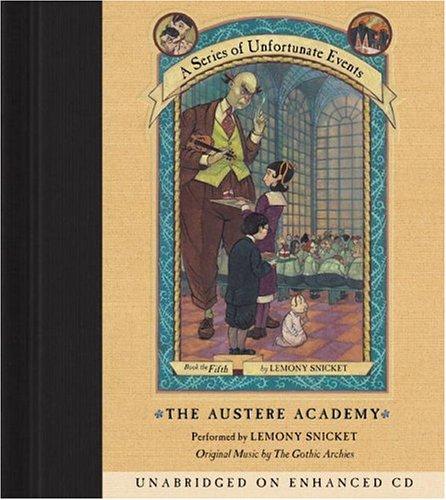
The Austere Academy
by Lemony Snicket
★ Top 25 book of 2000 · #20 on Best Books of 2000
The Baudelaire orphans arrive at Prufrock Preparatory School beneath a stone arch bearing a gloomy motto about remembering you will die. It is another wonderfully bleak chapter in the Series of Unfortunate Events, aimed at ages 10 and up.
Best for: Readers aged 10 and up who enjoy dark, bleak, morbid stories.
The Austere Academy is #20 on BookWard's Best Books of 2000, out of 46 2000 books that cleared our data bar.
What The Austere Academy is about
The Baudelaire orphans, Violet, Klaus and Sunny, are sent by Mr. Poe to Prufrock Preparatory School. It looks like a cemetery, and its motto is Memento Mori, Remember You Will Die. Vice Principal Nero makes the children sleep in a damp, crab-infested shack and sit through his nightly violin concerts, while the rude Carmelita Spats calls them cakesniffers.
They find friends in the Quagmire triplets, Duncan and Isadora, but trouble is never far behind. A new gym teacher turns up who seems oddly familiar to everyone except the grown-ups, and the children face impossible demands with their place at the school at stake. This is the fifth book in A Series of Unfortunate Events, a darkly comic and absurd story about clever children coping with foolish adults.
The Austere Academy on the Best Books of 2000
The Austere Academy came out in 2000. Of the 46 books first published in 2000 that met BookWard's data bar, it ranks #20 on our Best Books of 2000 list.
Why it made the list: 192 readers have shelved it on Open Library; readers rate it 4.1 out of 5 (41 ratings). The list ranks each year’s books on how many readers have picked them up, how highly readers rate them, and how many are reading them right now.
Nearby on the 2000 list
- Me Talk Pretty One Day David Sedaris, #18
- The Visitor Lee Child, #19
See all Best Books of 2000 Best books by year
More years: Best Books of 1999 Best Books of 2001.
The numbers behind it
- Readers: 103 want to read it, 7 are reading it now and 82 have read it, according to Open Library.
- Ratings: 4.1 out of 5 from 41 Open Library ratings.
| Signal | This book (0 to 100) | Weight |
|---|---|---|
| Reach | 39 | 55% |
| Reader love | 80 | 25% |
| Being read right now | 26 | 20% |
Questions about The Austere Academy
When was The Austere Academy published?
The Austere Academy by Lemony Snicket was first published in 2000.
Was The Austere Academy one of the best books of 2000?
The Austere Academy is #20 on BookWard's Best Books of 2000, out of 46 2000 books that cleared our data bar. 192 readers have shelved it on Open Library; readers rate it 4.1 out of 5 (41 ratings).
Why is The Austere Academy on the Best Books of 2000 list?
192 readers have shelved it on Open Library; readers rate it 4.1 out of 5 (41 ratings).
More of the best books of 2000
- Harry Potter and the Goblet of Fire J. K. Rowling, #1
- The 48 Laws of Power Robert Greene, #2
- Because of Winn-Dixie Kate DiCamillo, #3
- The Gruffalo Julia Donaldson, #4
- Life of Pi Yann Martel, #5
- Esperanza Rising Pam Muñoz Ryan, #6
See the full Best Books of 2000, the Top 100, or new books on Rising.
How we know
This page uses public data: Open Library reader counts and ratings, and Wikipedia page views for recent years. The description is paraphrased from real source text. Rankings reflect reading interest, not quality or sales, and can be affected by data gaps. Lists update monthly.
Suits readers around ten and up who enjoy dark comedy and a strong narrator.
Depends on the edition you pick.
A gleefully bleak boarding-school entry in a famously morbid series. 56% taste match
 BookWard’s take
A gleefully bleak boarding-school entry in a famously morbid series
The fifth Baudelaire book sends Violet, Klaus and Sunny to Prufrock Preparatory School, a place that looks like a cemetery and runs on absurd, petty rules. It hooks at once: the stone arch with its motto, Memento Mori, sets the tone before the children have unpacked. The originality is in the voice, a narrator who warns, digresses and defines words with a straight face, so the book is distinctive and funny while staying dark. Its logic is cartoonishly cruel but consistent, and the pace stays brisk across short chapters. The trade-off is familiarity: if you have read the earlier books, the pattern of bad adults and failing guardians is recognizable. BookWard likes the voice more than the formula.
A short children's novel with brisk chapters, which suits BookWard's love of tight books.
Short chapters and a steady stream of petty indignities keep things moving, close to BookWard's fast preference.
The deadpan, warning-laden narration is unlike most children's fiction, though the series pattern limits how fresh it feels.
The sentences are plain and clear, with the flavor coming from the narrator's asides rather than ornament.
Events and the villain's schemes drive the book more than the characters' inner change.
The tone is bleak and the orphans keep losing, with only friendship and cleverness as relief.
A linear chapter-by-chapter story, with the narrator's digressions as the only departure from convention.
Deadpan misery is the engine here, played for laughs even at the grimmest moments.
The gloom and misery are heavy in atmosphere, though softened by humor.
Feelings are kept at arm's length by the narrator's dry tone.
See all 50 dialsEvery position, side by side with this book
Where it lines up
- Story or ideasBookWard 3 · book 3
- LengthBookWard 1 · book 2
- OpeningBookWard 10 · book 9
Where it pulls apart
- Familiar tropesBookWard 10 · book 6
- Internal logicBookWard 10 · book 7
- EndingBookWard 8 · book 4
A short children's novel with brisk chapters, which suits BookWard's love of tight books.
The cemetery-like school and its Memento Mori arch grab you before the first rule is announced, matching BookWard's taste for instant hooks.
The cruel-adult and failed-guardian pattern repeats across the series, so it leans on its own formula more than BookWard prefers.
The absurd rules are cruel but applied consistently, and the story holds together within its own heightened world.
Short chapters and a steady stream of petty indignities keep things moving, close to BookWard's fast preference.
The deadpan, warning-laden narration is unlike most children's fiction, though the series pattern limits how fresh it feels.
The Baudelaires and the Quagmires are sketched with distinct talents, but most adults are comic types, below BookWard's depth.
Like the other books it resolves the school episode while leaving the larger mystery open, a partial fit for BookWard.
The sorrow is played for dry comedy rather than tears, though the orphans' loyalty stays warm.
The misery is comic and exaggerated, a mild version of dark that never feels cheap.
This is a novel, so rigor does not apply.
Lemony Snicket's narrator is among the most distinctive in children's fiction, exactly what BookWard rewards.
This is story-led, built around the school, its rules and Count Olaf's disguises rather than around an argument.
The narrator often stops to define words and explain things outright, which pulls it toward explanation more than BookWard likes.
Short chapters and escalating indignities keep the middle moving.
The sentences are plain and clear, with the flavor coming from the narrator's asides rather than ornament.
Events and the villain's schemes drive the book more than the characters' inner change.
The tone is bleak and the orphans keep losing, with only friendship and cleverness as relief.
A linear chapter-by-chapter story, with the narrator's digressions as the only departure from convention.
Deadpan misery is the engine here, played for laughs even at the grimmest moments.
It is an easy, quick read aimed at readers of ten and up.
The story stays with the Baudelaires, narrated by a single commenting voice.
The story runs forward in order, with no time jumps.
The world is slightly unreal and exaggerated but largely grounded, with no magic.
A modest cast of siblings, schoolmates, staff and the recurring villain.
The stakes stay small and local: one school, one villain, three children.
Action and incident outweigh reflection, though the narrator comments constantly.
Conversations carry much of the humor, especially the exchanges with the school's bad adults.
Romance plays no part in the story.
The boarding school with its crab-infested shack and absurd rules feels invented and unfamiliar.
The setting has a deliberately vague, old-fashioned feel rather than a clear present day.
The mix of voice, dread and comedy has kept the series appealing well beyond its debut.
The narrator is open about being a narrator and is reliable in his warnings, if theatrical.
Good and bad are clearly marked: the orphans are decent, the adults are monstrous.
Settings are drawn in a few strong, comic strokes, such as the shack and the arch, not at length.
This is book five of A Series of Unfortunate Events and works best read in order.
Count Olaf's disguises supply some surprise, but the pattern is familiar to series readers.
It is a comforting kind of unhappiness, easy to take despite the gloom.
The gloom and misery are heavy in atmosphere, though softened by humor.
Feelings are kept at arm's length by the narrator's dry tone.
The humor is deadpan with some broad absurdity in the school's rules and punishments.
Little physical violence is shown; the cruelty is mostly petty and psychological.
There is no sexual content.
There is no political content beyond a general mockery of negligent authority.
The language is plain and clear, with defined vocabulary here and there.
The narrator offers constant commentary, warnings and advice, making the book strongly opinionated.
The story keeps the orphans' past losses in view and looks ahead mainly to the next scheme.
The world is cruel and adults fail, though loyalty between the siblings offers some warmth.
Review written by BookWard, dial version 1, November 2026.
Who is The Austere Academy right for?
Suits readers around ten and up who enjoy dark comedy and a strong narrator. It deals with orphanhood and bullying, though in a comic, non-graphic way.
It is an easy, quick read aimed at readers of ten and up.
The gloom and misery are heavy in atmosphere, though softened by humor.
Feelings are kept at arm's length by the narrator's dry tone.
Little physical violence is shown; the cruelty is mostly petty and psychological.
Book CompanionThe Austere Academy: ideas, characters, themes
Three orphans arrive at a school run by petty, monstrous adults, where cleverness and friendship are their only protection.
- The school's motto. Memento Mori, Remember You Will Die, greets the children and sets the grim comic tone.
- Absurd rules and punishments. The orphans must sleep in a crab-infested shack and attend Vice Principal Nero's nightly violin concerts.
- New friends. Duncan and Isadora Quagmire stand up for the Baudelaires and become allies.
- Sunny's work. Too young to be a student, Sunny is made Nero's administrative assistant.
- Count Olaf returns. The villain turns up again in disguise, continuing the series pattern.
Characters
Violet Baudelaire
Eldest Baudelaire
Forced to take detailed notes in Mr. Remora's class.
Klaus Baudelaire
Middle Baudelaire
Made to measure objects endlessly in Mrs. Bass's class.
Sunny Baudelaire
Youngest Baudelaire
Struggles with the adult administrative work she is given.
Vice Principal Nero
School authority
Enforces odd rules and insists on terrible violin concerts.
Carmelita Spats
Rude schoolmate
Mocks the Baudelaires and calls them cakesniffers.
Themes
Adults in charge are foolish or cruel, and children must cope without their help.
The Quagmires offer the Baudelaires support when the adults do not.
The school's motto and look keep death at the edge of every scene.
The children rely on their own talents to get through hardship.
Silly rules and punishments are enforced as if they made sense.
Discussion questions
- Why does the narrator keep warning readers away from the story?
- How do the Quagmires change the Baudelaires' experience of the school?
- What makes the school's rules funny rather than only cruel?
- Why do you think adults in this series so often fail the children?
- How does the book use its gloomy setting for humor?
Personalize your Book Companion
This is the general edition. In BookWard, the Companion is written for you: your reading profile, your notes, and spoiler-safe to the page you are on.
Buy, listen or borrow The Austere Academy
Each link opens a search for this book on that store, in a new tab.
Read on a device
Borrow
Reviews and community
If you liked The Austere Academy
A dark, funny orphan tale where the whole village is the villain
The Bad BeginningLemony SnicketA short, wry orphan tale that dares you to keep reading
The Wide WindowLemony SnicketAunt Josephine fears everything, and Lake Lachrymose has plenty to be afraid of
The Slippery SlopeLemony SnicketSnicket's tenth Baudelaire misfortune takes the orphans up a mountain
Find your own best books
Add what you have read, rate it, and BookWard will recommend what to read next.
Free to start. No credit card needed.