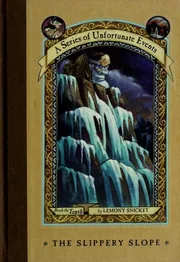
The Slippery Slope
by Lemony Snicket, Brett Helquist · 2003
Suits confident readers roughly eight to twelve who enjoy dark comedy and wordplay.
337 pages, about 5.5 to 8 hours.
Snicket's tenth Baudelaire misfortune takes the orphans up a mountain. 54% taste match
About the book
The Slippery Slope is the tenth book in Lemony Snicket's children's series about the Baudelaire orphans, first published in 2003. It is a humorous work of juvenile fiction that follows three siblings, Violet, Klaus, and Sunny, who have lost their parents in a fire and must make their own way through one misfortune after another.
In this volume the Baudelaires travel through a range of mountains, going up and then back down again as they face a string of troubles. Along the way they encounter a secret message, a toboggan, a map that misleads them, a swarm of snow gnats, a scheming villain, a group of organized young people, a covered casserole dish, and a survivor of the earlier fire. The narrator, who presents himself as a researcher devoted to recording the children's story, tells it in a mock-gloomy voice. The book runs to roughly 337 pages and has appeared in 26 editions.
A man of my acquaintance once wrote a poem called "The Road Less Traveled," describing a journey he took through the woods along a path most travelers never used.
Setting
Mountainrome
Themes
Humorous storiesMountainsBrothers and sistersOrphanstradestuckHumourSteampunk
- Want to read 103
- Reading now 6
- Read 73
Readers are split between finishing it and saving it for later.
Of 182 readers who put it on a shelf, 57% want to read it, 3% are reading it now, 40% have finished it and 0% stopped before the end.
By the numbers
- The median edition runs 337 pages. Counting about 275 words a page and an adult reading pace of 250 words a minute, that is about 6.2 hours of reading.
- Open Library tracks 26 editions from 12 publishers, the earliest dated 2003 and the latest 2018, across 3 languages.
- On reader demand it ranks in the top 4% of the modern books in our catalog (15,152 of them).
- Libraries shelve it under Dewey 813.54 and Library of Congress class PZ-0007.00000000.S6795Sli 2007.
 BookWard’s take
Snicket's tenth Baudelaire misfortune takes the orphans up a mountain
The tenth book in the Baudelaire series sends Violet, Klaus and Sunny up and down a range of mountains, with a secret message, a misleading map and a scheming villain on the way. Its great asset is voice. Snicket's mock-gloomy narrator, who keeps begging you to put the book down, is distinctive and funny, and it is the best reason to read. It is also a long way into a series, so it asks you to know the earlier books and is no place to start. The humor leans toward the deadpan and the absurd, which suits a taste for wit, though the tone is gently broader than dry. The narrator also explains words and ideas outright rather than leaving them in scene, and he does so often. The pace is brisk, and the stakes stay lightly dark rather than harrowing.
At 337 pages it is mid-length for children's fiction, longer than BookWard's tight ideal but moving quickly.
Mountain peril and shifting plans keep events moving at a steady clip, close to BookWard's preference.
The narrator's relentless self-sabotaging warnings are an unusual device, though the series premise is established by now.
Dry, formal and deliberately arch, it is stylized without being ornate.
Events and obstacles lead, with the children reacting to one misfortune after another.
The tone is melancholy and ironic, with the siblings' loyalty offering the main warmth.
A conventional chapter-by-chapter adventure, with the narrator's asides as the main flourish.
Deadpan gloom and absurd specifics make humor central to the reading experience.
Orphanhood and villainy are real, but softened by comic distance.
Feelings run beneath the jokes more than on the surface.
See all 50 dialsEvery position, side by side with this book
Where it lines up
- PaceBookWard 8 · book 7
- SentimentBookWard 8 · book 7
- Shock for effectBookWard 9 · book 8
Where it pulls apart
- ExpositionBookWard 2 · book 9
- Familiar tropesBookWard 10 · book 6
- Internal logicBookWard 10 · book 6
At 337 pages it is mid-length for children's fiction, longer than BookWard's tight ideal but moving quickly.
Snicket's warning-laden address gets into the story fast, which fits BookWard's taste for immediate hooks.
Orphans, villains and chases are familiar ground, though the mock-gloomy treatment freshens them.
The adventure holds together on its own comic terms, though coincidence does a good deal of work.
Mountain peril and shifting plans keep events moving at a steady clip, close to BookWard's preference.
The narrator's relentless self-sabotaging warnings are an unusual device, though the series premise is established by now.
The three siblings have clear skills and bonds, but they are drawn more lightly than deeply.
As a tenth volume it resolves its own episode while leaving the larger series threads open.
Grief is handled with comic distance rather than sweetness, which BookWard appreciates.
Its troubles are mostly played for gloomy humor rather than cheap shock, which sits well with BookWard.
This is fiction, so the dial does not apply.
The self-described researcher narrator is among children's literature's most recognizable voices, a clear match for BookWard.
Story comes first, with plot and peril driving things, though wordplay is part of the pleasure.
The narrator regularly stops to define words and explain situations outright, well past BookWard's show-in-scene taste.
Episodic mountain trouble keeps energy up, though the series formula can feel repetitive.
Dry, formal and deliberately arch, it is stylized without being ornate.
Events and obstacles lead, with the children reacting to one misfortune after another.
The tone is melancholy and ironic, with the siblings' loyalty offering the main warmth.
A conventional chapter-by-chapter adventure, with the narrator's asides as the main flourish.
Deadpan gloom and absurd specifics make humor central to the reading experience.
Accessible and quick for young readers, with vocabulary the narrator helpfully explains.
Told by one narrator following the siblings as a unit.
The story unfolds in straightforward order.
Set in an exaggerated, slightly storybook world with absurd organizations and snow gnats.
A handful of leads plus a modest supporting group of adults and young people.
The stakes are the siblings' survival and secrets, not world events.
Climbing, escaping and scheming drive the action more than reflection.
Conversations carry much of the humor and plot, with plenty of verbal sparring.
A gloomy, invented-feeling landscape of mountains and eccentric institutions.
Its time is vague and old-fashioned, not recognizably present day.
The orphan-adventure formula and the voice have kept it in print across many editions.
The narrator is open about his bias and his purpose, so he reads as reliable in his way.
Heroes and villains are fairly clear, with some muddying among the adults.
Settings are sketched through vivid, funny details rather than lingering description.
The tenth in a long series, best read after the earlier volumes.
Secret messages, deceptive maps and a returning survivor keep revelations coming.
A light, entertaining read that rarely troubles its audience.
Orphanhood and villainy are real, but softened by comic distance.
Feelings run beneath the jokes more than on the surface.
Mostly dry and arch, with some broader comic setups.
Peril is present but kept off the page or played lightly.
There is no sexual content.
Institutional corruption is a background theme, not a focus.
Language is plain and clear, with occasional elaborate vocabulary explained on the spot.
The narrator editorializes constantly, warning, advising and complaining throughout.
Concerned with the characters' ongoing past losses and immediate survival rather than the future.
Cynical about adults and institutions, but loyal to the children's courage and bond.
Review written by BookWard, dial version 1, November 2026.
Who is The Slippery Slope right for?
Suits confident readers roughly eight to twelve who enjoy dark comedy and wordplay. It deals with orphanhood, a deadly fire and recurring peril, treated with comic distance rather than graphic detail.
Accessible and quick for young readers, with vocabulary the narrator helpfully explains.
Orphanhood and villainy are real, but softened by comic distance.
Feelings run beneath the jokes more than on the surface.
Peril is present but kept off the page or played lightly.
Book CompanionThe Slippery Slope: ideas, characters, themes
Three clever orphans keep trying to survive and outwit a scheming villain, narrated by a man who insists you should stop reading.
- A narrator who warns you off. Snicket opens by urging readers to put the book down, a joke that runs through the whole series.
- The mountain setting. The Baudelaires' journey takes them up and down a range of strange and distressing mountains.
- Clues and false leads. A secret message and a deceitful map shape much of the siblings' route.
- A troupe of organized youngsters. The children meet a group of young people who add new complications.
- A survivor of the fire. A surprising survivor of a terrible fire links this volume to earlier events.
Characters
Violet Baudelaire
Eldest sibling
One of the three orphans, who faces the mountain troubles alongside her siblings.
Klaus Baudelaire
Middle sibling
One of the three orphans caught up in the secret message and map.
Sunny Baudelaire
Youngest sibling
The baby of the family, travelling with her brother and sister.
Lemony Snicket
Narrator
The self-styled researcher who records the children's story and warns you away.
Themes
The siblings keep moving after their parents' death in a fire.
The three stay together and protect one another.
False maps and scheming villains test whom the children can trust.
Bad luck compounds, treated as comic rather than crushing.
The narrator's pleas make the reader complicit in a story they were told to avoid.
Discussion questions
- Why does the narrator keep telling you not to read on?
- How do Violet, Klaus and Sunny each use their strengths?
- What makes the misleading map such a useful plot device?
- Is the humor here darker or lighter than you expected?
- What would you want to know from earlier books before starting this one?
Personalize your Book Companion
This is the general edition. In BookWard, the Companion is written for you: your reading profile, your notes, and spoiler-safe to the page you are on.
Buy, listen or borrow The Slippery Slope
Each link opens a search for this book on that store, in a new tab.
Read on a device
Borrow
Reviews and community
If you liked The Slippery Slope
A wry, mock-gloomy orphan adventure that rewards the curious young reader
The Vile VillageLemony SnicketA dark, funny orphan tale where the whole village is the villain
The Grim GrottoLemony SnicketThe Baudelaires go under water in a dark, funny, deeply unlucky volume
The Austere AcademyLemony SnicketA gleefully bleak boarding-school entry in a famously morbid series
Sources: Open Library.
Track The Slippery Slope and find your next favorite
Add it to your shelf, rate what you have read, and BookWard will recommend what fits you.
Free to start. No credit card needed.