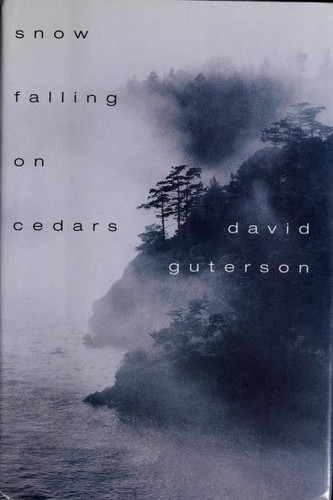
Snow Falling on Cedars
by David Guterson
★ Top 25 book of 1994 · #17 on Best Books of 1994
On a Puget Sound island in 1954, a Japanese-American fisherman is tried for murder while the memory of wartime internment lingers. A newspaper editor covering the case must face his past and his old love.
Best for: Readers who like courtroom drama blended with themes of justice, prejudice and love
Snow Falling on Cedars is #17 on BookWard's Best Books of 1994, out of 42 1994 books that cleared our data bar.
What Snow Falling on Cedars is about
On San Piedro Island, off the coast of Washington state, a fisherman named Carl Heine is found dead in 1954, his body trapped in his own net and his watch stopped at 1:47. Kabuo Miyamoto, a Japanese American man, is charged with killing him. The trial unfolds in December during a snowstorm, in a community still marked by suspicion of anyone of Japanese descent after World War II.
Ishmael Chambers, who edits the local newspaper and lost an arm in the war, covers the proceedings. He also once loved Kabuo's wife, Hatsue, and the memory of their secret high school romance complicates how he sees everything. A disputed strawberry field and a failed land sale are offered as the motive. David Guterson, who wrote the 1994 novel in early mornings while working as a teacher, builds a quiet, atmospheric story about prejudice, the uncertainties of justice, and how the past, including the internment of Hatsue's family at Manzanar, refuses to stay buried.
Snow Falling on Cedars on the Best Books of 1994
Snow Falling on Cedars came out in 1994. Of the 42 books first published in 1994 that met BookWard's data bar, it ranks #17 on our Best Books of 1994 list.
Why it made the list: 345 readers have shelved it on Open Library; readers rate it 3.7 out of 5 (44 ratings). The list ranks each year’s books on how many readers have picked them up, how highly readers rate them, and how many are reading them right now.
Nearby on the 1994 list
- Six Easy Pieces Richard Phillips Feynman, #15
- When I Was Puerto Rican Esmeralda Santiago, #16
- Walk Two Moons Sharon Creech, #18
- It's Perfectly Normal Robie H. Harris, #19
See all Best Books of 1994 Best books by year
More years: Best Books of 1993 Best Books of 1995.
The numbers behind it
- Readers: 283 want to read it, 11 are reading it now and 51 have read it, according to Open Library.
- Ratings: 3.7 out of 5 from 44 Open Library ratings.
| Signal | This book (0 to 100) | Weight |
|---|---|---|
| Reach | 71 | 55% |
| Reader love | 12 | 25% |
| Being read right now | 33 | 20% |
Questions about Snow Falling on Cedars
When was Snow Falling on Cedars published?
Snow Falling on Cedars by David Guterson was first published in 1994.
Was Snow Falling on Cedars one of the best books of 1994?
Snow Falling on Cedars is #17 on BookWard's Best Books of 1994, out of 42 1994 books that cleared our data bar. 345 readers have shelved it on Open Library; readers rate it 3.7 out of 5 (44 ratings).
Why is Snow Falling on Cedars on the Best Books of 1994 list?
345 readers have shelved it on Open Library; readers rate it 3.7 out of 5 (44 ratings).
More of the best books of 1994
- Guess How Much I Love You Sam McBratney, #1
- Artificial Intelligence Stuart J. Russell, #2
- The Six Pillars of Self-esteem Nathaniel Branden, #3
- Long Walk to Freedom Nelson Mandela, #4
- Mercury and Me Jim Hutton, #5
- Men Are from Mars, Women Are from Venus John Gray, #6
See the full Best Books of 1994, the Top 100, or new books on Rising.
How we know
This page uses public data: Open Library reader counts and ratings, and Wikipedia page views for recent years. The description is paraphrased from real source text. Rankings reflect reading interest, not quality or sales, and can be affected by data gaps. Lists update monthly.
Best suited to mature teens and adults who can handle a slow, reflective novel.
Depends on the edition you pick.
A courtroom drama where snow and memory press on an island. 49% taste match
 BookWard’s take
A courtroom drama where snow and memory press on an island
Guterson sets a murder trial on San Piedro Island in 1954 and lets a snowstorm close in around it. The first thing to adjust to is the pace: the book moves slowly, and this is where I part company with it, since the trial keeps pausing for long flashbacks. Those flashbacks are also where the characters earn their depth, with Ishmael Chambers, a one-armed newspaper editor, and Hatsue drawn through years of shared history. The story passes through many minds, which gives the island a crowded, communal feel, and the prose runs ornate, with weather and landscape rendered in rich detail. The ending is more resolved than ambiguous, and the book treats prejudice and justice without easy answers. Patient readers get a carefully built, humane novel.
A full-sized novel that gives its flashbacks room, so it runs longer than BookWard's taste for the tight and short.
The trial advances in small steps and keeps stopping for the past, which is slower than BookWard likes.
The island setting, the postwar tensions and the snowbound trial give familiar material a distinct shape.
The writing is lyrical and weather-soaked, richer than BookWard's middle-leaning preference.
The mystery frames it, but people and their past entanglements drive the book.
Heavy subjects and wartime injury weigh on it, with some grace and moral action as counterweight.
Flashbacks threaded through a single trial give it more shape than a straight chronicle.
This is a grave book, with little room for levity.
Murder, war injury and prejudice shadow the story, though it stays measured rather than grim.
Love, loss and moral strain run deep, delivered with feeling but not melodrama.
See all 50 dialsEvery position, side by side with this book
Where it lines up
- Character depthBookWard 8 · book 8
- EndingBookWard 8 · book 8
- Shock for effectBookWard 9 · book 8
Where it pulls apart
- OpeningBookWard 10 · book 4
- Rigor (nonfiction)BookWard 9 · book 1
- LengthBookWard 1 · book 6
A full-sized novel that gives its flashbacks room, so it runs longer than BookWard's taste for the tight and short.
It opens on a murder trial, but unhurriedly, so the pull builds gradually where BookWard wants an immediate grip.
A courtroom mystery and a forbidden youthful romance are familiar frames, though the setting and moral weight freshen them.
The case rests on concrete details, like a stopped watch and a net, and the story holds together soundly.
The trial advances in small steps and keeps stopping for the past, which is slower than BookWard likes.
The island setting, the postwar tensions and the snowbound trial give familiar material a distinct shape.
Ishmael, Hatsue and Kabuo are given years of history, which suits BookWard's appetite for deeply drawn people.
The central question of the trial is settled, giving the resolution BookWard values.
There is real feeling in the love story, but it is handled with some restraint rather than syrup.
The darkness grows from the murder case, wartime wounds and prejudice, not from shock for its own sake.
This is a novel, so the rigor dial does not apply.
Guterson's patient, landscape-minded narration is recognizable and consistent across the book.
Ideas about justice and prejudice matter, but a trial and a love story carry the book.
Much of the history arrives through extended flashback, which explains as much as it dramatizes.
The alternation of courtroom and flashback keeps momentum mostly steady, though some stretches drift.
The writing is lyrical and weather-soaked, richer than BookWard's middle-leaning preference.
The mystery frames it, but people and their past entanglements drive the book.
Heavy subjects and wartime injury weigh on it, with some grace and moral action as counterweight.
Flashbacks threaded through a single trial give it more shape than a straight chronicle.
This is a grave book, with little room for levity.
The prose and shifting time ask for some patience, but the story stays accessible.
The story moves among many minds in the community, well beyond a single point of view.
Extended flashbacks move between the 1954 trial and prior decades throughout.
Entirely grounded in a real coastal Pacific Northwest setting.
A whole island community appears, from lawyers and sheriff to fishermen and families.
Everything centers on one island and one trial, an intimate canvas despite the war's shadow.
Memory, guilt and conscience drive much of the story more than outward action.
Courtroom testimony supplies a good deal of talk, balanced against long descriptive passages.
The long-lost boyhood love of Ishmael and Hatsue is a major thread alongside the trial.
A fishing and strawberry-farming island in 1954 will be unfamiliar territory for most readers.
Set in 1954 with flashbacks into the war years, firmly in the past.
Its concerns of prejudice, justice and conscience continue to resonate beyond its postwar setting.
The narration is a trustworthy third-person view without trickery.
Guilt, justice and loyalty are weighed without tidy verdicts on the people involved.
Snow, sea and cedar country are described at length and in rich detail.
This is a novel, so the nonfiction style dial does not apply.
This is a novel, so the perspective dial does not apply.
A self-contained novel with no sequels in its frame.
Revelations arrive through the flashbacks, but the book is not built around a string of twists.
It confronts racism and wartime injustice, asking more than it comforts.
Murder, war injury and prejudice shadow the story, though it stays measured rather than grim.
Love, loss and moral strain run deep, delivered with feeling but not melodrama.
Humor is largely absent, and what little lightness exists is dry.
Violence is mostly in the past, wartime memory and a death at sea, rather than on stage.
A youthful relationship is part of the backstory, touched on without being the book's focus.
Anti-Japanese sentiment after the war sits at the center of the trial and community.
The language is literary but approachable, without heavy dialect.
The narration observes and reflects rather than lecturing the reader.
It looks back, dwelling on the war and the past that shaped the present.
It holds out for individual moral action while acknowledging prejudice and indifference.
Review written by BookWard, dial version 1, November 2026.
Who is Snow Falling on Cedars right for?
Best suited to mature teens and adults who can handle a slow, reflective novel. It deals with racism, war injury, a death and a youthful sexual relationship.
The prose and shifting time ask for some patience, but the story stays accessible.
Murder, war injury and prejudice shadow the story, though it stays measured rather than grim.
Love, loss and moral strain run deep, delivered with feeling but not melodrama.
Violence is mostly in the past, wartime memory and a death at sea, rather than on stage.
Book CompanionSnow Falling on Cedars: ideas, characters, themes
A murder trial on a snowbound island forces a community and one wounded newspaperman to reckon with prejudice, memory and the limits of justice.
- A trial in a storm. The 1954 case against Kabuo Miyamoto unfolds while a heavy snowstorm grips San Piedro Island.
- The accused. Kabuo, a Japanese American fisherman and war veteran, is charged with killing the respected fisherman Carl Heine.
- The reporter. Ishmael Chambers, who lost an arm in the war, covers the trial while carrying his own history with the accused man's wife.
- Flashbacks. Long returns to earlier decades show how the main characters came to be entangled.
- Prejudice after the war. The trial takes place amid deep anti-Japanese sentiment following World War II.
Characters
Ishmael Chambers
Newspaper editor and war veteran
He runs the island's newspaper and covers the trial, torn between old feelings and his conscience.
Kabuo Miyamoto
The accused
A Japanese American fisherman and decorated war veteran standing trial for murder.
Hatsue Miyamoto
Kabuo's wife
Kabuo's wife and Ishmael's boyhood love, linking the two men.
Carl Heine
The victim
A respected fisherman whose body was found tangled in his own net.
Nels Gudmondsson
Defense attorney
The old, experienced lawyer who leads Kabuo's defense.
Themes
How racism shapes the way a close community sees its neighbors.
The gap between what is proven in court and what is true.
How earlier choices and wartime experience continue to shape the present.
The sea and snow carry on regardless of human struggles.
The necessity of individual conscience when circumstances offer no easy answers.
Discussion questions
- How does the snowstorm shape the mood and meaning of the trial?
- Why might Guterson tell so much of the story through flashbacks?
- How does Ishmael's past with Hatsue complicate his role as a reporter?
- In what ways does postwar prejudice affect how witnesses are heard?
- What does the book suggest about individual responsibility when justice is uncertain?
Personalize your Book Companion
This is the general edition. In BookWard, the Companion is written for you: your reading profile, your notes, and spoiler-safe to the page you are on.
Buy, listen or borrow Snow Falling on Cedars
Each link opens a search for this book on that store, in a new tab.
Read on a device
Borrow
Reviews and community
If you liked Snow Falling on Cedars
A small Ohio town, two families, and one buried secret
Where the Crawdads SingDelia OwensA marsh girl, a death, and a slow-burning mystery
John of JohnDouglas StuartA returning son, a stern father, and a croft full of secrets
Hearts in AtlantisStephen KingStephen King's elegy for the sixties and the generation that blew it
Find your own best books
Add what you have read, rate it, and BookWard will recommend what to read next.
Free to start. No credit card needed.