Updated November 2, 2026 · reading data through October 2026
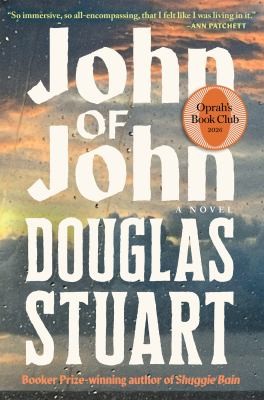
John of John
by Douglas Stuart
Out of money and with little to show for art school, John-Calum Macleod takes the ferry home to the Isle of Harris in the Outer Hebrides. Little has changed there except for him.
Best for: Readers who like novels about home, class and belonging.
John of John is #23 on BookWard's Rising chart for November 2026: the hottest new books published in the past two years.
What John of John is about
Cal MacLeod is 22 and fresh from four years at art school in Edinburgh when he heads home to his family's croft on the Isle of Harris in the late 1990s. His father, John, a sheep farmer, weaver and deacon in the island's strict Presbyterian church, has called him back with word that Cal's grandmother Ella is gravely ill. Ella turns out to be remarkably sturdy, a Glaswegian who won't speak Gaelic and swears freely, and it becomes clear the summons had another purpose.
Father and son soon clash over Cal's dyed long hair, ripped jeans and rejection of his father's austere faith. Each also hides his sexuality from the other. John's wife, Grace, has left him for his own brother, a loss that hangs over the household. The title comes from Cal's reply to an elderly passenger who asks "Who do you belong to?": "John of John of Ian of Ian the Breabadair", breabadair meaning weaver. Present tension is interleaved with flashbacks that uncover old family secrets. Douglas Stuart's novel was shortlisted for the 2026 Booker Prize.
Why John of John is on the Rising chart
Its Wikipedia page had 19,129 views last month. The Rising score blends six public signals, each scored from 0 to 100 against the other new books and weighted as shown.
| Signal | This book | Weight |
|---|---|---|
| Reader pace | 18 | 28% |
| Buzz | 84 | 24% |
| Growth | 9 | 18% |
| Being read right now | 43 | 12% |
| Reader love | 68 | 10% |
| Newness | 100 | 8% |
Holding strong Wikipedia attention is steady (within -20% to +25% of the two months before).
The numbers behind it
- Wikipedia: 19,129 page views last month, against an average of 22,227 in the two months before (down 14%). Read the article.
- Open Library readers: 1 want to read, 0 reading now, 1 have read it.
- Ratings: 5 out of 5 from 1 Open Library ratings.
John of John on the Rising chart: history
| Month | Rank | Score |
|---|---|---|
| November 2026 | #23 | 47 |
| October 2026 | #22 | 52 |
Questions about John of John
Is John of John a new book?
Yes. John of John by Douglas Stuart was first published in 2026, and BookWard's Rising chart only includes books published in the past two years.
Why is John of John on the Rising chart?
Its Wikipedia page had 19,129 views last month.
More new books readers are finding
- Life of M Rachel Cusk
- The Things We Never Say Elizabeth Strout
- Dream Count Chimamanda Ngozi Adichie
- Switzy Emma Cline
Prefer proven favorites? See the Top 100, or all Rising books.
How we know
This page uses public data: Open Library reader counts and ratings, and Wikipedia page views. The description is paraphrased from real source text (Open Library or Wikipedia). A book is on the Rising chart only if it was published in 2025 or 2026 and its readers are active and its interest is not falling. Rankings reflect reading interest, not quality or sales. Read the full methodology.
Suited to adult readers and mature older teens who enjoy literary family drama.
Depends on the edition you pick.
A returning son, a stern father, and a croft full of secrets. 59% taste match
 BookWard’s take
A returning son, a stern father, and a croft full of secrets
Douglas Stuart sets this on the Isle of Harris in the late 1990s, where 22-year-old Cal comes home from art school in Edinburgh to a father who is a Presbyterian deacon and a sharp-tongued Glaswegian grandmother. The setup is intimate, and the book is character-driven, with its real strength in the people: a father and son each hiding who they are from the other. The setting will be unfamiliar to most readers, which gives it fresh ground, and the strict Calvinist community and the croft feel drawn from a specific place rather than from stock material. The voice is distinctive enough that it's easy to see why the Booker shortlist took notice. Expect a quiet, tense domestic story rather than a fast one, with family secrets surfacing as the seasons turn.
A family drama on one croft over a lambing-to-shearing season suggests a mid-length novel, a little longer than BookWard's tight preference.
This is a slow-burning domestic drama of strained exchanges and secrets, steadier than BookWard's brisker preference.
The Hebridean Calvinist setting is rarely written about, though the coming-home frame is a familiar one.
The setting and speech invite rich language, but this is grounded literary prose rather than showy ornament.
The drama comes almost entirely from who these people are and what they hide from one another.
The material is heavy, with repression and loss, yet the book's emphasis on truth and change leaves room for hope.
Present-day scenes weave with flashbacks, a gentle departure from straight chronology but no formal experiment.
Ella's profanity brings some dry relief, but the book is mostly serious in tone.
See all 50 dialsEvery position, side by side with this book
Where it lines up
- Story or ideasBookWard 3 · book 3
- Character depthBookWard 8 · book 9
- Authorial voiceBookWard 9 · book 8
Where it pulls apart
- LengthBookWard 1 · book 5
- OpeningBookWard 10 · book 6
- Familiar tropesBookWard 10 · book 7
A family drama on one croft over a lambing-to-shearing season suggests a mid-length novel, a little longer than BookWard's tight preference.
The return by ferry and a father's summons set tension quickly, though the book builds through relationships rather than immediate jolts.
A gay son and a strict religious father is a known setup, but the Harris setting and Gaelic-Presbyterian detail keep it from feeling stock.
The family's motives and the community's rules hold together, matching BookWard's taste for sound internal logic.
This is a slow-burning domestic drama of strained exchanges and secrets, steadier than BookWard's brisker preference.
The Hebridean Calvinist setting is rarely written about, though the coming-home frame is a familiar one.
Cal, his father John and grandmother Ella each carry secrets and contradictions, which is just what BookWard values.
A book built on secrets coming to light should resolve its main threads, though some feeling may stay unsettled.
The harshness here comes from public shaming, repression and family conflict rooted in the story, not shock for its own sake.
Not applicable to a novel.
Stuart's strong sense of place and speech, including Ella's profane English, gives the book a distinct voice.
This is story-led, driven by a family's tensions and concealments rather than by an argument.
Customs and secrets come through scenes and flashbacks, with the title itself explained in a single ferry exchange.
A seasonal arc from lambing to shearing gives the middle structure, though a quiet domestic story can drift in places.
The setting and speech invite rich language, but this is grounded literary prose rather than showy ornament.
The drama comes almost entirely from who these people are and what they hide from one another.
The material is heavy, with repression and loss, yet the book's emphasis on truth and change leaves room for hope.
Present-day scenes weave with flashbacks, a gentle departure from straight chronology but no formal experiment.
Ella's profanity brings some dry relief, but the book is mostly serious in tone.
Dialect and a layered family history ask some attention, though the story itself is approachable.
Flashbacks reveal long-held family secrets alongside the present-day story, so time shifts moderately.
A realist story of croft life and church discipline, with no fantastical element.
The core is a small family household on a remote island, with a few community figures around it.
The stakes are intimate, played out in one house, one church and one island community.
Much of the weight is in what Cal and John feel and conceal, with plot events as the outward trace.
Tense exchanges between father and son and Ella's blunt talk make dialogue a major engine of the book.
Cal's and John's hidden desires matter, but the book centers on family rather than a love story.
A 1990s Presbyterian crofting community in the Outer Hebrides will be unfamiliar to many readers.
Set in the late 1990s, it looks back rather than reflecting the present day.
Themes of faith, secrecy and belonging suggest lasting appeal beyond its moment.
Faith, duty and honesty pull against each other here, so the moral questions are layered rather than neatly answered.
The windswept croft, the island and the weaving craft call for vivid, textured description.
Review written by BookWard, dial version 1, November 2026.
Who is John of John right for?
Suited to adult readers and mature older teens who enjoy literary family drama. It includes religious shaming, family conflict that turns violent at times, and themes of sexuality and repression.
Dialect and a layered family history ask some attention, though the story itself is approachable.
Book CompanionJohn of John: ideas, characters, themes
A young man returns to his strict island family and finds that father and son are each hiding the truth about who they are.
- The return. Cal comes back to Harris from art school in Edinburgh, summoned by his father with news of his grandmother's illness.
- The false alarm. Ella is far more vigorous than the summons implied, so the call serves another purpose.
- A strict faith. John is a deacon in a Calvinist congregation that still disciplines its members in public and forbids certain play on the Sabbath.
- Two hidden lives. Cal keeps his relationships with men in Edinburgh quiet, while John struggles against his own desires.
- The title. A ferry passenger asks Cal who he belongs to, and his answer traces his family back through generations of weavers.
Characters
John-Calum "Cal" MacLeod
Protagonist
A 22-year-old art school graduate who returns to his family's croft after four years away in Edinburgh.
John MacLeod
Cal's father
A sheep farmer, weaver and deacon in the local Presbyterian church, dismayed by his son's appearance and beliefs.
Ella
Cal's maternal grandmother
A Glasgow native who refuses to speak Gaelic and clings to her profanity-laced English.
Grace
Cal's mother
John's wife, who left him to live with his brother elsewhere on the island.
Themes
Who you come from and whether you can stay true to yourself while still being part of that lineage.
How a strict religious community shapes, disciplines and sometimes silences its people.
How father and son each hide their sexuality from the other.
Long-held truths that strain the bonds holding a household and community together.
The pull between what a family expects and the life a person wants.
Discussion questions
- Why do you think Cal and John find it so hard to speak plainly to each other?
- How does the strict community shape what each character feels able to reveal?
- What does Ella bring to the household that the others cannot?
- How does knowing a place's customs change the way you read a family conflict?
- What does it mean to answer the question 'Who do you belong to?'
Personalize your Book Companion
This is the general edition. In BookWard, the Companion is written for you: your reading profile, your notes, and spoiler-safe to the page you are on.
Buy, listen or borrow John of John
Each link opens a search for this book on that store, in a new tab.
Read on a device
Borrow
Reviews and community
If you liked John of John
A son's memoir, and his mother's own voice breaking through it
Petit paysGaël FayeA Burundian childhood breaks apart as history reaches the street
Far from the Madding CrowdThomas HardyHardy's pastoral love triangle, slow in the telling but sure-footed
BuckeyePatrick RyanA small Ohio town, two families, and one buried secret
Find new books before everyone else
Add what you have read, rate it, and BookWard will recommend what to read next.
Free to start. No credit card needed.