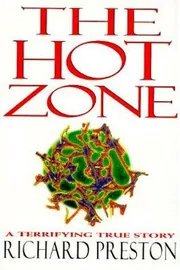
The Hot Zone
by Richard Preston, Richard Preston · 1994
Best suited to mature teens and adults who are comfortable with a serious scientific subject.
365 pages, about 6 to 8.5 hours.
A viral outbreak told at thriller speed, with real horror. 55% taste match
What it covers
The Hot Zone is a work of narrative nonfiction by Richard Preston, first published in 1994. It belongs to the science and nature category and deals with deadly viruses that cause bleeding fevers, with a focus on Ebola and its close relative Marburg. The book grew out of an earlier magazine piece the author wrote for The New Yorker in 1992, titled "Crisis in the Hot Zone."
The story moves between Africa, where these viruses have emerged, and Reston, Virginia, where an outbreak involving laboratory monkeys took place. It opens with a man named Charles Monet and goes on to follow the different strains of the virus and the people they touched. Along the way it touches on molecular virology, the spread of infection, epidemiology, and the use of primates in animal research. The events fall in the latter half of the twentieth century, roughly between 1950 and 2000. The paperback editions run to about 365 pages, and the book has appeared in many printings over the years.
Charles Monet was a loner.
Setting
AfricaRestonVirginiamei guo
Period
1950-2000
Themes
Ebola virus diseaseMolecular virologyPrimates as laboratory animalsEpidemiasEbolavirusBesmettingEpidemiologyPrimates como animales de laboratorio
- Want to read 117
- Reading now 11
- Read 35
Most people shelving it are saving it for later.
Of 163 readers who put it on a shelf, 72% want to read it, 7% are reading it now, 21% have finished it and 0% stopped before the end.
By the numbers
- The median edition runs 365 pages. Counting about 275 words a page and an adult reading pace of 250 words a minute, that is about 6.7 hours of reading.
- Open Library tracks 24 editions from 19 publishers, the earliest dated 1994 and the latest 2016, across 5 languages.
- On reader demand it ranks in the top 5% of the modern books in our catalog (15,152 of them).
- Libraries shelve it under Dewey 576.64 and Library of Congress class RC-0140.50000000.P74 1995b.
 BookWard’s take
A viral outbreak told at thriller speed, with real horror
Richard Preston's 1994 nonfiction thriller grew out of his 1992 New Yorker piece, and it still reads like one long held breath. It opens with Charles Monet and moves between Africa, where Ebola and Marburg emerged, and Reston, Virginia, where sick laboratory monkeys set off an alarm. The opening hooks at once, and the pace stays quick. There is no real sag in the middle, since the dread never lets up. The style leans narrative, with scenes first and science second. The trade-off is rigor: the book dramatizes more than it footnotes, so it is a gripping entry point to virology rather than a dispassionate text. The material runs dark, and the book earns that darkness by staying with real events.
At 365 pages it is mid-length, longer than BookWard's taste for tight reads, but the subject keeps it moving.
Short scenes and rising stakes keep it brisk, close to BookWard's preferred speed.
Few books made viral hemorrhagic fevers read like a thriller when this one appeared in 1994.
The prose is vivid and heightened without becoming ornate.
Events and the spread of the virus propel it far more than inner lives do.
It is a grim portrait of what viruses can do, with little reassurance, so bleaker than BookWard's outlook.
It follows a fairly conventional narrative path, moving between outbreak sites.
This is a serious, frightening book with almost no humor.
Graphic accounts of hemorrhagic disease make this a very dark read.
Fear and dread run strong, though they are mostly conveyed rather than dwelt on.
See all 50 dialsEvery position, side by side with this book
Where it lines up
- PaceBookWard 8 · book 8
- Sagging middleBookWard 8 · book 8
- OpeningBookWard 10 · book 9
Where it pulls apart
- Familiar tropesBookWard 10 · book 5
- LengthBookWard 1 · book 5
- Internal logicBookWard 10 · book 8
At 365 pages it is mid-length, longer than BookWard's taste for tight reads, but the subject keeps it moving.
It opens on Charles Monet and pulls the reader in immediately, exactly the kind of start BookWard rewards.
Medical-thriller conventions shape the telling, though the real events keep it from feeling formulaic.
The progression of outbreak, strain and consequence is laid out clearly, which sits well with BookWard.
Short scenes and rising stakes keep it brisk, close to BookWard's preferred speed.
Few books made viral hemorrhagic fevers read like a thriller when this one appeared in 1994.
People are sketched vividly through their encounters with the virus rather than drawn in full depth.
The outbreak episodes reach a conclusion, though the larger threat is left standing, a mild miss for BookWard.
It leans toward dread and awe over tenderness, though some human moments invite sympathy.
The horror comes from real disease and mostly earns its darkness, though it plays up the gore.
It is grounded in real events and virology but favors drama over citation, so less rigorous than BookWard likes.
Preston's urgent, cinematic narration is distinctive and instantly recognizable.
Story drives it, with the science carried inside scenes of people and outbreaks.
Science is mostly folded into scene, with occasional explanatory passages, close to BookWard's preference.
The tension is sustained from first case to last, which BookWard values.
The prose is vivid and heightened without becoming ornate.
Events and the spread of the virus propel it far more than inner lives do.
It is a grim portrait of what viruses can do, with little reassurance, so bleaker than BookWard's outlook.
It follows a fairly conventional narrative path, moving between outbreak sites.
This is a serious, frightening book with almost no humor.
Gripping and accessible, with some technical passages that ask for attention.
The story moves among several people and places, from Africa to Virginia.
It moves between settings and episodes rather than running as one straight line.
Entirely real events and real science, grounded throughout.
A modest group of scientists, victims and officials appears across the episodes.
It ranges from individual patients to the threat of a global outbreak.
Focus rests on outward events: infection, containment and response.
Scenes carry some speech, but narration does most of the work.
Romance plays no part in this story.
Biocontainment labs and African outbreak sites will be unfamiliar territory for most readers.
Set in the late twentieth century, recent enough to still feel relevant.
Its subject keeps drawing readers back, especially whenever outbreaks make headlines.
The narration is direct and trustworthy, reporting events as fact.
Scientists and nature, not villains, drive the story, and few moral questions are pressed.
Graphic, detailed descriptions of disease and its effects are a hallmark of the book.
It reads as narrative nonfiction, with scene and storytelling leading.
The author stays close to the people involved and shapes the telling around them.
It stands on its own as a single book.
Surprises come from how events unfold rather than from plotted twists.
The material is unsettling and asks the reader to sit with frightening realities.
Graphic accounts of hemorrhagic disease make this a very dark read.
Fear and dread run strong, though they are mostly conveyed rather than dwelt on.
Humor barely registers in this book.
The violence is bodily and disease-driven, described in unflinching detail.
It contains no sexual content of note.
Institutions and public health feature, but politics is not the point.
The language is plain, with some technical terms that are explained.
The narration is mostly neutral, though the framing is clearly meant to alarm.
It dwells on past outbreaks while hinting at future dangers.
It takes a sobering view of nature and human preparedness.
Review written by BookWard, dial version 1, November 2026.
Who is The Hot Zone right for?
Best suited to mature teens and adults who are comfortable with a serious scientific subject. It contains graphic descriptions of illness and death that some readers will find disturbing.
Gripping and accessible, with some technical passages that ask for attention.
Graphic accounts of hemorrhagic disease make this a very dark read.
Fear and dread run strong, though they are mostly conveyed rather than dwelt on.
The violence is bodily and disease-driven, described in unflinching detail.
Book CompanionThe Hot Zone: ideas, characters, themes
Deadly viruses from remote places can reach us through ordinary routes, and a single outbreak can expose how thin our defenses are.
- A magazine piece grows into a book. The book developed from Preston's 1992 New Yorker article 'Crisis in the Hot Zone', expanding a news story into a full narrative.
- Two settings, one threat. The story moves between Africa, where these viruses have emerged, and Reston, Virginia, where an outbreak involved laboratory monkeys.
- Ebola and its relative Marburg. It centers on viral hemorrhagic fevers, following the different strains and the people they affected.
- Science told as story. Molecular virology, epidemiology and the use of primates in research arrive through scenes rather than lectures.
- Starting with one patient. The narrative opens with a man named Charles Monet, grounding a global threat in one person's experience.
Characters
Charles Monet
The man the book opens with
His story begins the narrative and introduces the virus as a human, not just a scientific, problem.
Themes
How a poorly understood disease can inspire dread in scientists and the public alike.
The limits of human preparedness when a pathogen emerges from the wild.
What it looks like when researchers confront a deadly agent directly.
The role of primates in research and in carrying infection into human settings.
Discussion questions
- Does telling a true outbreak story as a thriller help or hurt public understanding of science?
- Why does the book move between Africa and Virginia, and what does the contrast show?
- How does opening with one patient change the way you read the rest of the book?
- What responsibilities do laboratories have when working with dangerous animals and pathogens?
- How has your view of outbreaks changed since the book was first published in 1994?
Personalize your Book Companion
This is the general edition. In BookWard, the Companion is written for you: your reading profile, your notes, and spoiler-safe to the page you are on.
Buy, listen or borrow The Hot Zone
Each link opens a search for this book on that store, in a new tab.
Read on a device
Borrow
Reviews and community
If you liked The Hot Zone
A tight, gripping history of the whaleship Essex and its survivors
Into Thin AirJon KrakauerA first-person Everest disaster account that grips from page one
The Perfect StormSebastian JungerA real storm, a lost fishing crew, and a fast, factual account
The Devil in the White CityErik LarsonTwo true stories braided together: a fair and a killer
Sources: Open Library.
Track The Hot Zone and find your next favorite
Add it to your shelf, rate what you have read, and BookWard will recommend what fits you.
Free to start. No credit card needed.