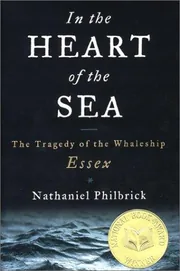
In the Heart of the Sea
by Nathaniel Philbrick · 2000
It suits mature teens and adults, and is listed at a Grade 11 to 12 reading level.
320 pages, about 5 to 7.5 hours.
A tight, gripping history of the whaleship Essex and its survivors. 64% taste match
What it covers
In the Heart of the Sea is a work of narrative nonfiction by Nathaniel Philbrick, first published in 2000 by Viking Press. It is a history of the whaleship Essex, a vessel out of Nantucket Island in Massachusetts, and of the disaster that ended her career in the Pacific Ocean. The Essex left port in 1819 on what was meant to be an ordinary whaling voyage, and her loss came roughly fifteen months later when a sperm whale struck and sank her.
The book follows the fate of the ship and her crew, including the ordeal of survival in open whaleboats after the wreck. It places the story within the world of Nantucket whaling and the seafaring life of the early nineteenth century. Readers interested in maritime history, shipwrecks and accounts of endurance at sea will find the subject squarely covered. The book won the 2000 National Book Award for Nonfiction, and a film adaptation of the same title reached theaters in December 2015. It runs to about 320 pages and has appeared in 38 editions.
It was, he later remembered, "the most pleasing moment of my life"-the moment he stepped aboard the whaleship essex for the first time.
Setting
Pacific OceanMassachusettsNantucket Island
Themes
Sperm whaleWhaleboatsEssex (Whaleship)Essex (Ship)ShipwrecksHistoryNantucket island (mass.), historyWhaling
- Want to read 111
- Reading now 4
- Read 25
- Stopped 1
Most people shelving it are saving it for later.
Of 141 readers who put it on a shelf, 79% want to read it, 3% are reading it now, 18% have finished it and 1% stopped before the end.
By the numbers
- The median edition runs 320 pages. Counting about 275 words a page and an adult reading pace of 250 words a minute, that is about 5.9 hours of reading.
- Open Library tracks 38 editions from 25 publishers, the earliest dated 2000 and the latest 2015, across 2 languages.
- On reader demand it ranks in the top 9% of the modern books in our catalog (15,152 of them).
- Libraries shelve it under Dewey 910.916 and Library of Congress class G--0530.00000000.E77 P45 2015.
 BookWard’s take
A tight, gripping history of the whaleship Essex and its survivors
Philbrick turns a single disaster into a propulsive piece of narrative nonfiction. At about 320 pages it stays tight, and the story pulls you in at once: a routine whaling voyage out of Nantucket, then a sperm whale and a sinking. On pace, it moves briskly, and on rigor it grounds the drama in the documented world of Nantucket whaling rather than leaning on anecdote alone. The ending is resolved, as history tends to be, and the darkness is earned by the events themselves, not added for shock. It is story-led more than idea-led, which fits BookWard's own lean. Readers who like endurance at sea, shipwrecks and early nineteenth-century seafaring will find the subject squarely covered.
At about 320 pages it keeps to one disaster and stays lean, which suits BookWard's preference for short, tight books.
The narrative moves briskly from voyage to sinking to the open-boat ordeal, close to BookWard's preferred speed.
The Essex story is well known territory, so the book earns its place through telling rather than novelty.
The prose is clear and direct, with vivid moments but no ornament, near BookWard's slightly plain preference.
Events drive the book more than inner lives, so it leans toward plot, a little off BookWard's character-driven lean.
Much of the book is suffering and loss at sea, so it sits on the bleak side of the outlook dial.
It follows a conventional chronological arc of voyage, disaster and aftermath, a touch plainer than BookWard's taste.
This is a grim survival history with essentially no humor, a notch below BookWard's lightness.
Shipwreck and survival in open whaleboats make for heavy, dark content.
The ordeal carries real weight, and the book lets the human cost land with intensity.
See all 50 dialsEvery position, side by side with this book
Where it lines up
- PaceBookWard 8 · book 8
- EndingBookWard 8 · book 8
- Story or ideasBookWard 3 · book 3
Where it pulls apart
- Familiar tropesBookWard 10 · book 7
- Internal logicBookWard 10 · book 8
- OriginalityBookWard 9 · book 6
At about 320 pages it keeps to one disaster and stays lean, which suits BookWard's preference for short, tight books.
A shipwreck survival tale carries familiar beats, but the real historical particulars keep it from reading as stock adventure.
As history it follows documented cause and effect from departure to wreck to survival, which BookWard rewards.
The narrative moves briskly from voyage to sinking to the open-boat ordeal, close to BookWard's preferred speed.
The Essex story is well known territory, so the book earns its place through telling rather than novelty.
Real crew members are drawn with care, though a historical account can only go so deep into private lives.
The fate of the crew is settled history, so the book closes with resolution, in line with BookWard's taste.
The suffering is told with some feeling but mostly lets the events speak, a fair fit with BookWard's restraint.
The dark turns come from what actually happened to the crew, so the grimness is earned, not manufactured.
It is a work of history grounded in the Nantucket whaling world, closer to rigorous than anecdotal, which BookWard values.
Philbrick has a clear narrative voice, confident and readable, though it serves the story more than it draws attention.
This is firmly story-led, built around a voyage and its survivors, which sits close to BookWard's own lean.
Context about whaling is woven into the narrative, with some outright explanation, but the book mostly lets events carry it.
The sinking and the long ordeal afterward keep tension up across the whole book, which BookWard prizes.
The prose is clear and direct, with vivid moments but no ornament, near BookWard's slightly plain preference.
Events drive the book more than inner lives, so it leans toward plot, a little off BookWard's character-driven lean.
Much of the book is suffering and loss at sea, so it sits on the bleak side of the outlook dial.
It follows a conventional chronological arc of voyage, disaster and aftermath, a touch plainer than BookWard's taste.
This is a grim survival history with essentially no humor, a notch below BookWard's lightness.
It reads accessibly for a history book, easy to follow without specialist knowledge.
It centers on the Essex and her crew, with a mostly unified lens rather than many competing perspectives.
The account runs largely in sequence from the 1819 departure onward, so it reads as linear.
It is a true account of a real ship and real events, fully grounded.
A whaleship crew gives it a moderate cast, larger than a single protagonist but not sprawling.
It stays on one ship and a small group of survivors, though the open ocean gives it breadth.
Action at sea dominates: the sinking, the boats and the struggle to survive take most of the page.
As nonfiction history it relies on narration and sources rather than extended conversation.
Romance is not part of this story of a whaling voyage and its aftermath.
Nantucket whaling and the Pacific of the early nineteenth century are unfamiliar to most modern readers.
Set in 1819 and 1820, it looks back to a distant era, the opposite of present day.
Survival at sea and the Essex story have lasting appeal, backed by a National Book Award and a later film.
A historian narrating documented events is a reliable guide, with no unreliability in play.
The ordeal raises hard questions about survival, but the book largely lets readers weigh them rather than preach.
Ships, whaleboats and open ocean are rendered with real texture, giving it rich description.
It is narrative nonfiction first, telling the Essex story as a tale more than an argument.
It is a historian's account with a fairly engaged, storytelling presence rather than a coldly detached survey.
It stands alone as a single account of the Essex.
The big events are known history, so surprises come from the particulars of the ordeal more than plot twists.
The subject matter is hard to sit with, though the telling stays approachable.
Shipwreck and survival in open whaleboats make for heavy, dark content.
The ordeal carries real weight, and the book lets the human cost land with intensity.
There is little humor here, so it sits near the dry end by default.
The whale attack and the extremity of survival bring harsh moments, though not constant bloodshed.
Sexual content is essentially absent from this account.
It is about a voyage and a disaster, not a political argument.
The language is plain and accessible, with some nautical terms but nothing dense.
It tells the story with a measured authorial stance rather than loud opinion.
It looks back at a historical event and its place in whaling history.
A story of hard survival and loss leans toward the cynical side of the worldview dial.
Review written by BookWard, dial version 1, November 2026.
Who is In the Heart of the Sea right for?
It suits mature teens and adults, and is listed at a Grade 11 to 12 reading level. It deals with shipwreck, suffering and the extremes of survival, which some readers may find distressing.
It reads accessibly for a history book, easy to follow without specialist knowledge.
Shipwreck and survival in open whaleboats make for heavy, dark content.
The ordeal carries real weight, and the book lets the human cost land with intensity.
The whale attack and the extremity of survival bring harsh moments, though not constant bloodshed.
Book CompanionIn the Heart of the Sea: ideas, characters, themes
A routine whaling voyage from Nantucket ends in disaster when a sperm whale sinks the Essex, and the crew must survive in open boats.
- The voyage begins. In 1819 the whaleship Essex leaves Nantucket on what is meant to be an ordinary whaling trip.
- The sinking. About fifteen months into the voyage, a sperm whale strikes and sinks the ship in the Pacific.
- Survival in whaleboats. After the wreck, the crew face an ordeal of survival in open whaleboats.
- Nantucket's whaling world. The story is set within the seafaring culture and economy of early nineteenth-century Nantucket whaling.
- Recognition. The book won the 2000 National Book Award for Nonfiction and later inspired a 2015 film.
Themes
What people endure and do to stay alive in extreme conditions.
The force of the sea and the whale against human ambition.
The industry that drove Nantucket and sent crews into danger.
The limits of physical and mental strength over a long ordeal.
How a real disaster can be told with narrative drive.
Discussion questions
- How does knowing the outcome of a real event change the way the story builds tension?
- What does the book suggest about the risks people accepted to work in whaling?
- How does the setting of Nantucket shape the crew's choices?
- Where does narrative nonfiction draw the line between storytelling and documented fact?
- What makes a survival story compelling when the facts are already known?
Personalize your Book Companion
This is the general edition. In BookWard, the Companion is written for you: your reading profile, your notes, and spoiler-safe to the page you are on.
Buy, listen or borrow In the Heart of the Sea
Each link opens a search for this book on that store, in a new tab.
Read on a device
Borrow
Reviews and community
If you liked In the Heart of the Sea
A viral outbreak told at thriller speed, with real horror
Into Thin AirJon KrakauerA first-person Everest disaster account that grips from page one
EnduranceAlfred LansingA true survival story that reads like a tightly built thriller
UnbrokenLaura HillenbrandA true survival story that moves like a thriller
Sources: Open Library.
Track In the Heart of the Sea and find your next favorite
Add it to your shelf, rate what you have read, and BookWard will recommend what fits you.
Free to start. No credit card needed.