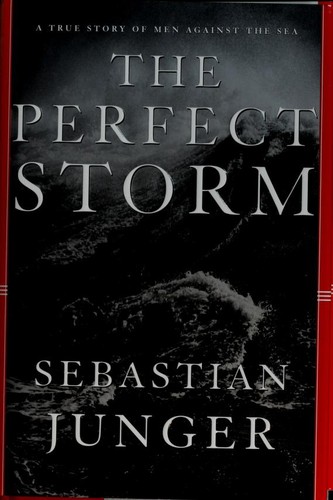
The Perfect Storm
by Sebastian Junger
★ Top 25 book of 1997 · #20 on Best Books of 1997
Sebastian Junger recounts the rare 1991 storm that swallowed the swordfishing boat Andrea Gail and its crew off Nova Scotia. He blends the lives of Gloucester fishermen, rescue efforts, and storm science into one gripping account.
Best for: Readers who enjoy true stories of survival, the sea, and nature's overwhelming power
The Perfect Storm is #20 on BookWard's Best Books of 1997, out of 28 1997 books that cleared our data bar.
What The Perfect Storm is about
In late October 1991, a storm struck North America, and the Andrea Gail, a swordfishing boat out of Gloucester, Massachusetts, was lost at sea in it. Sebastian Junger reconstructs the days leading up to it and the storm itself, following Captain Billy Tyne and his crew, along with the families waiting on shore. Many of these men were raised with the assumption that they would fish for a living, and Junger treats that life with care, explaining how the work is done and why it is so dangerous.
Alongside the human story, he explains how storms form, traces the history of the fishing industry, and describes waves taller than a hundred feet that arrived with almost no warning. The Coast Guard's rescue of a sailboat crew caught in the same weather runs through the book too. Readers who like true stories about the sea, or who simply want to understand what that work costs, will find it absorbing and quietly sad.
The Perfect Storm on the Best Books of 1997
The Perfect Storm came out in 1997. Of the 28 books first published in 1997 that met BookWard's data bar, it ranks #20 on our Best Books of 1997 list.
Why it made the list: 158 readers have shelved it on Open Library; readers rate it 4.1 out of 5 (16 ratings). The list ranks each year’s books on how many readers have picked them up, how highly readers rate them, and how many are reading them right now.
Nearby on the 1997 list
- How I Learned to Drive Paula Vogel, #18
- Ella Enchanted Gail Carson Levine, #19
- The Sovereign Individual James Dale Davidson, #21
- Story Robert McKee, #22
See all Best Books of 1997 Best books by year
More years: Best Books of 1996 Best Books of 1998.
The numbers behind it
- Readers: 132 want to read it, 7 are reading it now and 19 have read it, according to Open Library.
- Ratings: 4.1 out of 5 from 16 Open Library ratings.
| Signal | This book (0 to 100) | Weight |
|---|---|---|
| Reach | 14 | 55% |
| Reader love | 75 | 25% |
| Being read right now | 32 | 20% |
Questions about The Perfect Storm
When was The Perfect Storm published?
The Perfect Storm by Sebastian Junger was first published in 1997.
Was The Perfect Storm one of the best books of 1997?
The Perfect Storm is #20 on BookWard's Best Books of 1997, out of 28 1997 books that cleared our data bar. 158 readers have shelved it on Open Library; readers rate it 4.1 out of 5 (16 ratings).
Why is The Perfect Storm on the Best Books of 1997 list?
158 readers have shelved it on Open Library; readers rate it 4.1 out of 5 (16 ratings).
More of the best books of 1997
- Harry Potter and the Philosopher's Stone J. K. Rowling, #1
- Rich Dad, Poor Dad Robert T. Kiyosaki, #2
- Guns, Germs, and Steel Jared Diamond, #3
- The Adventures of Captain Underpants Dav Pilkey, #4
- The Power of Now Eckhart Tolle, #5
- Into Thin Air Jon Krakauer, #6
See the full Best Books of 1997, the Top 100, or new books on Rising.
How we know
This page uses public data: Open Library reader counts and ratings, and Wikipedia page views for recent years. The description is paraphrased from real source text. Rankings reflect reading interest, not quality or sales, and can be affected by data gaps. Lists update monthly.
Suits mature teens and adults who enjoy true-adventure narrative and are comfortable with a story built around death at sea.
Depends on the edition you pick.
A real storm, a lost fishing crew, and a fast, factual account. 51% taste match
 BookWard’s take
A real storm, a lost fishing crew, and a fast, factual account
Junger builds the story around the Andrea Gail and the swordfishermen of Gloucester, then widens out to the other vessels caught in the 1991 storm. The book earns its keep on rigor: the fishing trade, the weather science and the rescue work are laid out with real attention to how things actually work. The opening is slower than the cover promises, since the early chapters settle into dockside life and the Crow's Nest tavern before the sea takes over. Once it does, the pace and the pull of the setting carry you hard. The approach is more analytical than I tend to like in nonfiction, and the exposition leans toward explaining rather than showing, which isn't my preference. Still, this is vivid, well-built narrative nonfiction about people working at the edge of what the ocean allows.
Brisk once the storm builds, though the groundwork chapters give the first stretch a steadier tread.
Weaving fishing history, meteorology and rescue into one narrative was a fresh approach for its time.
Clear and muscular with flashes of vivid imagery, plainer than ornate.
Events drive the narrative, with the storm and the rescues pulling the people along.
The central tragedy is bleak, though the rescue accounts offer some courage and relief.
It alternates between the crew, the weather and other vessels, mildly more adventurous than a plain chronicle.
This is a serious book about a lethal storm and works almost wholly without humor.
It deals with death at sea and the loss of a crew, so the content is heavy.
The stakes and the loss carry real weight, particularly in the storm chapters.
See all 50 dialsEvery position, side by side with this book
Where it lines up
- PaceBookWard 8 · book 7
- EndingBookWard 8 · book 7
- Shock for effectBookWard 9 · book 8
Where it pulls apart
- OpeningBookWard 10 · book 5
- ExpositionBookWard 2 · book 7
- LengthBookWard 1 · book 4
The early chapters settle into dockside life before the storm arrives, a slower start than BookWard prefers.
The disaster-narrative frame is familiar, but the trade details and real people keep it from feeling stock.
Events are reconstructed from the storm's science and what is known of each vessel, so the account holds together firmly.
Brisk once the storm builds, though the groundwork chapters give the first stretch a steadier tread.
Weaving fishing history, meteorology and rescue into one narrative was a fresh approach for its time.
The crew are sketched through their work, families and motives, though the account cannot go deep on men it must reconstruct.
The central question is answered as far as the evidence allows, which fits BookWard's taste for resolution.
It feels the loss without wallowing, though it softens the tone more than BookWard's strict restraint would.
The darkness comes from the real event itself and is not exploited for effect, which BookWard respects.
Fishing economics, storm mechanics and rescue procedure are explained carefully, in line with BookWard's appetite for rigor.
Junger writes with a confident, individual narrative presence, and the voice is a real draw.
It is story-led at heart but carries a good deal of explanatory material, so it lands near the middle.
The book stops often to explain trades, tides and meteorology outright, which sits against BookWard's preference for showing.
The groundwork chapters slow things down a little, but the storm sections carry the momentum.
Clear and muscular with flashes of vivid imagery, plainer than ornate.
Events drive the narrative, with the storm and the rescues pulling the people along.
The central tragedy is bleak, though the rescue accounts offer some courage and relief.
It alternates between the crew, the weather and other vessels, mildly more adventurous than a plain chronicle.
This is a serious book about a lethal storm and works almost wholly without humor.
The prose is accessible, though the technical and nautical detail asks for some concentration.
It moves among the Andrea Gail, other vessels, rescuers and families, giving it a broad field of view.
Mostly chronological around the storm, with background history set before it.
Entirely real events and real people.
The Andrea Gail crew, rescuers, families and people from other ships add up to a sizable cast.
A single storm, but on a large canvas that takes in an industry, a town and the open ocean.
Action at sea and the physical work of survival dominate over inner reflection.
Recorded or reconstructed speech appears, but narration and explanation carry most of the weight.
Families and relationships appear in the background, but romance is not a thread.
Offshore swordfishing and Coast Guard rescue are unfamiliar worlds to most readers, and the book opens them up.
Set in 1991, recent enough to feel close but firmly in the past.
The struggle against the sea and the human cost of the trade keep its appeal fresh.
A reporting voice that sets out what is known and reconstructs the rest, rather than hiding anything.
It is less about moral judgment than about survival, risk and necessity, so it lands near clear.
Sea, weather and working life are rendered in rich, physical detail.
It reads as narrative nonfiction but with substantial analytical stretches on science and the industry.
Junger keeps close to his subjects and their world rather than standing apart from them.
A self-contained account of a single event.
The outcome is largely known from the outset, so there are few real surprises.
Emotionally heavy in places but approachable and not meant to unsettle.
It deals with death at sea and the loss of a crew, so the content is heavy.
The stakes and the loss carry real weight, particularly in the storm chapters.
Humor is rare and what exists is wry and dry.
The violence is the sea's: drowning, injury and peril rendered with care.
Sexual content is essentially absent.
Economics and risk touch on larger issues, but it is not a political book.
Fishing and maritime jargon and the speech of working men add some density.
Junger has a clear point of view and shapes the telling, while keeping close to the facts.
It reconstructs a past event and looks back on it.
Clear-eyed about danger and economic pressure, with admiration for courage but little sentiment.
Review written by BookWard, dial version 1, November 2026.
Who is The Perfect Storm right for?
Suits mature teens and adults who enjoy true-adventure narrative and are comfortable with a story built around death at sea. It contains peril, loss and some rough language from working men.
The prose is accessible, though the technical and nautical detail asks for some concentration.
It deals with death at sea and the loss of a crew, so the content is heavy.
The stakes and the loss carry real weight, particularly in the storm chapters.
The violence is the sea's: drowning, injury and peril rendered with care.
Book CompanionThe Perfect Storm: ideas, characters, themes
A single historic storm becomes a way into the lives, risks and economics of the people who work the North Atlantic.
- A crew and their boat. The book follows the swordfishing crew of the Andrea Gail and the families connected to them before and during the storm.
- Life in Gloucester. Early chapters describe the daily work of fishermen and the town, centered on a tavern called the Crow's Nest.
- The storm itself. A rare convergence of weather systems in late October 1991 forms the central force driving events.
- The Satori rescue. A Coast Guard cutter, the Tamaroa, rescues the three-person crew of the sailboat Satori during the storm.
- Why they go. Money drives the men to sea despite the danger, a point the book underlines through crew members' own words.
Characters
Billy Tyne
Captain of the Andrea Gail
The captain who leads the swordfishing trip and radios as the storm bears down.
Bobby Shatford
Crew member
One of the six men aboard, tied to the Gloucester community the book portrays.
Sully
Crew member
David Sullivan, who is quoted saying he goes to sea only because he needs the money.
Alfred Pierre
Crew member
Known as AP, one of the men raised to expect a life in fishing.
Themes
Forces of weather that people can only endure, not control.
Why people accept dangerous jobs and what it costs them.
How a fishing town absorbs the disappearance of its own.
The acts of rescuers and crews facing impossible conditions.
The way money pushes men toward danger.
Discussion questions
- Why do the crew choose to go to sea despite the danger, and does the book make their reasons convincing?
- How does the early focus on Gloucester change the way the storm chapters feel?
- Does reconstructing events that no one survived to describe make the account more or less trustworthy?
- How do the rescue stories alter the overall tone of the book?
- What does the book suggest about the relationship between risk and livelihood?
Personalize your Book Companion
This is the general edition. In BookWard, the Companion is written for you: your reading profile, your notes, and spoiler-safe to the page you are on.
Buy, listen or borrow The Perfect Storm
Each link opens a search for this book on that store, in a new tab.
Read on a device
Borrow
Reviews and community
If you liked The Perfect Storm
A viral outbreak told at thriller speed, with real horror
The Devil in the White CityErik LarsonTwo true stories braided together: a fair and a killer
Into Thin AirJon KrakauerA first-person Everest disaster account that grips from page one
In the Heart of the SeaNathaniel PhilbrickA tight, gripping history of the whaleship Essex and its survivors
Find your own best books
Add what you have read, rate it, and BookWard will recommend what to read next.
Free to start. No credit card needed.