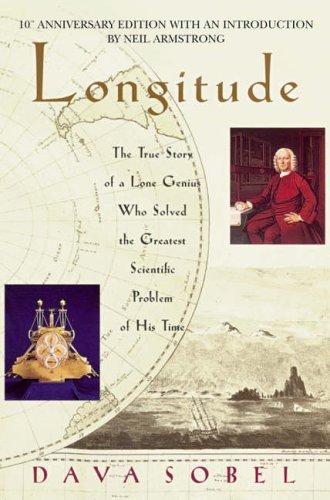
Longitude
by Dava Sobel
★ Top 25 book of 1995 · #19 on Best Books of 1995
Dava Sobel tells how John Harrison spent forty years defying the scientific establishment to build a clock that kept accurate time at sea. His quest to solve the longitude problem blends heroism, trickery and a short history of navigation.
Best for: Readers who love true stories of invention, obsession, astronomy and seafaring
Longitude is #19 on BookWard's Best Books of 1995, out of 28 1995 books that cleared our data bar.
What Longitude is about
For centuries, sailors who lost sight of land had no way to measure longitude, and thousands of lives and national fortunes depended on finding one. Dava Sobel tells how that problem, the thorniest scientific puzzle of the eighteenth century, was finally solved by John Harrison, a clockmaker who went against the scientific establishment. Where others looked to the heavens, he imagined a clock that could keep precise time at sea, and he spent forty years obsessively building it. Along the way the account becomes a short history of astronomy, navigation and clockmaking, full of heroism and chicanery. It will appeal to anyone who likes a true story of stubborn invention.
Longitude on the Best Books of 1995
Longitude came out in 1995. Of the 28 books first published in 1995 that met BookWard's data bar, it ranks #19 on our Best Books of 1995 list.
Why it made the list: 187 readers have shelved it on Open Library; readers rate it 4.2 out of 5 (35 ratings). The list ranks each year’s books on how many readers have picked them up, how highly readers rate them, and how many are reading them right now.
Nearby on the 1995 list
- Fingerprints of the Gods Graham Hancock, #17
- The Firework-maker's Daughter Philip Pullman, #18
- Naked in Death Nora Roberts, #20
- The Road Ahead Bill Gates, #21
See all Best Books of 1995 Best books by year
More years: Best Books of 1994 Best Books of 1996.
The numbers behind it
- Readers: 136 want to read it, 4 are reading it now and 47 have read it, according to Open Library.
- Ratings: 4.2 out of 5 from 35 Open Library ratings.
| Signal | This book (0 to 100) | Weight |
|---|---|---|
| Reach | 25 | 55% |
| Reader love | 89 | 25% |
| Being read right now | 7 | 20% |
Questions about Longitude
When was Longitude published?
Longitude by Dava Sobel was first published in 1995.
Was Longitude one of the best books of 1995?
Longitude is #19 on BookWard's Best Books of 1995, out of 28 1995 books that cleared our data bar. 187 readers have shelved it on Open Library; readers rate it 4.2 out of 5 (35 ratings).
Why is Longitude on the Best Books of 1995 list?
187 readers have shelved it on Open Library; readers rate it 4.2 out of 5 (35 ratings).
More of the best books of 1995
- The Lost World Michael Crichton, #1
- Emotional Intelligence Daniel Goleman, #2
- Northern Lights Philip Pullman, #3
- Rose Madder Stephen King, #4
- Mindhunter John E. Douglas, #5
- Wicked Gregory Maguire, #6
See the full Best Books of 1995, the Top 100, or new books on Rising.
How we know
This page uses public data: Open Library reader counts and ratings, and Wikipedia page views for recent years. The description is paraphrased from real source text. Rankings reflect reading interest, not quality or sales, and can be affected by data gaps. Lists update monthly.
Suitable for most teens and adults, and accessible to general readers with an interest in history or science.
Depends on the edition you pick.
A short, sharp tale of one clockmaker against the establishment. 63% taste match
 BookWard’s take
A short, sharp tale of one clockmaker against the establishment
Sobel keeps Longitude brief and driven by a single obsession: John Harrison's decades-long effort to build a clock that keeps true time at sea. The first thing to like is its economy, since the whole story is told without padding. The stakes arrive early, with lost sailors and national fortunes hanging on one unsolved problem. The science of navigation, astronomy and clockmaking is explained carefully and rigorously. Sobel's voice is distinctive, warm and wry, and the book reads closer to a story than a lecture. The one real reservation is that she tends to explain outright rather than dramatize, which keeps the book a step removed from the action. Overall it is a lean, absorbing account of a quest and the people who tried to block it.
A compact book that covers a forty-year saga without bloat, which suits BookWard's taste for the tight.
It moves briskly through decades, though technical stretches slow it slightly compared with BookWard's fast preference.
The subject is an unusual and well-chosen one, though the underdog framing is a known pattern.
Clear and graceful rather than ornate, in line with BookWard's middling lean.
A single man's obsession drives the story, but the problem itself pushes events along too.
Persistence is eventually rewarded, though the road is marked by frustration and obstruction.
A straightforward chronological telling with no formal experiments.
Gently wry in places, but fundamentally a serious account.
Sailors' deaths set the stakes, but the tone stays measured and gentle.
Feeling surfaces around Harrison's persistence, but the tone stays even.
See all 50 dialsEvery position, side by side with this book
Where it lines up
- Shock for effectBookWard 9 · book 9
- LengthBookWard 1 · book 2
- Internal logicBookWard 10 · book 9
Where it pulls apart
- ExpositionBookWard 2 · book 8
- Familiar tropesBookWard 10 · book 7
- OpeningBookWard 10 · book 8
A compact book that covers a forty-year saga without bloat, which suits BookWard's taste for the tight.
It opens on the stakes of the longitude problem straight away, close to BookWard's liking for an immediate pull.
Underdog-versus-establishment is a familiar shape, though the clockmaking detail keeps it from feeling stock.
The reasoning behind each approach to finding longitude is laid out clearly and holds together.
It moves briskly through decades, though technical stretches slow it slightly compared with BookWard's fast preference.
The subject is an unusual and well-chosen one, though the underdog framing is a known pattern.
Harrison and his rivals are drawn with real texture, though the format limits how deep any one portrait goes.
The quest reaches a clear resolution, which BookWard values.
It admires its hero openly without turning syrupy, a little warmer than BookWard prefers.
Nothing is shocking for effect; the drama comes from the real stakes of the problem.
Navigation, astronomy and horology are explained with care and grounded in history.
Sobel's tone is warm, wry and recognizable, which BookWard rewards.
It carries ideas through a human story, so it leans toward story rather than argument.
Much of the science is explained directly rather than dramatized, which cuts against BookWard's preference for showing.
The short length and steady quest keep the momentum even.
Clear and graceful rather than ornate, in line with BookWard's middling lean.
A single man's obsession drives the story, but the problem itself pushes events along too.
Persistence is eventually rewarded, though the road is marked by frustration and obstruction.
A straightforward chronological telling with no formal experiments.
Gently wry in places, but fundamentally a serious account.
Accessible to general readers, with technical ideas explained plainly.
Harrison stays central, with the scientific establishment and others brought in around him.
It follows events in order across the eighteenth century.
Entirely grounded in real history and science.
A moderate roster of scientists, officials and craftsmen appears around Harrison.
A single problem with national and maritime consequences gives it wider reach than a purely personal tale.
It follows what people do and build more than what they feel inside.
Told in narration rather than conversation, with little scene dialogue.
Romance plays no real part in the story.
The eighteenth-century sea and workshop world will feel unfamiliar to most readers.
Set in the eighteenth century, well back from the present day.
A story of invention and persistence that still reads freshly decades after it appeared.
A straightforward authorial voice recounting documented events.
Harrison is clearly the sympathetic figure, though institutional rivalries add some gray.
Instruments, ships and workshops are conveyed with moderate vividness.
It reads as narrative history with explanation woven in, more story than analysis.
Sobel is present as a guiding voice, though the focus stays on her subject.
A standalone work.
The outcome is known history, so surprises are few.
A smooth and absorbing read that doesn't push readers hard.
Sailors' deaths set the stakes, but the tone stays measured and gentle.
Feeling surfaces around Harrison's persistence, but the tone stays even.
Humor, where present, is dry and understated.
Shipwrecks are mentioned as stakes, with little violence on the page.
No sexual content of note.
Institutional politics and rivalry drive part of the conflict, though not partisan issues.
Plain, accessible English with explained terminology.
Sobel clearly favors Harrison and makes her admiration plain.
It is a look back at a historical achievement.
It celebrates stubborn ingenuity and perseverance against entrenched opposition.
Review written by BookWard, dial version 1, November 2026.
Who is Longitude right for?
Suitable for most teens and adults, and accessible to general readers with an interest in history or science. Sensitive material is limited to the dangers of sea travel and loss of life.
Accessible to general readers, with technical ideas explained plainly.
Sailors' deaths set the stakes, but the tone stays measured and gentle.
Feeling surfaces around Harrison's persistence, but the tone stays even.
Shipwrecks are mentioned as stakes, with little violence on the page.
Book CompanionLongitude: ideas, characters, themes
A self-taught clockmaker spent decades building a precise sea-going timekeeper to solve the problem of finding longitude, despite resistance from the scientific establishment.
- The longitude problem. Sailors could not measure their east-west position at sea, and thousands of lives and national fortunes depended on a solution.
- The mechanical answer. Harrison imagined a clock accurate enough to keep time at sea, something no clock had managed on land.
- A forty-year obsession. The book follows his long effort to perfect the chronometer.
- Conflict with the establishment. His approach ran against the scientific community of the day.
- A wider history. Alongside the main story, the book offers a brief history of astronomy, navigation and clockmaking.
Characters
John Harrison
Protagonist
An eighteenth-century clockmaker who devoted decades to building a clock that could determine longitude at sea.
Themes
Long, single-minded effort in pursuit of a goal.
A lone craftsman opposing the scientific authorities of his time.
How a technical problem carried human and national consequences.
The struggle for credit and acceptance of a new idea.
Discussion questions
- Why was the longitude problem so urgent in the eighteenth century?
- What made a mechanical solution so unlikely to the scientific community?
- How does Sobel build tension when the outcome is already historical fact?
- Does the book treat Harrison as a hero, and is that fair?
- What does the story suggest about how new ideas are accepted or resisted?
Personalize your Book Companion
This is the general edition. In BookWard, the Companion is written for you: your reading profile, your notes, and spoiler-safe to the page you are on.
Buy, listen or borrow Longitude
Each link opens a search for this book on that store, in a new tab.
Read on a device
Borrow
Reviews and community
If you liked Longitude
A Cold War spy story told with a novelist's grip
MarshaTourmalineA full-color biography of Marsha P. Johnson, by Tourmaline
The botany of desireMichael PollanA plant's-eye view of us, one apple at a time
OutliersMalcolm GladwellSuccess has a postcode and a birthday, not just talent
Find your own best books
Add what you have read, rate it, and BookWard will recommend what to read next.
Free to start. No credit card needed.