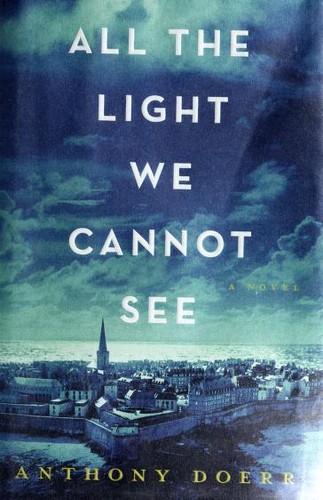
All the Light We Cannot See
by Anthony Doerr
★ Top 10 book of 2014 · #7 on Best Books of 2014
A blind French girl and a German orphan gifted with radios live parallel lives during World War II. Their separate struggles to survive eventually bring them together in occupied Saint-Malo, on France's Brittany coast.
Best for: Readers who enjoy ambitious, beautifully written historical novels set during World War II
All the Light We Cannot See is #7 on BookWard's Best Books of 2014, out of 66 2014 books that cleared our data bar.
What All the Light We Cannot See is about
Two young people live through the Second World War far apart, and the novel slowly draws them toward the same place. Marie-Laure LeBlanc, blind since the age of six, grows up in Paris, where her father, a locksmith at the Museum of Natural History, builds her a small model of the city so she can find her way by touch. When Germany invades France, they flee to Saint-Malo to stay with her great-uncle Etienne. Meanwhile Werner Pfennig, an orphan from a coal-mining town, has a gift for fixing radios that wins him a place at a harsh Nazi school.
Anthony Doerr moves back and forth in time, setting scenes from the 1944 battle for Saint-Malo among earlier years beginning in 1934. A legendary diamond and a gemologist hunting for it add tension. The book is admired for its lyrical prose and rich sensory detail. Readers who enjoy reflective, beautifully written historical fiction about war, connection and human resilience will find it rewarding.
All the Light We Cannot See on the Best Books of 2014
All the Light We Cannot See came out in 2014. Of the 66 books first published in 2014 that met BookWard's data bar, it ranks #7 on our Best Books of 2014 list.
Why it made the list: 1,446 readers have shelved it on Open Library; readers rate it 4.3 out of 5 (86 ratings); 59 are reading it right now. The list ranks each year’s books on how many readers have picked them up, how highly readers rate them, and how many are reading them right now.
Nearby on the 2014 list
- After (After Series, Book 1) Anna Todd, #5
- Ugly Love Colleen Hoover, #6
- Milk and Honey Rupi Kaur, #8
- The Body Keeps the Score Bessel van der Kolk, #9
See all Best Books of 2014 Best books by year
More years: Best Books of 2013 Best Books of 2015.
The numbers behind it
- Readers: 1,252 want to read it, 59 are reading it now and 135 have read it, according to Open Library.
- Ratings: 4.3 out of 5 from 86 Open Library ratings.
| Signal | This book (0 to 100) | Weight |
|---|---|---|
| Reach | 88 | 55% |
| Reader love | 85 | 25% |
| Being read right now | 83 | 20% |
Questions about All the Light We Cannot See
When was All the Light We Cannot See published?
All the Light We Cannot See by Anthony Doerr was first published in 2014.
Was All the Light We Cannot See one of the best books of 2014?
All the Light We Cannot See is #7 on BookWard's Best Books of 2014, out of 66 2014 books that cleared our data bar. 1,446 readers have shelved it on Open Library; readers rate it 4.3 out of 5 (86 ratings); 59 are reading it right now.
Why is All the Light We Cannot See on the Best Books of 2014 list?
1,446 readers have shelved it on Open Library; readers rate it 4.3 out of 5 (86 ratings); 59 are reading it right now.
More of the best books of 2014
- To All the Boys I've Loved Before Jenny Han, #1
- The Long Haul Jeff Kinney, #2
- Zero to One Peter A. Thiel, #3
- Surrounded by Idiots Thomas Erikson, #4
- After (After Series, Book 1) Anna Todd, #5
- Ugly Love Colleen Hoover, #6
See the full Best Books of 2014, the Top 100, or new books on Rising.
How we know
This page uses public data: Open Library reader counts and ratings, and Wikipedia page views for recent years. The description is paraphrased from real source text. Rankings reflect reading interest, not quality or sales, and can be affected by data gaps. Lists update monthly.
A good fit for mature teens and adults who enjoy historical fiction.
Depends on the edition you pick.
A lyrical war novel built from short chapters and a blind girl's Paris. 55% taste match
 BookWard’s take
A lyrical war novel built from short chapters and a blind girl's Paris
Doerr alternates between Marie-Laure, a blind French girl, and Werner, a German boy with a gift for radios, and the book is at its best when it lets sound, touch and small mechanisms carry the story. It is long for a quick-reading novel, but the short chapters keep it moving, so the pace stays brisk. The structure is the main craft choice: 1944 Saint-Malo intercut with years climbing from 1934, which gives it a steady pull with no real sag. The prose is where some readers may part ways, since the lyrical, sensory style runs richer than a taste for plain lines would like. The emotion is real and the ending resolves, though the book leans warmer than a more restrained reader might prefer. A well-built, humane war story with a distinctive voice.
A full-sized novel told in brief chapters, so it reads lighter than its bulk; BookWard prefers tighter books.
Short alternating chapters keep it moving, close to BookWard's preferred speed.
The blindness-and-radio pairing and the model of Paris give it a distinct angle on a crowded genre.
The language is ornate and image-heavy, richer than BookWard's usual lean.
Both plot and inner lives matter, tilting slightly toward character as BookWard likes.
It stays humane amid destruction, sitting near BookWard's mildly hopeful outlook.
Two timelines and two viewpoints are interleaved, more inventive than BookWard's usual pick.
This is a solemn war story with little humor, drier than BookWard's lightly funny taste.
War, loss and imprisonment give it weight, somewhat darker than BookWard's midpoint.
It builds real feeling, slightly more intense than BookWard's measured preference.
See all 50 dialsEvery position, side by side with this book
Where it lines up
- EndingBookWard 8 · book 8
- Sagging middleBookWard 8 · book 8
- Character depthBookWard 8 · book 7
Where it pulls apart
- LengthBookWard 1 · book 7
- Familiar tropesBookWard 10 · book 6
- OpeningBookWard 10 · book 7
A full-sized novel told in brief chapters, so it reads lighter than its bulk; BookWard prefers tighter books.
It opens inside the 1944 bombardment of Saint-Malo, which grabs attention quickly, in line with BookWard's taste for an immediate start.
War, orphans and a hidden jewel are familiar ground, though the radio and the blind girl's model city feel fresh.
The paired storylines are built to converge, and the cause-and-effect holds together well, which suits BookWard.
Short alternating chapters keep it moving, close to BookWard's preferred speed.
The blindness-and-radio pairing and the model of Paris give it a distinct angle on a crowded genre.
Marie-Laure and Werner are drawn with patient detail, matching BookWard's liking for deeply drawn people.
The converging threads are brought to a clear close, which BookWard values.
It reaches for tenderness and beauty openly, a little warmer than BookWard's restrained preference.
The darkness comes from the war itself and is not staged for effect, which BookWard respects.
Doerr's sensory, lyrical narration is unmistakable, a strong match for BookWard's love of distinct voices.
It is story-led, with ideas about wonder and war carried by the characters, as BookWard prefers.
Information arrives mostly through scene and sensation, close to BookWard's taste for showing.
The alternating chapters and rising tension keep the middle from drifting, which BookWard rewards.
The language is ornate and image-heavy, richer than BookWard's usual lean.
Both plot and inner lives matter, tilting slightly toward character as BookWard likes.
It stays humane amid destruction, sitting near BookWard's mildly hopeful outlook.
Two timelines and two viewpoints are interleaved, more inventive than BookWard's usual pick.
This is a solemn war story with little humor, drier than BookWard's lightly funny taste.
The lyrical style and shifting timelines ask for attention but never become hard going.
It alternates between two main perspectives, fewer than BookWard's fondness for many voices.
The 1944 siege is intercut with years counting up from 1934, a strongly shifting timeline beyond BookWard's norm.
The setting is historical and grounded, though a legendary diamond adds a faint mythic note.
Two leads with a modest supporting group, in line with BookWard's smaller-cast lean.
A world war frames it, but the focus stays on two lives, so it sits mid-scale.
Sensory, interior experience drives it more than action, close to BookWard's balance.
Scenes lean on narration and sensation over talk, lighter than BookWard's liking for dialogue.
Romance is not the engine; survival and connection across distance are.
Occupied France and wartime Germany are less familiar settings, which BookWard enjoys.
It is set in the 1930s and 1940s, well away from BookWard's present-day lean.
Its themes of wonder and war's cost are lasting, matching BookWard's taste for staying power.
The narration is trustworthy and clear, more reliable than BookWard's taste for the unreliable.
War's wrongs are plain, though the characters are shown with sympathy, a clearer moral field than BookWard likes.
Sensory detail is lavish throughout, richer than BookWard usually seeks.
It is a standalone novel.
The convergence and the jewel's fate add surprise, near BookWard's appetite for turns.
It moves and unsettles without being punishing, a middle path for BookWard.
War, loss and imprisonment give it weight, somewhat darker than BookWard's midpoint.
It builds real feeling, slightly more intense than BookWard's measured preference.
Humor is scarce and gentle, drier than BookWard's middle.
Wartime violence is present and bombardment is central, but handled with some restraint.
Sexual content is essentially absent, so it sits well below BookWard's middle.
The Nazi regime shapes everything, yet the book stays with people over argument.
The language is poetic but readable, not dialect-heavy.
Doerr's narration is mostly observational, more neutral than BookWard's lightly opinionated taste.
It looks back at a historical war, against BookWard's forward lean.
It holds out faith in wonder and decency amid brutality, leaning idealistic like BookWard.
Review written by BookWard, dial version 1, November 2026.
Who is All the Light We Cannot See right for?
A good fit for mature teens and adults who enjoy historical fiction. It deals with war, the loss of a parent figure and wartime violence, so younger readers may want some context.
The lyrical style and shifting timelines ask for attention but never become hard going.
War, loss and imprisonment give it weight, somewhat darker than BookWard's midpoint.
It builds real feeling, slightly more intense than BookWard's measured preference.
Wartime violence is present and bombardment is central, but handled with some restraint.
Book CompanionAll the Light We Cannot See: ideas, characters, themes
Two young people on opposite sides of World War II, one blind and French, one a gifted German radio builder, are drawn toward the same besieged town.
- Two threads, one town. Marie-Laure and Werner alternate by chapter, with their paths heading toward Saint-Malo in August 1944.
- A model of Paris. Marie-Laure's father builds her a tiny model of their neighborhood so she can learn it by touch.
- Radio as a gift and a tool. Werner's skill with radios wins him a place at a military school and shapes his wartime role.
- A legendary diamond. A gem called the Sea of Flames is said to grant immortality at the cost of misfortune for those around its owner.
- Nonlinear structure. The 1944 sections are interleaved with earlier years that count up in order from 1934.
Characters
Marie-Laure LeBlanc
Blind French girl
She loses her sight at six and learns to navigate by touch, then takes refuge in Saint-Malo.
Werner Pfennig
German orphan and radio prodigy
A bright boy who grows up with his sister and is accepted into a military school for his technical gift.
Daniel LeBlanc
Marie-Laure's father
The master locksmith at Paris's Museum of Natural History who builds the model of her neighborhood.
Etienne
Marie-Laure's great-uncle
A reclusive veteran of World War I who broadcasts educational recordings from his house in Saint-Malo.
Themes
The title points to forms of perception beyond sight, like sound, touch and radio waves.
The book shows the destructive weight of conflict on ordinary lives.
Doerr's fascination with science and nature runs through the story.
The idea began with appreciating the miracle of long-distance communication.
The legend of the diamond raises questions about luck and consequence.
Discussion questions
- How does the alternating structure change the way you feel about Marie-Laure and Werner?
- What does the book suggest about the difference between seeing and perceiving?
- How does the legend of the Sea of Flames shape the way you read the plot?
- Is Werner's path shown with sympathy, and should it be?
- Does the lyrical style add to the war story or soften it?
Personalize your Book Companion
This is the general edition. In BookWard, the Companion is written for you: your reading profile, your notes, and spoiler-safe to the page you are on.
Buy, listen or borrow All the Light We Cannot See
Each link opens a search for this book on that store, in a new tab.
Read on a device
Borrow
Reviews and community
If you liked All the Light We Cannot See
Four King novellas, one for each season, with horror held back
The Book ThiefMarkus ZusakDeath narrates a foster girl's war, and the book earns it
The Color of WaterJames McBrideA son's memoir, and his mother's own voice breaking through it
Where the Crawdads SingDelia OwensA marsh girl, a death, and a slow-burning mystery
Find your own best books
Add what you have read, rate it, and BookWard will recommend what to read next.
Free to start. No credit card needed.