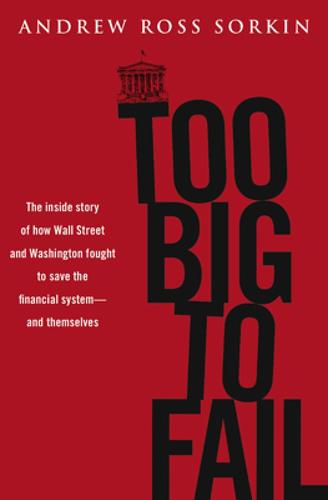
Too Big to Fail
by Andrew Ross Sorkin
★ Top 25 book of 2009 · #23 on Best Books of 2009
A New York Times reporter reconstructs the 2008 financial meltdown from inside the offices of Wall Street and Washington. It reveals the ego, greed and frantic decisions of the powerful figures who tried to contain it.
Best for: Readers wanting a gripping insider account of the global financial crisis
Too Big to Fail is #23 on BookWard's Best Books of 2009, out of 42 2009 books that cleared our data bar.
What Too Big to Fail is about
Sorkin reconstructs the 2008 financial crisis from the inside, following the Wall Street chiefs and government regulators who were making decisions as the system teetered. The account begins at the start of 2008 and ends with the decision to set up the Troubled Asset Relief Program, known as TARP. Figures such as Treasury Secretary Henry Paulson and Timothy Geithner, then head of the New York Fed, appear throughout, and the book lingers on their everyday conversations and judgment calls, showing how ego, greed and fear shaped the outcome. Written by a New York Times reporter in a detailed, tense, journalistic style, it explains how a handful of powerful people handled a crisis that touched everyone. It is a good fit for anyone who wants to understand how the bailouts came about, without needing a finance background.
Too Big to Fail on the Best Books of 2009
Too Big to Fail came out in 2009. Of the 42 books first published in 2009 that met BookWard's data bar, it ranks #23 on our Best Books of 2009 list.
Why it made the list: 201 readers have shelved it on Open Library; readers rate it 4 out of 5 (13 ratings). The list ranks each year’s books on how many readers have picked them up, how highly readers rate them, and how many are reading them right now.
Nearby on the 2009 list
- The Magicians Lev Grossman, #21
- The Gathering Storm Robert Jordan, #22
- The Windup Girl Paolo Bacigalupi, #24
See all Best Books of 2009 Best books by year
More years: Best Books of 2008 Best Books of 2010.
The numbers behind it
- Readers: 172 want to read it, 14 are reading it now and 15 have read it, according to Open Library.
- Ratings: 4 out of 5 from 13 Open Library ratings.
| Signal | This book (0 to 100) | Weight |
|---|---|---|
| Reach | 33 | 55% |
| Reader love | 50 | 25% |
| Being read right now | 62 | 20% |
Questions about Too Big to Fail
When was Too Big to Fail published?
Too Big to Fail by Andrew Ross Sorkin was first published in 2009.
Was Too Big to Fail one of the best books of 2009?
Too Big to Fail is #23 on BookWard's Best Books of 2009, out of 42 2009 books that cleared our data bar. 201 readers have shelved it on Open Library; readers rate it 4 out of 5 (13 ratings).
Why is Too Big to Fail on the Best Books of 2009 list?
201 readers have shelved it on Open Library; readers rate it 4 out of 5 (13 ratings).
More of the best books of 2009
- The Last Olympian Rick Riordan, #1
- Catching Fire Suzanne Collins, #2
- The Maze Runner James Dashner, #3
- The Help Kathryn Stockett, #4
- Dork Diaries Rachel Renée Russell, #5
- I Will Teach You to Be Rich Ramit Sethi, #6
See the full Best Books of 2009, the Top 100, or new books on Rising.
How we know
This page uses public data: Open Library reader counts and ratings, and Wikipedia page views for recent years. The description is paraphrased from real source text. Rankings reflect reading interest, not quality or sales, and can be affected by data gaps. Lists update monthly.
Best for adult readers and mature teens interested in business and politics.
Depends on the edition you pick.
The 2008 crash, told scene by scene from the inside. 60% taste match
 BookWard’s take
The 2008 crash, told scene by scene from the inside
Sorkin turns the 2008 financial crisis into a moment-by-moment account built around the CEOs and regulators who lived it, running from early 2008 to the creation of TARP. It reads like a thriller, and it grabs you right away: the Lehman collapse and the scramble in Washington are gripping on their own. The pace stays brisk because the story is shown in scene rather than explained, which suits a reader who prefers drama to lectures. It's rigorous, too, with a reporter's access behind every conversation. The large cast and many viewpoints can blur at first, but the stakes keep each chapter moving. It won the 2010 Gerald Loeb Award for Best Business Book, and it holds up as both history and drama.
A detailed, blow-by-blow chronicle that runs long, well past the tight and short end BookWard favours.
Short scenes and constant deadlines keep it moving, close to BookWard's fast preference.
The inside-the-room approach is distinctive, but the crisis itself was widely covered.
Plain, efficient reporting prose without ornament.
The sequence of events drives the book more than any individual's inner change.
A near-collapse of the financial system makes the mood tense and gloomy.
A conventional chronological narrative with no formal experiments.
The tone is serious throughout, with only occasional dry moments.
The subject is serious and the stakes high, but it is not graphically dark.
Tension and anxiety run through it, though it stays reportorial rather than raw.
See all 50 dialsEvery position, side by side with this book
Where it lines up
- PaceBookWard 8 · book 8
- Rigor (nonfiction)BookWard 9 · book 9
- Story or ideasBookWard 3 · book 3
Where it pulls apart
- LengthBookWard 1 · book 8
- Familiar tropesBookWard 10 · book 7
- Internal logicBookWard 10 · book 8
A detailed, blow-by-blow chronicle that runs long, well past the tight and short end BookWard favours.
The thriller framing is familiar, though the material is real events rather than recycled genre devices.
Events follow cause and effect closely, with decisions traced to the people and pressures behind them.
Short scenes and constant deadlines keep it moving, close to BookWard's fast preference.
The inside-the-room approach is distinctive, but the crisis itself was widely covered.
Figures are drawn through decisions and conversations rather than deep interior portraits.
It closes on the creation of TARP, a clear endpoint, though the wider fallout lies beyond it.
The account is reportorial and unsentimental, which fits BookWard's taste for restraint.
The drama comes from real events, so any darkness is earned rather than staged.
Built on unusual access to the key players and detailed reconstruction, matching BookWard's high bar.
The reporter's voice is clear and controlled but stays in service of the story.
It is firmly story-led, driven by people and events more than by argument.
Most of it plays out in scene and dialogue, though some financial concepts are explained outright.
With a crisis escalating throughout, momentum holds with only occasional density.
Plain, efficient reporting prose without ornament.
The sequence of events drives the book more than any individual's inner change.
A near-collapse of the financial system makes the mood tense and gloomy.
A conventional chronological narrative with no formal experiments.
The tone is serious throughout, with only occasional dry moments.
The financial detail and crowded cast take some effort, though the narrative pulls you along.
The story passes among many CEOs and regulators, so perspectives are plentiful.
Events unfold in order across 2008 with no jumps.
Entirely grounded in documented real events.
A very large roster of executives and officials crowds the pages.
The stakes are the global financial system, though most scenes take place in small rooms.
It focuses on actions, meetings and decisions rather than private thought.
Conversations among principals carry much of the narrative.
Romance plays no part in this account.
The worlds of Wall Street and Treasury will be unfamiliar to most readers.
It is set in 2008 and written soon after, close to the present.
The crisis remains a reference point, and the book is a lasting record of it.
The narrator is a straight reporter, not a character with a stake.
The book shows many sides and leaves blame and judgment largely open.
Settings and people get brief touches, with plot taking priority over description.
It reads as narrative history rather than an analytical treatise.
The author stays in the background, observing rather than sharing a personal view.
A standalone work.
Sudden failures, rescues and reversals keep surprising even those who know the outcome.
It asks readers to reckon with how those in power failed and improvised.
The subject is serious and the stakes high, but it is not graphically dark.
Tension and anxiety run through it, though it stays reportorial rather than raw.
Little humor, and what there is stays dry.
No physical violence; the harm is economic.
Sexual content is absent.
Government, regulation and bailout decisions are central to the story.
Financial terms add density, but the language is largely plain.
The narration stays mostly neutral, letting events and sources carry the weight.
It looks back on a crisis that had just happened when it was published.
It leans cynical, showing ego, greed and improvisation among the powerful.
Review written by BookWard, dial version 1, November 2026.
Who is Too Big to Fail right for?
Best for adult readers and mature teens interested in business and politics. There is little sensitive content, though the financial detail can be dense.
The financial detail and crowded cast take some effort, though the narrative pulls you along.
The subject is serious and the stakes high, but it is not graphically dark.
Tension and anxiety run through it, though it stays reportorial rather than raw.
No physical violence; the harm is economic.
Book CompanionToo Big to Fail: ideas, characters, themes
The 2008 financial crisis, followed through the daily decisions of the Wall Street chiefs and regulators who tried to contain it.
- Insider access. The account is built on close reporting of private discussions among executives and officials.
- Lehman's collapse. The failure of Lehman Brothers is a central turning point in the story.
- Government response. Treasury and Federal Reserve leaders scramble to find a way to stop the spread of failure.
- The road to TARP. The narrative runs up to the decision to create the Troubled Asset Relief Program.
- Ego and fear. Personal ambition and panic shape choices at the highest levels of finance and government.
Characters
Henry M. Paulson
Treasury secretary
A key government figure in the crisis response.
Timothy Geithner
President of the Federal Reserve Bank of New York
Works with Paulson as the system comes under strain.
Themes
Powerful people who believed their institutions were safe.
How leaders act with limited time and information.
How the failure of one firm threatens many others.
The tension between Washington and Wall Street.
Discussion questions
- Which decision in the book do you think changed the course of the crisis most?
- How does knowing the outcome affect the way you read the early chapters?
- Does the inside-the-room approach make you more or less sympathetic to the leaders?
- What does the book suggest about the limits of regulators' knowledge?
- What would you want a reader to understand about the crisis that a simple summary misses?
Personalize your Book Companion
This is the general edition. In BookWard, the Companion is written for you: your reading profile, your notes, and spoiler-safe to the page you are on.
Buy, listen or borrow Too Big to Fail
Each link opens a search for this book on that store, in a new tab.
Read on a device
Borrow
Reviews and community
If you liked Too Big to Fail
A Cold War spy story told with a novelist's grip
The Hunt for Red OctoberTom ClancyA Cold War chase beneath the sea, packed with technical detail
PachinkoMin Jin LeeFour generations of a Korean family in Japan, told with patience
Steve JobsWalter IsaacsonA candid, sprawling portrait of a brilliant, difficult man
Find your own best books
Add what you have read, rate it, and BookWard will recommend what to read next.
Free to start. No credit card needed.