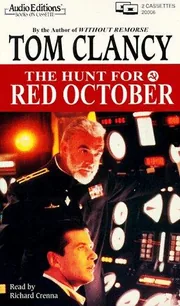
The Hunt for Red October
by Tom Clancy · 1984
Suits adult and older teen readers comfortable with military and technical detail.
479 pages, about 7.5 to 11 hours.
A Cold War chase beneath the sea, packed with technical detail. 53% taste match
The story
The Hunt for Red October is a Cold War espionage thriller by Tom Clancy, first published in 1984 as his debut novel. It was brought out by the Naval Institute Press and runs to roughly 479 pages in its typical edition, with 63 editions in print over the years.
The story follows Marko Ramius, a captain in the Soviet Navy, who commands the Red October, a new nuclear ballistic missile submarine. When he appears to break away from his orders and take the vessel off course, both superpowers are drawn into a tense pursuit beneath the sea. Jack Ryan, an analyst with the Central Intelligence Agency, makes his first appearance here. He sets out to show that Ramius means to defect to the United States rather than attack it. The book belongs to the military and intelligence thriller tradition, with nuclear submarines, naval operations, and the work of spy agencies at its core. It is set in the late Cold War, around 1981, and moves between the Soviet Union and the United States, with its action taking place largely at sea.
Captain First Rank Marko Ramius of the Soviet Navy was dressed for the Arctic conditions normal to the Northern Fleet submarine base at Polyarnyy.
Setting
United StatesSoviet UnionThor's Twins
Period
about 1981
Themes
ThrillerIntelligence serviceJack Ryan (Fictitious character)United StatesNuclear submarinesDefectorsSubmarines (Ships)Sr. Ryan, Jack (Fictitious character)
- Want to read 332
- Reading now 11
- Read 85
Most people shelving it are saving it for later.
Of 428 readers who put it on a shelf, 78% want to read it, 3% are reading it now, 20% have finished it and 0% stopped before the end.
By the numbers
- The median edition runs 479 pages. Counting about 275 words a page and an adult reading pace of 250 words a minute, that is about 8.8 hours of reading.
- Open Library tracks 63 editions from 36 publishers, the earliest dated 1984 and the latest 2018, across 7 languages.
- On reader demand it ranks in the top 1% of the modern books in our catalog (15,152 of them).
- Libraries shelve it under Dewey 813.54 and Library of Congress class PS-3553.00000000.L24/.
 BookWard’s take
A Cold War chase beneath the sea, packed with technical detail
Clancy's debut is a submarine pursuit with a clear engine: Marko Ramius takes the Red October off course, and both superpowers scramble to understand why. It hooks at once and keeps a fast pace, which suits BookWard. The internal logic is its great strength, since the naval and intelligence detail is built to hold together and feel plausible. Where it parts company with BookWard is exposition, because Clancy often explains the machinery outright instead of showing it in scene. Character depth is solid for a thriller, with Jack Ryan introduced here, though the technology sometimes outshines the people. It runs long at 479 pages, yet the chase is sustained rather than sagging. A strong pick for readers who want rigor in their suspense.
At 479 pages it is a substantial thriller, longer than BookWard's taste for tight books.
The chase keeps moving, though technical passages slow it in places, a little under BookWard's pace.
A fresh premise for its time, but the genre it founded makes it feel familiar now.
The writing is plain and utilitarian, built for clarity over ornament, a touch plainer than BookWard likes.
Events and the chase carry the book more than inner change, so plot leads.
The tension is serious but the story tilts toward resolution rather than despair.
It follows a conventional thriller shape, cutting between camps, without formal experiment.
The tone is serious and procedural, with little room for jokes.
Nuclear stakes lend it weight, though the tone is more tense than grim.
Feeling stays subdued beneath procedure and strategy.
See all 50 dialsEvery position, side by side with this book
Where it lines up
- EndingBookWard 8 · book 8
- Internal logicBookWard 10 · book 9
- PaceBookWard 8 · book 7
Where it pulls apart
- LengthBookWard 1 · book 7
- Familiar tropesBookWard 10 · book 5
- ExpositionBookWard 2 · book 8
At 479 pages it is a substantial thriller, longer than BookWard's taste for tight books.
The premise of a submarine breaking course is set up quickly, matching BookWard's wish for an immediate pull.
It helped define the military thriller, though its Cold War heroes and villains follow familiar lines.
Its naval and intelligence detail is built to feel plausible and consistent, which is exactly what BookWard prizes.
The chase keeps moving, though technical passages slow it in places, a little under BookWard's pace.
A fresh premise for its time, but the genre it founded makes it feel familiar now.
Ramius and Ryan are well sketched, yet people often give way to machinery, short of BookWard's depth.
The pursuit builds to a firm resolution rather than leaving matters open, in line with BookWard.
Duty and loyalty carry some feeling, but the tone stays mostly clipped and professional.
Its tension comes from the stakes of the chase, not from gratuitous darkness, which BookWard respects.
Its technical grounding is a selling point, though it is fiction rather than documented fact.
Clancy's manner is brisk and procedural, recognizable but more functional than distinctive.
Story leads here, with the technology serving the chase rather than the other way round.
Clancy often explains systems and tactics outright, which pulls against BookWard's preference for showing in scene.
The pursuit holds attention through its length, with only the technical stretches softening the drive.
The writing is plain and utilitarian, built for clarity over ornament, a touch plainer than BookWard likes.
Events and the chase carry the book more than inner change, so plot leads.
The tension is serious but the story tilts toward resolution rather than despair.
It follows a conventional thriller shape, cutting between camps, without formal experiment.
The tone is serious and procedural, with little room for jokes.
Dense technical and naval detail asks for some patience, a bit more effort than BookWard expects.
It cuts between Soviet and American vantage points, a wide spread that fits BookWard.
The story advances in a straightforward line, so the chronology is easy to follow.
It is firmly grounded in real submarines, navies and agencies, with nothing fantastical.
A broad ensemble spans both navies and intelligence services, larger than BookWard's usual.
A superpower standoff gives it large stakes, though much of the action stays inside a few vessels.
Action, maneuvers and decisions dominate over private reflection.
Conversations among officers and analysts carry much of the briefing and planning.
Romance is a minor thread at most in this military and intelligence tale.
Submarines and spy agencies are an unfamiliar world to most readers, which BookWard enjoys.
It is set in the late Cold War, around 1981, so firmly in the past.
The Cold War setting dates it, though the chase still reads as a genre landmark.
A conventional third-person telling, with no reason to doubt it.
Both sides have understandable aims and the lines are fairly clear, so moral ambiguity is modest.
Ships, systems and ocean operations are described in rich, specific detail.
It introduces Jack Ryan, who goes on to anchor a long line of Clancy novels.
The mystery of Ramius's intent drives reveals, though the genre keeps them fairly predictable.
It is a gripping read, but the technical density asks something of the reader.
Nuclear stakes lend it weight, though the tone is more tense than grim.
Feeling stays subdued beneath procedure and strategy.
What humor exists is dry and brief, not broad.
Naval engagement brings some violence, but it is not the focus.
Sexual content is essentially absent.
The Cold War standoff between superpowers is central to the plot.
Military and technical jargon makes some passages dense, though the grammar stays plain.
The narration stays largely neutral and procedural, letting events speak.
It is rooted in contemporary Cold War tensions of its time, looking neither far back nor ahead.
It sits between cynicism and idealism, trusting institutions while showing their rivalries.
Review written by BookWard, dial version 1, November 2026.
Who is The Hunt for Red October right for?
Suits adult and older teen readers comfortable with military and technical detail. It contains naval combat and Cold War nuclear tension but little else of concern.
Dense technical and naval detail asks for some patience, a bit more effort than BookWard expects.
Nuclear stakes lend it weight, though the tone is more tense than grim.
Feeling stays subdued beneath procedure and strategy.
Naval engagement brings some violence, but it is not the focus.
Book CompanionThe Hunt for Red October: ideas, characters, themes
A Soviet submarine captain takes a prized new missile submarine off course, and two superpowers race to learn whether he means to attack or defect.
- The premise. Marko Ramius commands the Red October, a new nuclear ballistic missile submarine, and appears to break from his orders.
- Two sides. The story shifts between Soviet and American perspectives as each tries to read his intent.
- Jack Ryan. A CIA analyst makes his first appearance and sets out to prove Ramius plans to defect to the United States.
- At sea. Much of the action takes place beneath the ocean, built around naval operations and intelligence work.
- Cold War backdrop. The book is set in the late Cold War, around 1981, and its tension rests on superpower rivalry.
Characters
Marko Ramius
Soviet Navy captain
Commands the Red October and appears to go rogue with her.
Jack Ryan
CIA analyst
Makes his first appearance here and tries to prove Ramius plans to defect.
Themes
Each side must decide whether to believe what the other seems to be doing.
The Cold War standoff shapes every decision and raises the stakes.
Leaving one's country raises questions of loyalty and conscience.
Advanced submarines and sensors shape both strategy and risk.
Discussion questions
- How does the story make you read Ramius's intentions, and did your view change as it went?
- What does the book gain, and lose, from its heavy technical detail?
- How does Jack Ryan's role as an analyst differ from the usual action hero?
- Why might both superpowers have reason to fear a single runaway submarine?
- How does the Cold War setting shape the stakes, and does it still feel tense today?
Personalize your Book Companion
This is the general edition. In BookWard, the Companion is written for you: your reading profile, your notes, and spoiler-safe to the page you are on.
Buy, listen or borrow The Hunt for Red October
Each link opens a search for this book on that store, in a new tab.
Read on a device
Borrow
Reviews and community
If you liked The Hunt for Red October
A vast Cold War thriller that earns its nuclear dread
Without RemorseTom ClancyA grief-fueled revenge thriller that doubles as Clancy's Mr. Clark origin
Rainbow SixTom ClancyClancy's doorstop thriller: elite counterterrorism, and a plot that overreaches
Shadow of the HegemonOrson Scott CardBean goes to ground while Ender's old army is kidnapped
Sources: Open Library.
Track The Hunt for Red October and find your next favorite
Add it to your shelf, rate what you have read, and BookWard will recommend what fits you.
Free to start. No credit card needed.