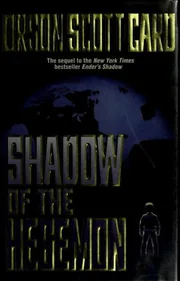
Shadow of the Hegemon
by Orson Scott Card · 2001
It suits teens and adults who enjoy military and political science fiction, and it reads well for grades 9 to 12.
444 pages, about 7 to 10.5 hours.
Bean goes to ground while Ender's old army is kidnapped. 53% taste match
The story
Shadow of the Hegemon is a science fiction novel by Orson Scott Card, first published in 2001. It is the second book in the Ender's Shadow series and the sixth in the larger Ender's Game series, running to roughly 444 pages in its median edition. The story belongs to the Ender Wiggin universe, with Ender's brother Peter Wiggin among its central figures, and it deals with child soldiers and the aftermath of war.
The story picks up after the Formic War has ended in victory. Bean and the other members of Ender's Dragon Army come back to Earth, only to find that most of them are soon taken in a mysterious kidnapping. Bean is the one who remains free, and he turns to Peter for help. Bean, a minor figure in Ender's Game and the lead of its parallel novel Ender's Shadow, is the point of view through which most of the book is told. The novel was nominated for a Locus Award in 2002 and has appeared in 25 editions.
I was given your idname by a mutual friend who once worked for you but now is a glorified dispatcher-I'm sure you know whom I mean.
Themes
Ender Wiggin (Fictitious character)Peter Wiggin (Fictitious character)Child soldiers
- Want to read 55
- Read 57
Readers are split between finishing it and saving it for later.
Of 112 readers who put it on a shelf, 49% want to read it, 0% are reading it now, 51% have finished it and 0% stopped before the end.
By the numbers
- The median edition runs 444 pages. Counting about 275 words a page and an adult reading pace of 250 words a minute, that is about 8.1 hours of reading.
- Open Library tracks 25 editions from 19 publishers, the earliest dated 2001 and the latest 2019, across 4 languages.
- On reader demand it ranks in the top 10% of the modern books in our catalog (15,152 of them).
- Libraries shelve it under Dewey 813.54 and Library of Congress class PS-3553.00000000.A655 S46 2001.
 BookWard’s take
Bean goes to ground while Ender's old army is kidnapped
Shadow of the Hegemon picks up after the Formic War, with Bean back on Earth and most of Ender's Dragon Army suddenly taken. Bean stays free and turns to Peter Wiggin for help. The book moves briskly, and the kidnapping makes for a strong opening. The perspective works well: Bean carries most of the story, but the book is built around geopolitics, with children as pieces on the board. The characters are solid rather than deep. Ideas matter more than people here, and the novel leans hard in that direction. It is also thoroughly a series book, the second in the Shadow sequence and the sixth in the larger run, so having read Ender's Game helps.
At 444 pages it runs moderate, longer than BookWard's taste for tight books but not sprawling.
Kidnapping, flight and maneuvering keep events coming, close to BookWard's quick pace.
Child strategists in a power struggle among nations feel fresh, though the book builds on an established universe.
The prose is plain and functional, below BookWard's mid-range taste for ornament.
Events and schemes drive the story more than inner change, so it leans plot-led against BookWard's character-driven lean.
Survival and alliance give some light, but the stakes and the aftermath of war keep it from being strongly hopeful.
The story moves in a conventional straight line, close to BookWard's conventional-leaning taste.
The tone stays serious, with little humor, well below BookWard's mild lean toward funny.
Kidnapping and child soldiers carry real weight, a little above BookWard's middle position.
Feeling is present but kept in check by the strategic focus, near BookWard's middle.
See all 50 dialsEvery position, side by side with this book
Where it lines up
- PaceBookWard 8 · book 8
- Character depthBookWard 8 · book 7
- OpeningBookWard 10 · book 8
Where it pulls apart
- Familiar tropesBookWard 10 · book 6
- LengthBookWard 1 · book 4
- Internal logicBookWard 10 · book 7
At 444 pages it runs moderate, longer than BookWard's taste for tight books but not sprawling.
A kidnapping of Ender's old army sets the story moving early, which suits BookWard's liking for an immediate opening.
Child soldiers and political scheming are familiar ground in military science fiction, so it avoids tropes less than BookWard prefers.
Plans and counterplans give the story a strategic structure, though it sits a little below BookWard's airtight standard.
Kidnapping, flight and maneuvering keep events coming, close to BookWard's quick pace.
Child strategists in a power struggle among nations feel fresh, though the book builds on an established universe.
Bean has real interior life and the cast is distinct, though some figures serve the plot more than they deepen.
As the second book in a series it resolves its main conflict while leaving the larger story open, short of BookWard's full closure.
Loyalty and friendship matter, but the story stays on strategy more than feeling, so it leans restrained.
Kidnapping and the risk to young characters raise the stakes, and the darkness mostly serves the plot.
Not applicable to a novel.
Card's clear, brisk delivery is recognizable, though it favors plot over a stand-out style.
Ideas about power, strategy and statecraft carry real weight, pulling it further toward ideas than BookWard prefers.
Strategy and politics get explained a fair amount, more than BookWard's preference for showing in scene.
The pace holds fairly well, though the political maneuvering can slow the middle slightly.
The prose is plain and functional, below BookWard's mid-range taste for ornament.
Events and schemes drive the story more than inner change, so it leans plot-led against BookWard's character-driven lean.
Survival and alliance give some light, but the stakes and the aftermath of war keep it from being strongly hopeful.
The story moves in a conventional straight line, close to BookWard's conventional-leaning taste.
The tone stays serious, with little humor, well below BookWard's mild lean toward funny.
Accessible, with clear action and a clear style, though the politics ask for some attention.
Bean carries most of the story, but other threads including Peter's widen the view.
Events unfold in order, more linear than BookWard's slight lean toward shifting time.
Set in a future with space war in its past, but mostly about Earth politics, so it stays fairly grounded.
Many figures from the Dragon Army and from political circles make this a large cast, larger than BookWard's preference.
The struggle involves nations and the fate of the world, far more epic than BookWard's intimate lean.
Kidnappings, escapes and maneuvering put outer action ahead of inner reflection, more than BookWard prefers.
Strategy and persuasion play out through conversation, so dialogue is heavy, in line with BookWard.
The story concerns war and politics, so romance stays in the background.
A future Earth shaped by war after the Formic conflict feels moderately unfamiliar, a bit below BookWard's liking.
Set in a future world, it sits closer to the past end of BookWard's lean toward the present day.
Power and war are lasting themes, but the book is tied to its universe, so staying power is middling.
The story is told straightforwardly through Bean, with little reason to doubt the narration.
Choices about power and loyalty involve gray areas, moderately ambiguous, close to BookWard's taste.
Description serves action and stays light, below BookWard's mild lean toward richness.
Not applicable to a novel.
Not applicable to a novel.
It is the second Shadow book and sixth in the wider series, so it leans well into series territory.
The kidnapping and the maneuvering around it set up reversals, in line with BookWard's taste for surprises.
It asks readers to track politics and strategy, giving moderate challenge, a bit under BookWard's lean.
Kidnapping and child soldiers carry real weight, a little above BookWard's middle position.
Feeling is present but kept in check by the strategic focus, near BookWard's middle.
The humor is dry and sparse, below BookWard's middle position.
War and kidnapping bring danger, but the focus is scheming more than gore, around the middle or a little above.
Sexual content is minimal, well below BookWard's middle position.
Power struggles between nations sit at the center, far past BookWard's middle position.
The language is plain and easy to follow, well below BookWard's middle position.
Narration stays mostly neutral, though the viewpoint character's judgments color it, near BookWard's middle.
It looks backward to the war while thinking forward about what comes next, near BookWard's middle.
Cunning and compromise shape the story more than ideals, so it leans somewhat cynical.
Review written by BookWard, dial version 1, November 2026.
Who is Shadow of the Hegemon right for?
It suits teens and adults who enjoy military and political science fiction, and it reads well for grades 9 to 12. It centers on child soldiers, kidnapping and war, which some younger readers may find heavy.
Accessible, with clear action and a clear style, though the politics ask for some attention.
Kidnapping and child soldiers carry real weight, a little above BookWard's middle position.
Feeling is present but kept in check by the strategic focus, near BookWard's middle.
War and kidnapping bring danger, but the focus is scheming more than gore, around the middle or a little above.
Book CompanionShadow of the Hegemon: ideas, characters, themes
After a war, the children who won it are pulled into the power struggles of the world they saved.
- The return to Earth. Bean and Ender's Dragon Army come home after the victory in the Formic War.
- A kidnapping. Most of the former Dragon Army members are taken, leaving Bean as the one still free.
- Turning to Peter. Bean turns to Ender's brother Peter Wiggin for help.
- Bean's point of view. Most of the book is told through Bean, a peripheral figure in Ender's Game who led Ender's Shadow.
- Place in the series. It is the second Ender's Shadow book and the sixth in the larger Ender's Game series.
Characters
Bean
Main viewpoint character
A former member of Ender's Dragon Army and the one who stays free after the kidnapping.
Peter Wiggin
Ender's brother
Bean turns to him for help.
Ender Wiggin
Hero of the earlier war
The commander of the Dragon Army, who sets the story in motion by his earlier victory.
Themes
What it costs to ask children to fight and win a war.
How leaders and nations compete once the common enemy is gone.
Whom Bean can trust when his friends are taken.
How victory brings new dangers rather than simple peace.
Discussion questions
- Why does Bean turn to Peter, and what does that choice say about him?
- How does the story treat the cost of using children as soldiers?
- What does it add to see events through Bean instead of Ender?
- How does the end of the Formic War reshape the politics of Earth?
- Do you need to know Ender's Game to follow this book?
Personalize your Book Companion
This is the general edition. In BookWard, the Companion is written for you: your reading profile, your notes, and spoiler-safe to the page you are on.
Buy, listen or borrow Shadow of the Hegemon
Each link opens a search for this book on that store, in a new tab.
Read on a device
Borrow
Reviews and community
If you liked Shadow of the Hegemon
Space war on a grand scale, with Holden at the center
ScytheNeal ShustermanA sharp, fast YA dystopia where death is a job
DragonquestAnne McCaffreyPern's second Threadfall: dragons, politics, and a planet to save
The Secret of the NagasAmish TripathiShiva's quest for a Naga warrior, wrapped in epic mythological adventure
Sources: Open Library.
Track Shadow of the Hegemon and find your next favorite
Add it to your shelf, rate what you have read, and BookWard will recommend what fits you.
Free to start. No credit card needed.