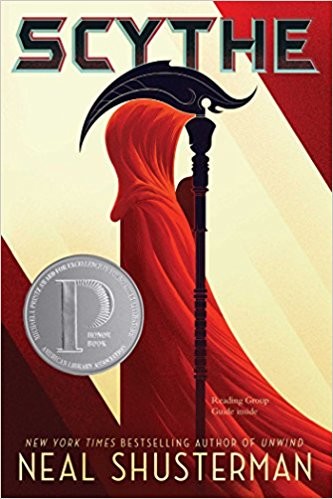
Scythe
by Neal Shusterman
★ Top 25 book of 2016 · #13 on Best Books of 2016
In a world that has defeated hunger, disease, and even death, scythes alone may end lives to control population. Citra and Rowan are chosen as apprentices to the role, though neither wants it, and failure could cost them everything.
Best for: Teen and adult readers who enjoy dystopian worlds with high moral stakes
Scythe is #13 on BookWard's Best Books of 2016, out of 70 2016 books that cleared our data bar.
What Scythe is about
In a far future where disease, hunger and even death have been virtually conquered, a kindly artificial intelligence called the Thunderhead runs a united Earth. One job it leaves to people: the Scythes, who take lives on purpose so that the population stays in balance. They call it gleaning, and it is meant to echo the way death once arrived on its own.
Sixteen-year-old Citra Terranova and Rowan Damisch never wanted any part of this. Both are chosen as apprentices to Scythe Michael Faraday, and both know that failing could cost them their own lives. Then a rival Scythe who relishes the work begins pushing for something far crueler. Shusterman uses the setup to ask what a perfect world costs, who should hold the power to kill, and what it does to a person. It suits teen and adult readers who like dark, suspenseful ideas that linger.
Scythe on the Best Books of 2016
Scythe came out in 2016. Of the 70 books first published in 2016 that met BookWard's data bar, it ranks #13 on our Best Books of 2016 list.
Why it made the list: 773 readers have shelved it on Open Library; readers rate it 4.3 out of 5 (31 ratings); 38 are reading it right now. The list ranks each year’s books on how many readers have picked them up, how highly readers rate them, and how many are reading them right now.
Nearby on the 2016 list
- Crooked Kingdom Leigh Bardugo, #11
- The Way I Used to Be Amber Smith, #12
- Ego Is the Enemy Ryan Holiday, #14
- Culpa Tuya Mercedes Ron, #15
See all Best Books of 2016 Best books by year
More years: Best Books of 2015 Best Books of 2017.
The numbers behind it
- Readers: 681 want to read it, 38 are reading it now and 54 have read it, according to Open Library.
- Ratings: 4.3 out of 5 from 31 Open Library ratings.
| Signal | This book (0 to 100) | Weight |
|---|---|---|
| Reach | 74 | 55% |
| Reader love | 80 | 25% |
| Being read right now | 73 | 20% |
Questions about Scythe
When was Scythe published?
Scythe by Neal Shusterman was first published in 2016.
Was Scythe one of the best books of 2016?
Scythe is #13 on BookWard's Best Books of 2016, out of 70 2016 books that cleared our data bar. 773 readers have shelved it on Open Library; readers rate it 4.3 out of 5 (31 ratings); 38 are reading it right now.
Why is Scythe on the Best Books of 2016 list?
773 readers have shelved it on Open Library; readers rate it 4.3 out of 5 (31 ratings); 38 are reading it right now.
More of the best books of 2016
- It Ends with Us Colleen Hoover, #1
- Dog Man Dav Pilkey, #2
- The Subtle Art of Not Giving a F*ck Mark Manson, #3
- Never Split the Difference Chris Voss, #4
- The Hidden Oracle Rick Riordan, #5
- Born a Crime Trevor Noah, #6
See the full Best Books of 2016, the Top 100, or new books on Rising.
How we know
This page uses public data: Open Library reader counts and ratings, and Wikipedia page views for recent years. The description is paraphrased from real source text. Rankings reflect reading interest, not quality or sales, and can be affected by data gaps. Lists update monthly.
Suits mid-teens and up, including adult readers who enjoy speculative fiction.
Depends on the edition you pick.
A sharp, fast YA dystopia where death is a job. 62% taste match
 BookWard’s take
A sharp, fast YA dystopia where death is a job
Scythe starts with a premise that hooks at once: humanity has beaten death, so killing has become a regulated duty. Shusterman builds it carefully, and the logic of the world holds together, which suits BookWard's love of airtight setups. It leans story-led rather than idea-led, and the pace stays brisk, so the middle rarely sags. Two teenage apprentices give it character depth without slowing the plot, and the moral ambiguity is real rather than decorative. Sentiment stays restrained and the darkness feels earned, not shock for effect. Where it slips is originality in the YA toolkit: apprentices, rival mentors and a looming conclave are familiar shapes. It is also the first of a series, so its ending resolves a stretch but leaves a larger story open.
A mid-sized YA novel that moves briskly, shorter than BookWard's sprawl-averse ideal would fear but not truly tight.
Events keep moving through training, conclaves and conflict, close to BookWard's preference for speed.
A world that has conquered death and licenses killing is a fresh angle, though the plot machinery is more conventional.
Plain, readable sentences that favor clarity over ornament, close to BookWard's slightly plain lean.
Plot machinery and the dilemmas of its two leads share the load, tilting a little toward plot.
The world is outwardly utopian yet morally troubling, leaving the outlook balanced between hope and unease.
It follows a conventional linear structure, close to BookWard's own mild preference.
The tone is serious, with only small touches of wry humor.
Death is the subject and killing is routine, yet the tone stays within YA bounds.
Feeling runs steady and controlled, with moments of intensity rather than constant heat.
See all 50 dialsEvery position, side by side with this book
Where it lines up
- PaceBookWard 8 · book 8
- OpeningBookWard 10 · book 9
- Character depthBookWard 8 · book 7
Where it pulls apart
- Familiar tropesBookWard 10 · book 5
- LengthBookWard 1 · book 5
- Internal logicBookWard 10 · book 8
A mid-sized YA novel that moves briskly, shorter than BookWard's sprawl-averse ideal would fear but not truly tight.
Its central conceit, killing as a sanctioned profession, grabs immediately, matching BookWard's taste for openings that hook at once.
The apprentice-and-mentor frame and rival factions are familiar YA moves, so it avoids tropes less than BookWard prefers.
The Thunderhead and the Scythedom rules fit together tightly, which BookWard rewards in a built world.
Events keep moving through training, conclaves and conflict, close to BookWard's preference for speed.
A world that has conquered death and licenses killing is a fresh angle, though the plot machinery is more conventional.
Citra and Rowan are developed through choices and doubt, a little short of the deeply drawn characters BookWard likes.
The main conflicts resolve, but the series hook leaves threads open, a bit looser than BookWard's resolved taste.
Emotion is handled with some restraint, though a YA warmth peeks through in places.
The killing is central and reasoned, so the darkness serves the premise rather than existing to shock.
This is fiction, so rigor does not apply.
The prose is clean and confident, with a recognizable authorial hand, though not strongly idiosyncratic.
Ideas about mortality drive it, but the story of two apprentices stays in front, near BookWard's story-led lean.
Much of the world is shown through scenes, with some outright explaining of the Scythedom's rules.
Momentum holds through the training and conclave stretches, in line with BookWard's wish for a sustained middle.
Plain, readable sentences that favor clarity over ornament, close to BookWard's slightly plain lean.
Plot machinery and the dilemmas of its two leads share the load, tilting a little toward plot.
The world is outwardly utopian yet morally troubling, leaving the outlook balanced between hope and unease.
It follows a conventional linear structure, close to BookWard's own mild preference.
The tone is serious, with only small touches of wry humor.
It reads easily and quickly, lighter on effort than BookWard's middling taste.
The story follows two apprentices and occasionally adds other voices, so a few viewpoints in play.
Events run in order without time jumps, slightly more linear than BookWard's middle position.
Set in a far-future world with a governing AI, it is speculative but grounded in rules.
A handful of apprentices and Scythes carry the story, a moderate cast.
It builds from two apprentices to a conclave of Scythes, with a broader society at stake.
Events and confrontations drive the book more than interior reflection.
Conversations between mentors, rivals and apprentices carry a good share of the story.
Romance plays a supporting role, never the central thread.
A future Earth with a ruling AI and licensed killers is unfamiliar territory, which BookWard enjoys.
Set in a distant future rather than the present day.
Its questions about death and control should hold up, though it reads as a YA of its moment.
The narration is straightforward and trustworthy, not a source of doubt.
Whether killing can ever be ethical is left genuinely contested, matching BookWard's liking for ambiguity.
Setting is sketched efficiently rather than lavished with detail.
It opens the Arc of a Scythe series, so it is firmly part of a larger run.
Betrayals and reversals among the Scythes keep the plot turning.
It poses uncomfortable questions but stays accessible, more provocative than demanding.
Death is the subject and killing is routine, yet the tone stays within YA bounds.
Feeling runs steady and controlled, with moments of intensity rather than constant heat.
Humor is dry and occasional rather than broad.
Killing drives the premise and is shown, though not in lingering detail.
Sexual content is minimal for a YA novel.
Governance and the ethics of power sit in the background of the Scythedom plot.
Language is plain and contemporary with no dense dialect.
The narration lets events speak, keeping its own view mostly in the wings.
It imagines a far future and what humanity might become, so it looks forward.
A seemingly perfect world is shown to harbor corruption, leaning toward the skeptical.
Review written by BookWard, dial version 1, November 2026.
Who is Scythe right for?
Suits mid-teens and up, including adult readers who enjoy speculative fiction. Killing is central to the premise and some scenes depict death and cruelty.
It reads easily and quickly, lighter on effort than BookWard's middling taste.
Death is the subject and killing is routine, yet the tone stays within YA bounds.
Feeling runs steady and controlled, with moments of intensity rather than constant heat.
Killing drives the premise and is shown, though not in lingering detail.
Book CompanionScythe: ideas, characters, themes
In a world that has conquered death, humans called Scythes must kill to control the population, and two teens are chosen to learn the craft.
- A world without death. Technology and a benevolent AI called the Thunderhead have removed hunger, disease and war, and even made death reversible.
- The Scythes. A small order of humans is required to end lives to mimic natural death and keep population in check.
- Two reluctant apprentices. Citra Terranova and Rowan Damisch are taken on by Scythe Michael Faraday despite not wanting the role.
- The Conclave. Apprentices are tested before a gathering of Scythes, where rivalries and competing philosophies come into view.
- Competing ideas of killing. Faraday and Goddard represent opposing attitudes toward the duty to glean, setting up the central moral conflict.
Characters
Citra Terranova
Apprentice Scythe
A sixteen-year-old taken on by Faraday who pushes to understand the world she has entered.
Rowan Damisch
Apprentice Scythe
A sixteen-year-old apprentice whose path diverges from Citra's.
Scythe Michael Faraday
Mentor
The Scythe who takes both teens in and trains them.
Scythe Goddard
Antagonist
A Scythe who enjoys killing and lives extravagantly.
Scythe Curie
Fellow Scythe
An established Scythe with a history connected to Faraday.
Themes
What a life is worth when death is controlled by choice.
How authority over life and death can warp those who hold it.
Whether killing can be a burden accepted with conscience or a pleasure indulged.
What is lost in a world that has removed suffering.
The trade-offs of handing society's order to a benevolent machine.
Discussion questions
- Is a world without natural death better or worse, and why?
- Does Faraday's reluctance make him more moral than Goddard, or only more comfortable?
- Why might the Thunderhead be barred from governing the Scythes?
- What would you do if chosen as an apprentice and could not refuse?
- Does the novel treat gleaning as justified, or only as a necessary evil?
Personalize your Book Companion
This is the general edition. In BookWard, the Companion is written for you: your reading profile, your notes, and spoiler-safe to the page you are on.
Buy, listen or borrow Scythe
Each link opens a search for this book on that store, in a new tab.
Read on a device
Borrow
Reviews and community
If you liked Scythe
A street-smart genius, a familiar war, and a sharper angle on it
DragonquestAnne McCaffreyPern's second Threadfall: dragons, politics, and a planet to save
UgliesScott WesterfeldA fast YA dystopia about beauty, choice, and a friend's escape
Shadow and BoneLeigh BardugoA brisk Russia-inspired fantasy debut that opens in the dark
Find your own best books
Add what you have read, rate it, and BookWard will recommend what to read next.
Free to start. No credit card needed.