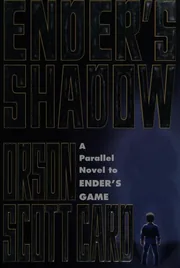
Ender's Shadow
by Orson Scott Card · 1999
This suits older teens and adults, and its reading levels are listed around grades 9 to 12.
454 pages, about 7 to 10.5 hours.
A street-smart genius, a familiar war, and a sharper angle on it. 63% taste match
The story
Ender's Shadow is a science fiction novel by Orson Scott Card, first published in 1999. It is a parallel novel to Ender's Game, set during the same years and revisiting some of the same events, but told from the point of view of Bean, a supporting figure in that earlier book. The story opens with a child named Poke, and follows Bean from a childhood of hunger and gang violence on city streets toward a very different life.
Bean is small and survives by intelligence rather than strength. His abilities bring him to Battle School, where children are trained as future military commanders for a coming war against an alien enemy known as the Buggers. There he meets Ender Wiggin, another young commander in the making, and the two form a friendship marked by rivalry. The book belongs to the Ender saga and draws on themes of child soldiers, war games, and gifted children placed in command. It runs to about 454 pages in its median edition and has appeared in 33 editions.
Poke kept her eyes open all the time.
Themes
Child soldiersBean (Ficticious Character)Ender Wiggin (Fictitious character)Exceptional childrenGeneralsImaginary wars and battlesMale friendshipWar games
- Want to read 128
- Reading now 1
- Read 104
Readers are split between finishing it and saving it for later.
Of 233 readers who put it on a shelf, 55% want to read it, 0% are reading it now, 45% have finished it and 0% stopped before the end.
By the numbers
- The median edition runs 454 pages. Counting about 275 words a page and an adult reading pace of 250 words a minute, that is about 8.3 hours of reading.
- Open Library tracks 33 editions from 23 publishers, the earliest dated 1999 and the latest 2019, across 4 languages.
- On reader demand it ranks in the top 3% of the modern books in our catalog (15,152 of them).
- Libraries shelve it under Dewey 813 and Library of Congress class PS-3553.00000000.A655 E58 2013.
 BookWard’s take
A street-smart genius, a familiar war, and a sharper angle on it
Ender's Shadow retells the world of Ender's Game through Bean, a tiny child who survives hunger and gang violence by thinking faster than everyone around him. It opens with a child named Poke and drops you straight into the streets, so the hook is immediate. This is a character-driven book, and Bean is drawn with real depth, a mind you want to follow. The pace stays brisk across its 454 pages, and the internal logic of the war games and Bean's reasoning holds together tightly. The ending is largely resolved, which is satisfying. My reservation is the reliance on familiar tropes: the gifted-child-in-command premise is well worn, and the Ender saga context shapes much of what follows. Still, the shift in viewpoint keeps the material fresh.
At 454 pages it is mid-length, longer than BookWard's tight preference but paced so it does not feel padded.
Street survival and Battle School keep things moving, close to BookWard's quick preference.
Retelling a known story from a supporting character's side adds freshness, though the core premise is familiar.
The writing is plain and efficient rather than ornate, a touch plainer than BookWard's middle position.
Bean's mind and choices drive events more than external plot, matching BookWard's character-led leaning.
A harsh start and a looming war tilt it darker than BookWard's hopeful lean, though friendship offers some light.
It runs in a fairly conventional line, even as it parallels another novel's events.
The tone is serious, with little humor, which is more earnest than BookWard's lightly funny lean.
Starvation, gangs, and child soldiers make for dark material, a bit above BookWard's midpoint.
The emotions are present but contained, close to BookWard's middle position.
See all 50 dialsEvery position, side by side with this book
Where it lines up
- PaceBookWard 8 · book 8
- EndingBookWard 8 · book 8
- OpeningBookWard 10 · book 9
Where it pulls apart
- Familiar tropesBookWard 10 · book 4
- LengthBookWard 1 · book 5
- OriginalityBookWard 9 · book 6
At 454 pages it is mid-length, longer than BookWard's tight preference but paced so it does not feel padded.
It starts on the streets with a hungry child, which matches BookWard's love of a book that grabs at once.
Gifted children trained as commanders is a well-known setup, so it leans on tropes more than BookWard likes.
Bean wins by reasoning, and the war games reward tight cause and effect, which is exactly what BookWard prizes.
Street survival and Battle School keep things moving, close to BookWard's quick preference.
Retelling a known story from a supporting character's side adds freshness, though the core premise is familiar.
Bean's mind and background are the point of the book, which BookWard values highly.
The parallel storyline reaches a clear conclusion, in line with BookWard's taste for resolved endings.
Emotion is present but handled with some restraint, a little warmer than BookWard prefers.
Hunger and child violence are central to the setting, but they serve the story rather than shock for effect.
This is a novel, so the nonfiction rigor dial does not apply.
Card's clear, controlled narration is recognizable but more functional than strikingly distinctive.
The story and character come first, with ideas about war and giftedness woven through, matching BookWard's story-led lean.
Much is shown through Bean's scenes, though his reasoning is sometimes laid out plainly.
The move from the streets to Battle School keeps momentum, so the middle holds up well.
The writing is plain and efficient rather than ornate, a touch plainer than BookWard's middle position.
Bean's mind and choices drive events more than external plot, matching BookWard's character-led leaning.
A harsh start and a looming war tilt it darker than BookWard's hopeful lean, though friendship offers some light.
It runs in a fairly conventional line, even as it parallels another novel's events.
The tone is serious, with little humor, which is more earnest than BookWard's lightly funny lean.
The prose is accessible and the plot clear, so it asks little extra effort from the reader.
It follows Bean closely, giving a mostly single viewpoint that is narrower than BookWard's usual range.
Events move forward from childhood into training in a straightforward sequence.
An alien enemy and a future war place it in science fiction, a bit more fantastical than BookWard's middle.
A school full of young commanders and street kids gives it a sizable cast beyond BookWard's smaller norm.
A world at war with an alien enemy gives it a larger canvas than an intimate story.
Bean's thinking and his actions both matter, with a lean toward his inner reasoning.
Conversations between children and officers carry much of the story, in line with BookWard's taste for dialogue.
Friendship and rivalry matter more here than romance, which stays in the background.
A future Battle School and hostile alien war form a setting unfamiliar to most readers.
It is set in a far-future world rather than the present day.
Its themes of gifted children and war games give it staying power beyond its moment.
The story is told straightforwardly through Bean, with no sign of an unreliable narrator.
Questions about training children for war lean toward ambiguity, a good fit with BookWard.
The prose favors action and thought over lavish scenery, so description stays moderate.
This is fiction, so the nonfiction style dial does not apply.
This is fiction, so the nonfiction perspective dial does not apply.
It belongs to the Ender saga and works best alongside Ender's Game, more connected than BookWard's usual standalone lean.
Bean's cleverness yields some surprises, but not at BookWard's heavy-twist level.
The premise about child soldiers raises uncomfortable questions, sitting near BookWard's lean toward challenge.
Starvation, gangs, and child soldiers make for dark material, a bit above BookWard's midpoint.
The emotions are present but contained, close to BookWard's middle position.
Humor is minimal and understated, leaning dry rather than broad.
Gang violence on the streets and war training bring a fair amount of it onto the page.
Sexual content is essentially absent from this book.
Power, war, and who controls children's training bring politics in, but it is not the main focus.
The language is plain and easy to follow, well below BookWard's midpoint on density.
Narration stays close to Bean's point of view without much editorializing.
It looks toward a coming war, but its backstory material pulls it back toward the past.
The world is harsh and cynical, though friendship adds a touch of idealism.
Review written by BookWard, dial version 1, November 2026.
Who is Ender's Shadow right for?
This suits older teens and adults, and its reading levels are listed around grades 9 to 12. It deals with child hunger, gang violence, and children trained for war, which some readers may find heavy.
The prose is accessible and the plot clear, so it asks little extra effort from the reader.
Starvation, gangs, and child soldiers make for dark material, a bit above BookWard's midpoint.
The emotions are present but contained, close to BookWard's middle position.
Gang violence on the streets and war training bring a fair amount of it onto the page.
Book CompanionEnder's Shadow: ideas, characters, themes
A tiny, brilliant street child survives on intelligence rather than strength and is pulled into a school that trains children to command a war.
- A parallel story. It takes place during the same years as Ender's Game and revisits some of the same events from Bean's point of view.
- Brains over brawn. Bean is far too small to fight, so he lives by reading people and exploiting their weaknesses.
- From streets to Battle School. The story moves from a childhood of hunger and gang violence to training as a potential military commander.
- A rivalry and a friendship. At Battle School Bean meets Ender Wiggin, another young commander in the making, and the two bond through rivalry.
- Part of the Ender saga. It adds character background for readers who want to know more about Bean and fits within the larger series.
Characters
Bean
Protagonist
A very small child who survives the streets through intelligence and is drawn into Battle School.
Poke
Street child
A child on the streets who appears at the opening of the story.
Ender Wiggin
Fellow commander in training
Another gifted young commander whom Bean meets at Battle School and forms a friendship with.
Themes
How intelligence can substitute for strength when the odds are brutal.
The cost of training gifted children to lead a war.
How competition and loyalty can coexist between equals.
What it means to be exceptional and what is demanded of such children.
Strategy and simulation as preparation for a real conflict.
Discussion questions
- How does Bean's small size shape the way he thinks and survives?
- What does the book suggest about training children for war?
- How does knowing the Ender's Game events change your reading of this story?
- What makes the friendship between Bean and Ender both a bond and a rivalry?
- Does seeing the same events from a supporting character change your view of the original story?
Personalize your Book Companion
This is the general edition. In BookWard, the Companion is written for you: your reading profile, your notes, and spoiler-safe to the page you are on.
Buy, listen or borrow Ender's Shadow
Each link opens a search for this book on that store, in a new tab.
Read on a device
Borrow
Reviews and community
If you liked Ender's Shadow
A sharp, fast YA dystopia where death is a job
SunbringerHannah KanerA gods-and-war sequel that rides on three strong leads
King of ScarsLeigh BardugoA young king's secret curse, told through three sharp voices
DragonquestAnne McCaffreyPern's second Threadfall: dragons, politics, and a planet to save
Sources: Open Library.
Track Ender's Shadow and find your next favorite
Add it to your shelf, rate what you have read, and BookWard will recommend what fits you.
Free to start. No credit card needed.