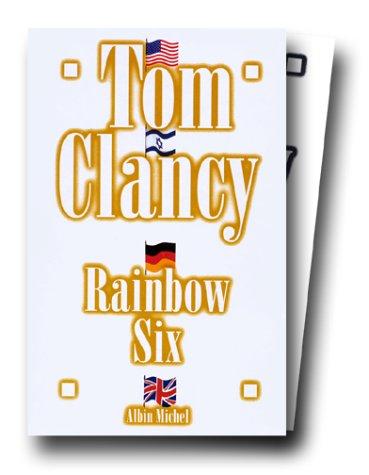
Rainbow Six
by Tom Clancy
★ Top 25 book of 1998 · #11 on Best Books of 1998
John Clark, the ex-Navy SEAL who handles secret missions Jack Ryan cannot touch, faces his gravest test yet. A band of unprecedented extremists threatens life on earth as we know it.
Best for: Fans of Clancy's realistic, suspenseful plots and covert operative John Clark
Rainbow Six is #11 on BookWard's Best Books of 1998, out of 36 1998 books that cleared our data bar.
What Rainbow Six is about
After the Cold War, terrorism begins to rise, and John Clark answers by building Rainbow, a secret international unit based in Hereford. He commands it under the call sign Rainbow Six, with SAS officer Alistair Stanley as his deputy. Two teams of elite soldiers from NATO countries do the fieldwork, one led by his son-in-law Domingo "Ding" Chavez and the other by SAS man Peter Covington.
The crises come quickly: a bank robbery in Bern, hostages held in a Vienna schloss, and a standoff at a Madrid amusement park. Behind the violence sits a larger conspiracy tied to a biotechnology company and its CEO, with a plan that reaches toward the Sydney Olympics and the fate of humanity. Clancy mixes procedural detail, strategy and a steady sense of pressure. Readers who enjoy military and security thrillers, and the world of Jack Ryan's darker colleague, will find plenty to chew on.
Rainbow Six on the Best Books of 1998
Rainbow Six came out in 1998. Of the 36 books first published in 1998 that met BookWard's data bar, it ranks #11 on our Best Books of 1998 list.
Why it made the list: 400 readers have shelved it on Open Library; readers rate it 3.8 out of 5 (38 ratings); 20 are reading it right now. The list ranks each year’s books on how many readers have picked them up, how highly readers rate them, and how many are reading them right now.
Nearby on the 1998 list
- A Bad Case of Stripes David Shannon, #9
- The Art of Happiness His Holiness Tenzin Gyatso the XIV Dalai Lama, #10
- Skellig David Almond, #12
- The Poisonwood Bible Barbara Kingsolver, #13
See all Best Books of 1998 Best books by year
More years: Best Books of 1997 Best Books of 1999.
The numbers behind it
- Readers: 327 want to read it, 20 are reading it now and 53 have read it, according to Open Library.
- Ratings: 3.8 out of 5 from 38 Open Library ratings.
| Signal | This book (0 to 100) | Weight |
|---|---|---|
| Reach | 78 | 55% |
| Reader love | 44 | 25% |
| Being read right now | 69 | 20% |
Questions about Rainbow Six
When was Rainbow Six published?
Rainbow Six by Tom Clancy was first published in 1998.
Was Rainbow Six one of the best books of 1998?
Rainbow Six is #11 on BookWard's Best Books of 1998, out of 36 1998 books that cleared our data bar. 400 readers have shelved it on Open Library; readers rate it 3.8 out of 5 (38 ratings); 20 are reading it right now.
Why is Rainbow Six on the Best Books of 1998 list?
400 readers have shelved it on Open Library; readers rate it 3.8 out of 5 (38 ratings); 20 are reading it right now.
More of the best books of 1998
- Harry Potter and the Chamber of Secrets J. K. Rowling, #1
- Holes Louis Sachar, #2
- A Clash of Kings George R. R. Martin, #3
- Among the Hidden Margaret Peterson Haddix, #4
- Who Moved My Cheese? Spencer Johnson, #5
- No, David! David Shannon, #6
See the full Best Books of 1998, the Top 100, or new books on Rising.
How we know
This page uses public data: Open Library reader counts and ratings, and Wikipedia page views for recent years. The description is paraphrased from real source text. Rankings reflect reading interest, not quality or sales, and can be affected by data gaps. Lists update monthly.
Best suited to adult and older teen readers who enjoy action thrillers.
Depends on the edition you pick.
Clancy's doorstop thriller: elite counterterrorism, and a plot that overreaches. 38% taste match
 BookWard’s take
Clancy's doorstop thriller: elite counterterrorism, and a plot that overreaches
Rainbow Six follows John Clark as he builds a secret international counterterrorism unit, then sends it into a run of hostage crises across Europe that look unrelated. The first half is where it earns its reputation: the Rainbow operations are staged with procedural care, and the logic of how each team works holds together. That meets BookWard's love of airtight internal logic. Where it parts company with us is length, since Clancy sprawls, and exposition, since he stops the story to explain gear and tactics outright. Character depth is thin outside Clark and Chavez, and the larger conspiracy asks for a leap of belief the careful opening hasn't prepared. Read it for the operations, not the villains.
A long, sprawling techno-thriller with many threads, far from the tight, short books BookWard favors.
The action sequences move quickly, but long stretches of planning and training slow the overall rhythm.
A counterterrorism unit was fresh in its day, yet the genre beats are familiar, so it lands in the middle.
Plain, functional sentences built for clarity and momentum, not beauty.
Events and operations lead; character mostly arrives through what people do on a mission.
Competent professionals stand between the world and catastrophe, which leaves a hopeful undertone despite the stakes.
A conventional thriller structure of parallel threads converging on a final operation.
A serious book with only the occasional bit of barracks banter.
Terrorism, hostage-taking and a plan to wipe out most of humanity make the subject dark.
Tension is high, but feeling is held at arm's length behind professional calm.
See all 50 dialsEvery position, side by side with this book
Where it lines up
- EndingBookWard 8 · book 8
- Story or ideasBookWard 3 · book 4
- PaceBookWard 8 · book 6
Where it pulls apart
- LengthBookWard 1 · book 9
- Familiar tropesBookWard 10 · book 3
- ExpositionBookWard 2 · book 9
A long, sprawling techno-thriller with many threads, far from the tight, short books BookWard favors.
The elite-unit, ex-KGB villain and doomsday-plot machinery are well-worn thriller territory, which BookWard marks down.
The operations are staged with procedural care and hang together, though the central conspiracy strains plausibility.
The action sequences move quickly, but long stretches of planning and training slow the overall rhythm.
A counterterrorism unit was fresh in its day, yet the genre beats are familiar, so it lands in the middle.
Clark and Chavez are sketched through their competence; most others, especially the villains, stay types.
The threads are pulled together and resolved, giving the fully closed ending BookWard rewards.
Mostly procedural and unfussy, with occasional flag-waving warmth around the team and their families.
The violence serves the plot rather than shock for its own sake, though the stakes are deliberately apocalyptic.
It is fiction, but the weapons, tactics and virology are rendered with the detail Clancy is known for.
Clancy's matter-of-fact, gear-obsessed manner is recognizable, though more workmanlike than distinctive.
Story drives it, with the big environmental conspiracy serving as the engine rather than the point.
Clancy routinely stops to explain equipment, tactics and background outright instead of letting scenes carry them.
Plain, functional sentences built for clarity and momentum, not beauty.
Events and operations lead; character mostly arrives through what people do on a mission.
Competent professionals stand between the world and catastrophe, which leaves a hopeful undertone despite the stakes.
A conventional thriller structure of parallel threads converging on a final operation.
A serious book with only the occasional bit of barracks banter.
Easy to follow in plot, though the technical detail and sheer length ask for stamina.
It cuts among Rainbow, the conspirators and others, giving a wide spread of viewpoints.
The story moves forward chronologically through its series of incidents.
Firmly grounded in a realistic world, even when the plot stretches credibility.
A large ensemble across two teams, support agencies and the conspirators.
Moves from hostage standoffs to a plot threatening most of humanity, so the scale is epic.
Mostly external action and operations, with little time spent inside characters' heads.
Plenty of briefings, radio chatter and planning conversation carry much of the story.
Personal relationships appear at the edges, never driving the story.
The setting is the specialist world of elite units and secret agencies, unfamiliar to most readers.
Set in its late-1990s present, which now reads as a period piece.
The gadgets and politics are tied to their moment, though the gripping-operation appeal endures.
A straightforward third-person narrator who can be taken at face value.
Heroes and villains are drawn in clear terms with little moral ambiguity.
Moderate description, concentrated on equipment, locations and tactical detail.
Part of the Ryanverse and the second book to focus on John Clark.
The connections between the apparently random attacks unfold with a fair share of reveals.
A fast, absorbing thriller that entertains more than it unsettles.
Terrorism, hostage-taking and a plan to wipe out most of humanity make the subject dark.
Tension is high, but feeling is held at arm's length behind professional calm.
What humor there is stays dry and understated.
Shootouts and hostage situations are central, with real bloodshed on the page.
Sexual content is minimal and incidental.
Terrorism and radical environmentalism are central to the story and its stance.
Clear language, though acronyms and technical jargon add some density.
The narration openly favors the professionals and takes a firm view of the villains' ideology.
Rooted in post-Cold War anxieties, it looks more at present threats than at what comes next.
It trusts competent institutions and dedicated people to hold back disaster.
Review written by BookWard, dial version 1, November 2026.
Who is Rainbow Six right for?
Best suited to adult and older teen readers who enjoy action thrillers. It contains violence, hostage situations and a plot involving mass death.
Easy to follow in plot, though the technical detail and sheer length ask for stamina.
Terrorism, hostage-taking and a plan to wipe out most of humanity make the subject dark.
Tension is high, but feeling is held at arm's length behind professional calm.
Shootouts and hostage situations are central, with real bloodshed on the page.
Book CompanionRainbow Six: ideas, characters, themes
A secret international counterterrorism unit uncovers a hidden conspiracy behind a string of seemingly separate attacks.
- Rainbow is formed. After a post-Cold War rise in terrorism, John Clark assembles an elite multinational force based in Hereford.
- Crises across Europe. The team is sent to a bank robbery in Bern, a hostage-taking in Vienna and a hostage crisis in Madrid.
- A hidden pattern. Clark and his colleagues investigate and see that the attacks came within weeks of one another.
- The Project. A radical environmentalist plot is revealed, built on a modified Ebola strain.
- The Olympic target. The conspirators aim to release the virus at the Games in Sydney.
Characters
John Clark
Rainbow's commander, call sign Rainbow Six
A CIA officer who forms and leads the unit.
Domingo Chavez
Team leader
Clark's son-in-law, who leads one of Rainbow's two teams.
Peter Covington
Team leader
An SAS member who leads the other Rainbow team.
Alistair Stanley
Second in command
An SAS officer who serves as Clark's deputy.
John Brightling
Antagonist
CEO of Horizon Corporation, behind the secret plot.
Themes
How states organize to meet threats that cross borders.
The book's depiction of an extreme ideology that views humanity as a disease.
The value placed on skilled professionals working together.
The hidden organizations and conspiracies working behind public events.
How advanced tools and biotechnology can protect or endanger.
Discussion questions
- Does the tactical detail add to the tension or slow the story down?
- How believable is the central conspiracy compared with the opening operations?
- What does the book's portrayal of radical environmentalism say about its own politics?
- Which characters feel fully drawn, and which feel like types?
- How has the story aged since the late 1990s?
Personalize your Book Companion
This is the general edition. In BookWard, the Companion is written for you: your reading profile, your notes, and spoiler-safe to the page you are on.
Buy, listen or borrow Rainbow Six
Each link opens a search for this book on that store, in a new tab.
Read on a device
Borrow
Reviews and community
If you liked Rainbow Six
A grief-fueled revenge thriller that doubles as Clancy's Mr. Clark origin
The Sum of All FearsTom ClancyA vast Cold War thriller that earns its nuclear dread
TreasureClive CusslerA big, brisk Dirk Pitt adventure chasing Alexandria's lost treasures
The Hunt for Red OctoberTom ClancyA Cold War chase beneath the sea, packed with technical detail
Find your own best books
Add what you have read, rate it, and BookWard will recommend what to read next.
Free to start. No credit card needed.