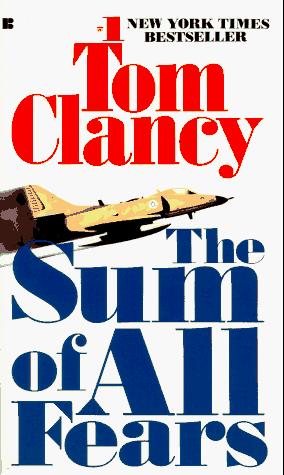
The Sum of All Fears
by Tom Clancy
★ Top 25 book of 1991 · #11 on Best Books of 1991
As Jack Ryan works toward a plan that might end long-running Middle East conflict, terrorists stage one final act that pushes the world toward nuclear catastrophe. With the American president struggling, Ryan races to find a way out.
Best for: Fans of tense political thrillers with global stakes and nuclear danger
The Sum of All Fears is #11 on BookWard's Best Books of 1991, out of 23 1991 books that cleared our data bar.
What The Sum of All Fears is about
Jack Ryan has risen to Deputy Director of Central Intelligence, and the world he works in is full of old secrets that refuse to stay buried. Years earlier, during the 1973 Yom Kippur War, an Israeli nuclear bomb was lost when the plane carrying it went down over Syria. Now a Middle East peace effort is gathering pace, helped along by Ryan's idea of turning Jerusalem into an independent city-state, much like the Vatican.
Not everyone in Washington is on his side. National Security Advisor Elizabeth Elliot holds a grudge against him and manipulates the president, while Ryan relies on trusted operatives John Clark and Domingo Chavez. Meanwhile, Palestinian militants led by Ismael Qati discover the lost weapon and, with help from a German physicist, plan to put it to use at the Super Bowl in Denver. This sequel to Clear and Present Danger weighs political infighting and weak leadership against a very real threat.
The Sum of All Fears on the Best Books of 1991
The Sum of All Fears came out in 1991. Of the 23 books first published in 1991 that met BookWard's data bar, it ranks #11 on our Best Books of 1991 list.
Why it made the list: 213 readers have shelved it on Open Library; readers rate it 3.5 out of 5 (23 ratings). The list ranks each year’s books on how many readers have picked them up, how highly readers rate them, and how many are reading them right now.
Nearby on the 1991 list
- Xenocide Orson Scott Card, #9
- On Directing Film David Mamet, #10
- Scarlett Alexandra Ripley, #12
- Muhammad Karen Armstrong, #13
See all Best Books of 1991 Best books by year
More years: Best Books of 1990 Best Books of 1992.
The numbers behind it
- Readers: 158 want to read it, 14 are reading it now and 41 have read it, according to Open Library.
- Ratings: 3.5 out of 5 from 23 Open Library ratings.
| Signal | This book (0 to 100) | Weight |
|---|---|---|
| Reach | 57 | 55% |
| Reader love | 9 | 25% |
| Being read right now | 70 | 20% |
Questions about The Sum of All Fears
When was The Sum of All Fears published?
The Sum of All Fears by Tom Clancy was first published in 1991.
Was The Sum of All Fears one of the best books of 1991?
The Sum of All Fears is #11 on BookWard's Best Books of 1991, out of 23 1991 books that cleared our data bar. 213 readers have shelved it on Open Library; readers rate it 3.5 out of 5 (23 ratings).
Why is The Sum of All Fears on the Best Books of 1991 list?
213 readers have shelved it on Open Library; readers rate it 3.5 out of 5 (23 ratings).
More of the best books of 1991
- Outlander Diana Gabaldon, #1
- Needful Things Stephen King, #2
- American Psycho Bret Easton Ellis, #3
- Shiloh Phyllis Reynolds Naylor, #4
- The Firm John Grisham, #5
- Reaper Man Terry Pratchett, #6
See the full Best Books of 1991, the Top 100, or new books on Rising.
How we know
This page uses public data: Open Library reader counts and ratings, and Wikipedia page views for recent years. The description is paraphrased from real source text. Rankings reflect reading interest, not quality or sales, and can be affected by data gaps. Lists update monthly.
Best suited to adult and mature teen readers who enjoy political thrillers.
Depends on the edition you pick.
A vast Cold War thriller that earns its nuclear dread. 43% taste match
 BookWard’s take
A vast Cold War thriller that earns its nuclear dread
The Sum of All Fears is Tom Clancy at full stretch: a Jack Ryan novel about how a lost bomb and a fragile Middle East peace could drag two superpowers toward war. It is long and sprawling, and it is the kind of book where logic is the main pleasure. Every decision in the chain follows from the last, so the airtight internal logic is what BookWard would single out. The cast is large and the viewpoints many, and the exposition leans heavily toward explaining outright, which cuts against BookWard's preference for scenes that show. It is idea-led and procedural more than character-driven. Come for the pressure, the plausibility and the sense of a world one mistake from disaster, and accept that the prose is plain and the pace uneven in the early stretches.
A huge, sprawling thriller that runs far longer than BookWard's taste for tight books.
It moves briskly once the crisis starts, but the long setup and detail slow it down.
The central idea is inventive, but it is built from familiar thriller parts.
The prose is plain, functional and built for clarity rather than beauty.
Events and geopolitics drive everything, with characters mainly reacting to the crisis.
Peace efforts offer hope, but the book spends most of its time in dread.
It is a conventional multi-thread thriller with little formal experiment.
The tone is serious throughout, with only the occasional dry moment.
Terrorism and the threat of nuclear war make it a dark book overall.
Tension is high, but feeling is kept at the level of professionals under pressure.
See all 50 dialsEvery position, side by side with this book
Where it lines up
- EndingBookWard 8 · book 8
- Internal logicBookWard 10 · book 9
- Rigor (nonfiction)BookWard 9 · book 8
Where it pulls apart
- LengthBookWard 1 · book 10
- OpeningBookWard 10 · book 4
- Familiar tropesBookWard 10 · book 4
A huge, sprawling thriller that runs far longer than BookWard's taste for tight books.
It opens in 1973 with a lost nuclear bomb, then builds slowly toward the main story, so the hook is not immediate.
Spies, terrorists and a heroic analyst are genre staples, though the nuclear-accident premise gives it some freshness.
Cause and effect are tracked closely from lost bomb to crisis, which is exactly the airtight plotting BookWard rewards.
It moves briskly once the crisis starts, but the long setup and detail slow it down.
The central idea is inventive, but it is built from familiar thriller parts.
Characters serve the plot and the machinery of statecraft more than they are drawn in depth.
The crisis is fully played out and resolved, which suits BookWard's liking for closure.
It is mostly unsentimental, though it leans on heroic patriotism and family loyalty.
The darkness comes from the stakes of nuclear catastrophe, which feels earned rather than gratuitous.
Technical and political detail is heavily researched and forms the backbone of the book, though this is fiction.
Clancy's procedural, technical style is recognizable, though not especially personal.
It is driven by the plot and the what-if, but the technical and political ideas are central too.
Background, technology and politics are often explained outright, which is far from BookWard's love of showing in scene.
The intricate setup and sheer length drag in places before the tension tightens.
The prose is plain, functional and built for clarity rather than beauty.
Events and geopolitics drive everything, with characters mainly reacting to the crisis.
Peace efforts offer hope, but the book spends most of its time in dread.
It is a conventional multi-thread thriller with little formal experiment.
The tone is serious throughout, with only the occasional dry moment.
The technical and political detail asks for patience, though the story itself is easy to follow.
It cuts among Washington, the Middle East and terrorist cells, which gives many perspectives.
After a 1973 prologue it runs forward in a straight line.
Everything is grounded in real-world politics and technology.
A very large cast spans governments, agencies and terrorist groups.
The stakes are global and nuclear, which is as epic as a thriller gets.
The focus is on action, decisions and events rather than inner thoughts.
Briefings and arguments between officials carry much of the story, so talk is heavy.
Relationships appear mainly as personal subplots and political scandal rather than the center.
The corridors of intelligence, the White House and Middle East politics are an unfamiliar world to most readers.
It is set in the early 1990s, firmly a Cold War period piece.
The tension holds up, but the Cold War setting and politics feel dated.
A plain third-person narrator tells it straight with no sign of unreliability.
Heroes and villains are fairly clearly drawn, though the politics add some gray.
Technical and procedural detail is rich, with plenty of precise physical description.
It is fiction, but the technical exposition gives it a documentary feel.
The narration stays at a professional distance rather than getting personal.
It is a Jack Ryan novel, and the sequel to Clear and Present Danger.
The plot turns on conspiracies and crises, but much is foreshadowed.
It is gripping but not comforting, built around fears of nuclear war.
Terrorism and the threat of nuclear war make it a dark book overall.
Tension is high, but feeling is kept at the level of professionals under pressure.
Humor is rare and mostly dry when it appears.
Terrorism and nuclear stakes bring real violence, though the focus stays on plot rather than gore.
There are a few scandal subplots and relationships, but sex is not a focus.
Geopolitics, diplomacy and the Middle East peace process drive the whole plot.
Jargon and acronyms add density, though the language is otherwise plain.
The narration stays mostly neutral, though Clancy's politics are visible.
It is rooted in the Cold War, with a nervous eye on what could come next.
It admires competent, honest public servants while showing politics at its worst.
Review written by BookWard, dial version 1, November 2026.
Who is The Sum of All Fears right for?
Best suited to adult and mature teen readers who enjoy political thrillers. It contains terrorism, the threat of mass death, political scandal and some sexual situations.
The technical and political detail asks for patience, though the story itself is easy to follow.
Terrorism and the threat of nuclear war make it a dark book overall.
Tension is high, but feeling is kept at the level of professionals under pressure.
Terrorism and nuclear stakes bring real violence, though the focus stays on plot rather than gore.
Book CompanionThe Sum of All Fears: ideas, characters, themes
A forgotten nuclear bomb and a delicate Middle East peace process combine into a crisis that could push the United States and the Soviet Union toward war.
- A lost bomb. In 1973 during the Yom Kippur War an Israeli nuclear bomb is accidentally left on a plane that is shot down over Syria, and the weapon is buried in a Druze farmer's field.
- A peace plan. Years later Jack Ryan's plan would make Jerusalem an independent city-state run by religious leaders and guarded by Swiss Guards, easing Middle East negotiations.
- Washington infighting. After the National Security Advisor's death, his successor Elizabeth Elliot holds a grudge against Ryan and works to sideline him.
- Terrorist conspiracy. Palestinian and former East German terrorists plot to bring the superpowers into nuclear war.
- Ryan under pressure. As Deputy Director of Central Intelligence, Ryan must try to stop the crisis while his own role is being undermined.
Characters
Jack Ryan
Deputy Director of Central Intelligence
The analyst whose plan drives the peace process and who tries to stop the nuclear crisis.
Elizabeth Elliot
National Security Advisor
Succeeds Alden, holds a grudge against Ryan and works against him.
J. Robert Fowler
U.S. President
The president whose judgment is tested as the crisis builds.
Charles Alden
National Security Advisor
Helps enact Ryan's plan before his death in a scandal.
Themes
How close ordinary mistakes can bring the world to catastrophe.
Whether sharing sacred places can calm old conflicts.
How personal grudges and ambition get in the way of sound judgment.
How small groups try to trigger larger wars.
What public servants owe the truth when credit and blame are on the line.
Discussion questions
- Is the plan for Jerusalem plausible as a model for peace, or does the book make it look easier than it would be?
- How does the opening in 1973 shape your sense of the stakes later?
- Which is more dangerous here, the terrorists or the people in Washington?
- Does the heavy technical detail add tension or slow the story for you?
- How well does a Cold War thriller hold up when read today?
Personalize your Book Companion
This is the general edition. In BookWard, the Companion is written for you: your reading profile, your notes, and spoiler-safe to the page you are on.
Buy, listen or borrow The Sum of All Fears
Each link opens a search for this book on that store, in a new tab.
Read on a device
Borrow
Reviews and community
If you liked The Sum of All Fears
Clancy's doorstop thriller: elite counterterrorism, and a plot that overreaches
The Hunt for Red OctoberTom ClancyA Cold War chase beneath the sea, packed with technical detail
Without RemorseTom ClancyA grief-fueled revenge thriller that doubles as Clancy's Mr. Clark origin
Babylon’s ashesJames S. A. CoreySpace war on a grand scale, with Holden at the center
Find your own best books
Add what you have read, rate it, and BookWard will recommend what to read next.
Free to start. No credit card needed.