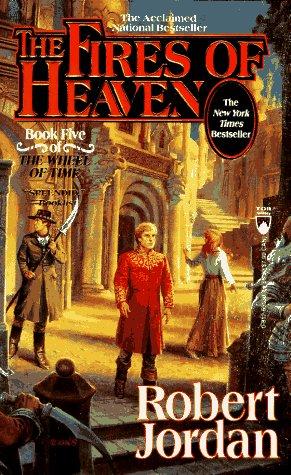
The Fires of Heaven
by Robert Jordan
★ Top 25 book of 1993 · #12 on Best Books of 1993
The prison holding the Dark One is weakening, and his immortal servants tighten their hold on the world. Rand al'Thor, the Dragon Reborn, must strike back while betrayal, division and madness threaten his side.
Best for: Epic fantasy fans following the Dragon Reborn and the war against the Dark One
The Fires of Heaven is #12 on BookWard's Best Books of 1993, out of 36 1993 books that cleared our data bar.
What The Fires of Heaven is about
The prison that holds the Great Lord of the Dark is weakening. His immortal servants, the Forsaken, are tightening their hold on the realms of men and feel certain their master will soon walk free. Rand al'Thor, the Dragon Reborn, knows that he must strike the Enemy before that happens.
But Rand's own side is far from united. His forces are split by treachery and ambition, the Aes Sedai who guard the Light are fighting a civil war among themselves, and allies turn against him while enemies close in. All the while he fights the madness that haunts men who wield the One Power. This is a large-scale fantasy about the cost of power and the danger of division, best suited to readers already following the long Wheel of Time series.
The Fires of Heaven on the Best Books of 1993
The Fires of Heaven came out in 1993. Of the 36 books first published in 1993 that met BookWard's data bar, it ranks #12 on our Best Books of 1993 list.
Why it made the list: 247 readers have shelved it on Open Library; readers rate it 4 out of 5 (41 ratings). The list ranks each year’s books on how many readers have picked them up, how highly readers rate them, and how many are reading them right now.
Nearby on the 1993 list
- The Client John Grisham, #10
- Voice in the Wind Francine Rivers, #11
- Nightmares & Dreamscapes Stephen King, #13
- Let Me Hear Your Voice Catherine Maurice, #14
See all Best Books of 1993 Best books by year
More years: Best Books of 1992 Best Books of 1994.
The numbers behind it
- Readers: 157 want to read it, 11 are reading it now and 79 have read it, according to Open Library.
- Ratings: 4 out of 5 from 41 Open Library ratings.
| Signal | This book (0 to 100) | Weight |
|---|---|---|
| Reach | 64 | 55% |
| Reader love | 53 | 25% |
| Being read right now | 47 | 20% |
Questions about The Fires of Heaven
When was The Fires of Heaven published?
The Fires of Heaven by Robert Jordan was first published in 1993.
Was The Fires of Heaven one of the best books of 1993?
The Fires of Heaven is #12 on BookWard's Best Books of 1993, out of 36 1993 books that cleared our data bar. 247 readers have shelved it on Open Library; readers rate it 4 out of 5 (41 ratings).
Why is The Fires of Heaven on the Best Books of 1993 list?
247 readers have shelved it on Open Library; readers rate it 4 out of 5 (41 ratings).
More of the best books of 1993
- The Giver Lois Lowry, #1
- The Scam Debashis Basu, #2
- Along Came a Spider James Patterson, #3
- A Suitable Boy Vikram Seth, #4
- Girl, Interrupted Susanna Kaysen, #5
- Understanding Comics Scott McCloud, #6
See the full Best Books of 1993, the Top 100, or new books on Rising.
How we know
This page uses public data: Open Library reader counts and ratings, and Wikipedia page views for recent years. The description is paraphrased from real source text. Rankings reflect reading interest, not quality or sales, and can be affected by data gaps. Lists update monthly.
Best for older teens and adults comfortable with long, dense fantasy.
Depends on the edition you pick.
Book five of the Wheel of Time: vast, uneven, undeniably ambitious. 43% taste match
 BookWard’s take
Book five of the Wheel of Time: vast, uneven, undeniably ambitious
The Fires of Heaven is the fifth volume of The Wheel of Time, and it asks for a serious commitment before you open it. It is long and sprawling, with many viewpoints and a large cast spread across rival camps, and it makes no effort to catch newcomers up. The pace is steadier than it is fast, and the middle stretches test patience, which will frustrate anyone who wants sustained momentum. Familiar fantasy machinery is all over it: a prophesied hero, ancient evil, immortal servants of the dark. Where it earns respect is its internal logic and the sheer depth of its built world, where rules and politics stay consistent across a huge canvas. Do not start here. It only pays off for people already deep in the series.
It is a very long, sprawling fantasy volume, far from BookWard's preference for tight, short books.
The story moves at a measured, accumulating pace with lots of positioning, slower than BookWard likes.
The world-building is distinctive in detail, though the core premise is classic epic fantasy, so originality is middling.
The prose is richly descriptive and sometimes elaborate, more ornate than BookWard typically favors.
Plot and character share the load, with large events and personal arcs pulling in roughly equal measure.
The overall mood is hopeful in its fight against the dark, though losses and betrayals weigh on it.
It follows a conventional multi-thread epic structure, with no formal experimentation.
It is mostly serious in tone, with only occasional flashes of humor among the characters.
War, betrayal and the threat of a dark lord give it real darkness without being relentless.
Loyalty, betrayal and burden run strongly through the characters without tipping into melodrama.
See all 50 dialsEvery position, side by side with this book
Where it lines up
- Story or ideasBookWard 3 · book 3
- Character depthBookWard 8 · book 7
- Internal logicBookWard 10 · book 8
Where it pulls apart
- LengthBookWard 1 · book 10
- Familiar tropesBookWard 10 · book 3
- OpeningBookWard 10 · book 5
It is a very long, sprawling fantasy volume, far from BookWard's preference for tight, short books.
It joins an established story already in motion, so the opening rewards series readers rather than grabbing newcomers instantly.
A prophesied hero, ancient dark lord and immortal servants are well-worn fantasy materials, which sits against BookWard's wish to avoid tropes.
Its magic system and political machinery follow consistent rules across a huge canvas, which BookWard values highly.
The story moves at a measured, accumulating pace with lots of positioning, slower than BookWard likes.
The world-building is distinctive in detail, though the core premise is classic epic fantasy, so originality is middling.
Rand, the Aes Sedai and the other principals are developed over many volumes, giving real depth, though some drift toward archetype.
As the fifth book in a long series, it resolves its own arc while leaving the larger conflict open.
It leans toward heroic, earnest emotion without being syrupy, a middling fit for BookWard's restraint.
Dark events arise from the stakes of a war against evil rather than shock for its own sake.
Jordan's long, descriptive, procedural style is recognizable, though not unusually singular.
This is firmly story-led, driven by quests, battles and rivalries rather than abstract ideas.
Backstory and politics are woven in but frequently explained at length, which BookWard likes less.
Across such length, the middle stretches slow down with travel and positioning, short of BookWard's sustained-momentum ideal.
The prose is richly descriptive and sometimes elaborate, more ornate than BookWard typically favors.
Plot and character share the load, with large events and personal arcs pulling in roughly equal measure.
The overall mood is hopeful in its fight against the dark, though losses and betrayals weigh on it.
It follows a conventional multi-thread epic structure, with no formal experimentation.
It is mostly serious in tone, with only occasional flashes of humor among the characters.
The size, cast and demand to remember earlier books make it noticeably work to read.
Many characters in separate places carry their own storylines, making the viewpoints very numerous.
Events unfold in a mostly linear sequence, with threads running in parallel rather than jumping in time.
Magic, prophecy and immortal servants of evil make this fully fantastical.
The cast is enormous, spanning nations, factions and rival power structures.
The stakes cover continents and the fate of the world itself, an epic canvas.
Action, travel and conflict take priority, though characters' internal struggles still matter.
Conversation, negotiation and argument carry a large share of the page.
Romantic threads exist and matter to some characters but are not the central driver.
A richly built invented world with its own history, cultures and magic is far from everyday familiarity.
It is set in an invented secondary world, so present-day framing does not apply.
As a durable chapter in a famous epic, its appeal depends on the series rather than a particular moment.
The third-person narration is straightforward and reliable, with no tricks played on the reader.
The fight between Light and Shadow is fairly clear, though some characters and factions complicate it.
Settings, clothing, customs and landscapes receive generous, detailed description.
It is the fifth volume of a long series and depends on the earlier books.
Betrayals, shifting alliances and revelations arrive regularly across the plot lines.
It is gripping and heroic but demanding, giving more challenge than comfort.
War, betrayal and the threat of a dark lord give it real darkness without being relentless.
Loyalty, betrayal and burden run strongly through the characters without tipping into melodrama.
Humor is wry and character-based rather than broad or farcical.
Battles and conflict feature prominently, with violence a regular part of the story.
Sexual content is limited, with romance played mostly as tension and implication.
Rival rulers, factions and power struggles drive much of the plot, putting politics near the center.
The invented names, terms and customs add density, though the sentences themselves are not hard.
The narration stays largely neutral, letting characters and events carry the story.
It looks forward to a final confrontation while resting on a deep legendary past.
Duty, sacrifice and the hope that the Light can prevail give it an idealistic bent.
Review written by BookWard, dial version 1, November 2026.
Who is The Fires of Heaven right for?
Best for older teens and adults comfortable with long, dense fantasy. It contains war, betrayal and fantasy violence, but little explicit content.
The size, cast and demand to remember earlier books make it noticeably work to read.
War, betrayal and the threat of a dark lord give it real darkness without being relentless.
Loyalty, betrayal and burden run strongly through the characters without tipping into melodrama.
Battles and conflict feature prominently, with violence a regular part of the story.
Book CompanionThe Fires of Heaven: ideas, characters, themes
As the Dragon Reborn confronts the Shadow, the forces opposing it are divided by treachery, ambition and civil war.
- A world on the brink. The bonds holding the Great Lord of the Dark are failing, raising the stakes for everyone.
- Rand's burden. Rand al'Thor must strike at the Enemy while contending with the madness that afflicts male wielders of the One Power.
- Servants of the Shadow. The Forsaken, immortal servants of the dark, tighten their grip on the realms of men.
- Light divided. Even the Aes Sedai, guardians of the Light, are split by civil war.
- Betrayal and pursuit. Rand is betrayed by allies and pursued by enemies as he rides out to face the foe.
Characters
Rand al'Thor
The Dragon Reborn
He knows he must strike at the Enemy while betrayed by allies and threatened by the madness that comes to male wielders of the One Power.
The Forsaken
Immortal servants of the Shadow
They weave snares and tighten their grip on the realms of men, certain their master will break free.
The Aes Sedai
Ancient guardians of the Light
Their ranks are riven by civil war even as the threat grows.
Themes
What a chosen figure owes the world, and what it costs him.
How broken trust among allies weakens the fight against a common enemy.
How ambition and infighting undermine those meant to protect the world.
How the One Power brings both strength and the danger of madness.
Discussion questions
- Why do divisions among Rand's allies feel more dangerous than the enemy?
- How does the threat of madness change how Rand makes decisions?
- Does the Light's civil war make the Shadow's victory more likely?
- What does the book suggest about the burden of being a chosen figure?
- How well does a long series sustain tension when the central conflict stays unresolved?
Personalize your Book Companion
This is the general edition. In BookWard, the Companion is written for you: your reading profile, your notes, and spoiler-safe to the page you are on.
Buy, listen or borrow The Fires of Heaven
Each link opens a search for this book on that store, in a new tab.
Read on a device
Borrow
Reviews and community
If you liked The Fires of Heaven
The sixth Wheel of Time book: vast, political, and deep in the series
The Shadow RisingRobert JordanThe Wheel of Time's biggest installment, scattering its heroes in four directions
The Gathering StormRobert JordanRand unravels and Egwene holds the Tower in book twelve
The Great Hunt (the Wheel of Time Book 2)Robert JordanJordan's second Wheel of Time book widens the world and the stakes
Find your own best books
Add what you have read, rate it, and BookWard will recommend what to read next.
Free to start. No credit card needed.