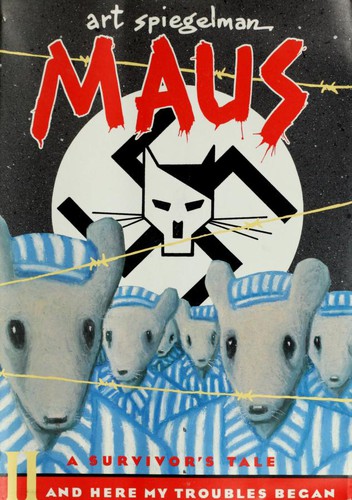
Maus II
by Art Spiegelman
★ Top 25 book of 1991 · #19 on Best Books of 1991
This second volume follows a Holocaust survivor from Auschwitz to the Catskills, while his cartoonist son wrestles with their strained bond. Told with Jews as mice and Nazis as cats, it shifts between tragedy and comedy.
Best for: Readers drawn to survivor stories told through graphic, inventive storytelling
Maus II is #19 on BookWard's Best Books of 1991, out of 23 1991 books that cleared our data bar.
What Maus II is about
Art Spiegelman continues his account of his father Vladek, a Jewish survivor of Hitler's Europe, drawing the Nazis as cats and the Jews as mice. The story moves from the barracks of Auschwitz to a quiet Catskills holiday colony, setting Vladek's improbable survival beside the cartoonist's difficult, often painful relationship with his aging father. It shows the strange contradictions of family life inside the camps, and it asks what is passed on to the children of survivors. The tone swings between tragedy and dark comedy, never looking away. This is the second volume, so those new to the story should start with the first.
Maus II on the Best Books of 1991
Maus II came out in 1991. Of the 23 books first published in 1991 that met BookWard's data bar, it ranks #19 on our Best Books of 1991 list.
Why it made the list: 151 readers have shelved it on Open Library; readers rate it 4.5 out of 5 (40 ratings). The list ranks each year’s books on how many readers have picked them up, how highly readers rate them, and how many are reading them right now.
It earns Reader favorite.
Nearby on the 1991 list
- The River Gary Paulsen, #17
- Sojourn R. A. Salvatore, #18
- Perilous Refuge Patricia Wilson, #20
- Party Summer Robert Lawrence Stine, #21
See all Best Books of 1991 Best books by year
More years: Best Books of 1990 Best Books of 1992.
The numbers behind it
- Readers: 91 want to read it, 4 are reading it now and 56 have read it, according to Open Library.
- Ratings: 4.5 out of 5 from 40 Open Library ratings.
| Signal | This book (0 to 100) | Weight |
|---|---|---|
| Reach | 9 | 55% |
| Reader love | 100 | 25% |
| Being read right now | 26 | 20% |
Questions about Maus II
When was Maus II published?
Maus II by Art Spiegelman was first published in 1991.
Was Maus II one of the best books of 1991?
Maus II is #19 on BookWard's Best Books of 1991, out of 23 1991 books that cleared our data bar. 151 readers have shelved it on Open Library; readers rate it 4.5 out of 5 (40 ratings).
Why is Maus II on the Best Books of 1991 list?
151 readers have shelved it on Open Library; readers rate it 4.5 out of 5 (40 ratings).
More of the best books of 1991
- Outlander Diana Gabaldon, #1
- Needful Things Stephen King, #2
- American Psycho Bret Easton Ellis, #3
- Shiloh Phyllis Reynolds Naylor, #4
- The Firm John Grisham, #5
- Reaper Man Terry Pratchett, #6
See the full Best Books of 1991, the Top 100, or new books on Rising.
How we know
This page uses public data: Open Library reader counts and ratings, and Wikipedia page views for recent years. The description is paraphrased from real source text. Rankings reflect reading interest, not quality or sales, and can be affected by data gaps. Lists update monthly.
Best suited to mature teens and adults ready for the subject.
Depends on the edition you pick.
The survivor's tale, and the cost of being his son. 67% taste match
 BookWard’s take
The survivor's tale, and the cost of being his son
Maus II, subtitled And Here My Troubles Began, carries Vladek Spiegelman's account from the barracks of Auschwitz to the bungalows of the Catskills, set beside Art's strained relationship with his aging father. It is a comic that earns its darkness: the cats-and-mice conceit is a deliberate jolt, not a gimmick. The voice is unmistakable, and few books can match its originality. It also refuses sentiment, withholding easy comfort even in its family scenes. The dialogue is heavy, the viewpoint and timeline shift between past and present, and the ending resolves in a way that stays quiet and exact. Read the first volume first.
Scenes move briskly through panels, though the weight of events slows the emotional going, a little under BookWard's fast preference.
Few books in any medium approach this subject through cartoon animals and a nested family story, squarely where BookWard wants to be.
The words are plain and spoken, with the art doing the ornate work, so the prose sits well below BookWard's middle.
Events matter, but the weight lies in how Vladek and Art relate and change, which BookWard also favors.
Survival is the thread, yet loss and unresolved guilt dominate, leaving the book largely bleak, a little darker than BookWard's outlook.
Interleaving the Catskills present with the wartime past, and the cartoonist's self-portrait, is a clear departure from straight narrative.
Dark comedy flickers in the father-son scenes, but the book stays overwhelmingly serious, well under BookWard's lighter tilt.
The subject is genocide and its aftermath, so the content sits at the very dark end.
It builds an intense emotional pull through what is shown and what is left unsaid.
See all 50 dialsEvery position, side by side with this book
Where it lines up
- Familiar tropesBookWard 10 · book 10
- Shock for effectBookWard 9 · book 9
- Story or ideasBookWard 3 · book 3
Where it pulls apart
- LengthBookWard 1 · book 4
- OpeningBookWard 10 · book 8
- TimelineBookWard 4 · book 9
It opens inside the father-son tension and the survivor's story almost at once, which matches BookWard's love of an immediate pull.
Animal allegory applied to the Holocaust, framed by a cartoonist arguing with himself, avoids familiar tropes entirely, a big win here.
Its memory-driven structure holds together tightly, with each strand of the survival story and the frame story reinforcing the other.
Scenes move briskly through panels, though the weight of events slows the emotional going, a little under BookWard's fast preference.
Few books in any medium approach this subject through cartoon animals and a nested family story, squarely where BookWard wants to be.
Vladek and Art are drawn with flaws, contradictions and small cruelties, giving the book the depth BookWard prizes.
The central story closes with weight and clarity, resolving what it set out to tell, close to BookWard's taste for resolution.
It declines to soften its subject or its people, which fits BookWard's preference for restraint over tears on cue.
The darkness is the subject itself, handled with care and purpose rather than for effect, which is what BookWard wants.
It is grounded in a real survivor's testimony and a son's careful reconstruction, giving it documentary seriousness.
The drawing style, the framing and the self-questioning narration could only belong to Spiegelman, a plus for BookWard.
Story-led, built on one man's account and one family's story rather than argument, which is nearer BookWard's own pull.
Most of what matters is dramatized in scene and image, in line with BookWard's preference for showing over explaining.
Both the survival narrative and the modern-day frame stay tense, so the middle holds without drifting.
The words are plain and spoken, with the art doing the ornate work, so the prose sits well below BookWard's middle.
Events matter, but the weight lies in how Vladek and Art relate and change, which BookWard also favors.
Survival is the thread, yet loss and unresolved guilt dominate, leaving the book largely bleak, a little darker than BookWard's outlook.
Interleaving the Catskills present with the wartime past, and the cartoonist's self-portrait, is a clear departure from straight narrative.
Dark comedy flickers in the father-son scenes, but the book stays overwhelmingly serious, well under BookWard's lighter tilt.
The comic form eases entry, but the subject and layered structure ask a lot of the reader emotionally.
Mostly Vladek's story told to Art, with Art's own frame, so a couple of strong voices rather than many.
It moves between the camp years and the later conversations, making the timeline shift in a way BookWard likes.
The animal figures are symbolic, but the world and events are historically real, so the book is firmly grounded.
A modest circle of family and fellow prisoners, with a larger background of figures kept deliberately subordinate.
It touches a vast historical catastrophe yet stays rooted in one family, tilting more intimate than epic.
External events drive the survival story, but Art's guilt and difficult relationship supply a strong inner pull.
Conversation between father and son carries much of the book, with speech balloons doing steady work.
Vladek and his wife matter to the story, but romance is not the engine, so it stays minor.
Auschwitz and its aftermath are an unfamiliar place for most readers, and the book brings them in with unusual intimacy.
The core events are from the 1940s, with the telling set decades later, so it leans clearly toward the past.
It has already outlasted its moment and still reads as essential, which BookWard prizes.
Art is open about his own doubts, and Vladek tells his story as he remembers it, so reliability is mostly sound.
The book refuses easy judgments about survival, guilt and family, leaving a good deal ambiguous, well matched to BookWard's lean.
Images carry the descriptive load, with captions and text kept sparing, so word description stays light.
It is a narrative memoir at heart, not an analytical study, so it sits at the narrative end.
A son telling his father's story while admitting his own role in it is as personal as it gets.
A second volume that picks up where the first leaves off, so reading Maus I first matters.
The power is in testimony and detail, not surprise, so there are few twists.
It asks you to sit with atrocity and unresolved family pain, which BookWard counts a strength.
The subject is genocide and its aftermath, so the content sits at the very dark end.
It builds an intense emotional pull through what is shown and what is left unsaid.
Where humor appears it is dry and bitter, not broad.
Violence is present and unflinching but drawn in stylized animal form, which tempers it without softening it.
Sexual content is minimal and incidental to the story.
History and persecution shape everything, but the book is testimony, not a political argument.
Vladek's broken English is rendered directly, a mild hurdle that adds texture rather than blocking the read.
Art frames the telling with his own doubts and judgments, so the narration is somewhat opinionated.
The book is about looking back, at memory and the debt it creates, so it faces the past.
It looks unflinchingly at human cruelty and failure, leaving it nearer the cynical end.
Review written by BookWard, dial version 1, November 2026.
Who is Maus II right for?
Best suited to mature teens and adults ready for the subject. It contains depictions of genocide, violence, death and suicide, drawn in stylized form.
The comic form eases entry, but the subject and layered structure ask a lot of the reader emotionally.
The subject is genocide and its aftermath, so the content sits at the very dark end.
It builds an intense emotional pull through what is shown and what is left unsaid.
Violence is present and unflinching but drawn in stylized animal form, which tempers it without softening it.
Book CompanionMaus II: ideas, characters, themes
A son confronts his father's survival of the Holocaust and the toll it took on both of them.
- The cats and mice. The animal conceit shocks readers out of any lingering familiarity with the events described.
- Two stories at once. Vladek's wartime survival is paired with Art's difficult relationship with his aging father.
- From Auschwitz to the Catskills. The book moves from the camp barracks to the bungalows of the Catskills, linking past and present.
- Tragic and comic by turns. The mix of tragedy and comedy gives the book a complexity rare in comics.
- Children of survivors. It also tells the story of the children who survive even the survivors.
Characters
Vladek Spiegelman
Survivor and father
A Jewish survivor of Hitler's Europe whose story of survival drives the book.
Art Spiegelman
Cartoonist and son
The cartoonist trying to come to terms with his father, his father's story and History itself.
Themes
What it takes to live through catastrophe and what living costs.
How a story is told, retold and shaped across generations.
The paradox of love and friction between parent and child.
What survivors and their children carry.
Whether and how the unspeakable can be shown.
Discussion questions
- How does turning people into animals change how you read the events?
- What does the father-son tension add that the survival story alone could not?
- Why move between the camps and the Catskills?
- Where does the book find humor, and what does it do there?
- What does the book suggest the children of survivors inherit?
Personalize your Book Companion
This is the general edition. In BookWard, the Companion is written for you: your reading profile, your notes, and spoiler-safe to the page you are on.
Buy, listen or borrow Maus II
Each link opens a search for this book on that store, in a new tab.
Read on a device
Borrow
Reviews and community
If you liked Maus II
Two centuries of one family, from Sand Creek to Oakland
JazzToni MorrisonA murder told in the improvised rhythm of Harlem jazz
Persepolis 1 & 2Marjane SatrapiA child's-eye memoir of revolution, drawn in stark black and white
No Longer at EaseChinua AchebeA short, exact novel of a young man caught between worlds
Find your own best books
Add what you have read, rate it, and BookWard will recommend what to read next.
Free to start. No credit card needed.