Suits mature teens and adults; it is short and readable, with themes of corruption and moral failure that reward discussion.
169 pages, about 2.5 to 4 hours.
A short, exact novel of a young man caught between worlds. 72% taste match
The story
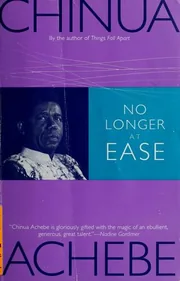
No Longer at Ease is a novel by Chinua Achebe, first published in 1960. It is part of his African Trilogy, following Things Fall Apart and coming before Arrow of God, and it centres on Obi Okonkwo, the grandson of Okonkwo from Things Fall Apart. The story is set in Nigeria in the 1950s, with much of its city life taking place in Lagos, in the years when independence from colonial rule was drawing near.
Obi is an Igbo man who leaves his village to study in Britain and then returns to take a post in the colonial civil service. Back home, he finds himself pulled between the expectations of his family and village, which belong to the traditional world of his ancestors, and the Western lifestyle and colonial institutions he has come to know. He is surrounded by a Nigerian elite whose corruption he dislikes, yet he ends up accepting a bribe. The book follows a young man caught between two cultures while a society changes around him. It is categorised as African fiction in English and sits within urban fiction about Nigeria.
For three or four weeks Obi Okonkwo had been steeling himself against this moment.
Setting
NigeriaLagosLagos (Nigeria)
Period
1950's
Themes
Igbo (African Tribe)City and town lifeRomanceRomanLiteratura africanaIgbo (African people)
- Want to read 149
- Reading now 9
- Read 5
Most people shelving it are saving it for later.
Of 163 readers who put it on a shelf, 91% want to read it, 6% are reading it now, 3% have finished it and 0% stopped before the end.
By the numbers
- The median edition runs 169 pages. Counting about 275 words a page and an adult reading pace of 250 words a minute, that is about 3.1 hours of reading.
- Open Library tracks 41 editions from 21 publishers, the earliest dated 1960 and the latest 2019, across 2 languages.
- On reader demand it ranks in the top 14% of the classic books in our catalog (8,749 of them).
- Libraries shelve it under Dewey 823.914 and Library of Congress class PR-9387.90000000.A3 N6 1994.
 BookWard’s take
A short, exact novel of a young man caught between worlds
At 169 pages, this is Achebe at his most compressed. It follows Obi Okonkwo, the grandson of Okonkwo from Things Fall Apart, home from Britain and into the colonial civil service in 1950s Lagos. On length, it is tight, which BookWard likes. Its internal logic is close to airtight: every pressure on Obi, from family, village and office, feels earned, and the corruption he despises is drawn without melodrama. The characters are deeply drawn rather than types, and the voice is distinctive, dry and unsentimental. It reads as story-led more than idea-led, even though the ideas are plain. The book is restrained where lesser novels would plead for your tears. It is the second of the African Trilogy, but it stands alone.
At 169 pages it says what it needs and stops, which suits BookWard's love of tight books.
It moves steadily and economically without rushing, a little more measured than BookWard's fast taste.
A grandson of a famous literary figure facing a new Nigeria gives a fresh angle on a familiar clash.
The prose is plain, clear and spare, a shade plainer than BookWard's middling taste.
The drama comes from who Obi is and what he cannot reconcile, more than from plot machinery.
The outlook is sober and tends toward disillusionment, darker than BookWard's mild optimism.
The telling is fairly conventional, a straight narrative that sits near BookWard's own middle.
Irony and dry observation give it a light edge without making it a comedy.
The theme is moral failure, treated seriously without gratuitous bleakness.
Feeling runs beneath a controlled surface, strong but never overstated.
See all 50 dialsEvery position, side by side with this book
Where it lines up
- LengthBookWard 1 · book 1
- Character depthBookWard 8 · book 8
- Shock for effectBookWard 9 · book 9
Where it pulls apart
- OpeningBookWard 10 · book 6
- Familiar tropesBookWard 10 · book 8
- EraBookWard 7 · book 2
At 169 pages it says what it needs and stops, which suits BookWard's love of tight books.
It builds through situation and consequence more than a grabbing first page, a little slower out of the gate than BookWard prefers.
The clash of cultures could be a stock theme, but Achebe's handling avoids easy villains and easy lessons.
Obi's choices follow from the pressures on him, so the fall feels earned and consistent, as BookWard likes.
It moves steadily and economically without rushing, a little more measured than BookWard's fast taste.
A grandson of a famous literary figure facing a new Nigeria gives a fresh angle on a familiar clash.
Obi is drawn with real contradiction, torn between ideals and obligations, matching BookWard's taste for depth.
The story resolves its central question, though it leaves you with weight rather than comfort.
Achebe keeps feeling controlled and observed, avoiding sentimentality, which BookWard rewards.
Its darkness comes from consequence and character, never from shock for its own sake.
This is a novel, so the nonfiction rigor dial does not apply.
Achebe's dry, exact, ironic narration is unmistakable and sits at the top of BookWard's range.
Ideas about colonial legacy matter, but they arrive through a person's story, closer to BookWard's story-led side.
Meaning is carried in scene and action rather than lectures, which BookWard prefers.
The book is short enough that the middle stays purposeful, with only mild drift.
The prose is plain, clear and spare, a shade plainer than BookWard's middling taste.
The drama comes from who Obi is and what he cannot reconcile, more than from plot machinery.
The outlook is sober and tends toward disillusionment, darker than BookWard's mild optimism.
The telling is fairly conventional, a straight narrative that sits near BookWard's own middle.
Irony and dry observation give it a light edge without making it a comedy.
It reads easily on the page, though its social and cultural context rewards attention.
The story stays close to Obi, so the viewpoint is essentially single.
The story moves forward with some looking back, so it is mostly linear.
It is firmly grounded in a realistic 1950s Nigeria.
The circle around Obi, family, colleagues and friends, is moderate in size.
It is an intimate story of one man, though it carries a nation's uncertainty behind it.
Obi's inner conflict drives the book more than external action.
Conversation carries a lot of the social tension and characterisation.
A relationship runs through the story, but the main weight falls on Obi's cultural and moral conflict.
Lagos and Igbo village life in the 1950s may be new territory for many readers, matching BookWard's taste for the unfamiliar.
It is set in the 1950s, firmly in the past, though written close to that time.
The tension between tradition, ambition and corruption still reads as current.
The narration is steady and trustworthy, with no deception about events.
Obi's choices resist easy judgment, leaving a complicated moral picture that suits BookWard.
Setting is sketched economically rather than lavishly.
Events unfold with a sense of inevitability rather than sudden reversals.
It asks hard questions about integrity and belonging and does not offer comfort.
The theme is moral failure, treated seriously without gratuitous bleakness.
Feeling runs beneath a controlled surface, strong but never overstated.
Humor is dry and ironic, well matched to BookWard's own.
Violence is minimal; the damage here is social and moral.
Intimacy is present in the relationship but handled briefly.
Colonial rule, corruption and approaching independence frame everything.
Igbo proverbs and Nigerian speech patterns add some texture, but the English stays accessible.
The narrator observes with irony but does not preach.
The book looks at a society about to change while holding onto its roots.
Obi starts with ideals that the world wears down, so the book leans cynical.
Review written by BookWard, dial version 1, November 2026.
Who is No Longer at Ease right for?
Suits mature teens and adults; it is short and readable, with themes of corruption and moral failure that reward discussion. Some adult situations and social tension appear, but nothing gratuitous.
It reads easily on the page, though its social and cultural context rewards attention.
The theme is moral failure, treated seriously without gratuitous bleakness.
Feeling runs beneath a controlled surface, strong but never overstated.
Violence is minimal; the damage here is social and moral.
Book CompanionNo Longer at Ease: ideas, characters, themes
A young Nigerian educated abroad returns home and finds that neither his ideals nor his roots can carry him through the pressures of a changing society.
- A bridge between generations. Obi is the grandson of Okonkwo from Things Fall Apart, linking this book to Achebe's earlier novel.
- Education abroad. Obi's time in Britain sets him apart from his village and shapes how he sees both worlds.
- The colonial civil service. His post puts him inside the institutions of colonial Nigeria as independence approaches.
- Family and village expectations. Obi is pulled by the claims of kin and community that belong to the traditional world.
- The bribe. Despite disliking the corruption around him, Obi ends up taking a bribe, the book's central fall.
Characters
Obi Okonkwo
Protagonist
An Igbo man who studies in Britain, then takes a civil service post in Lagos, torn between two cultures.
Okonkwo
Grandfather (from Things Fall Apart)
The main character of Achebe's earlier novel, whose legacy sits behind Obi's story.
Themes
The strain of living between traditional and Western ways.
How a society's compromises pull in even those who reject them.
What it means to come home changed by experience elsewhere.
How good intentions meet institutional and personal pressure.
A nation and a man both on the edge of a new era.
Discussion questions
- Why do you think Obi, who dislikes corruption, ends up accepting a bribe?
- How does Obi's time in Britain shape his view of his village and family?
- What does the book gain from linking Obi to Okonkwo of Things Fall Apart?
- Is Obi a victim of circumstance, of his own weakness, or both?
- How does the approach of independence color the choices people make?
Personalize your Book Companion
This is the general edition. In BookWard, the Companion is written for you: your reading profile, your notes, and spoiler-safe to the page you are on.
Buy, listen or borrow No Longer at Ease
Each link opens a search for this book on that store, in a new tab.
Read on a device
Borrow
Reviews and community
If you liked No Longer at Ease
A compact, clear-eyed tragedy of a man and his clan
Persepolis 1 & 2Marjane SatrapiA child's-eye memoir of revolution, drawn in stark black and white
If Beale Street Could TalkJames BaldwinA tender, furious love story told by a pregnant Harlem teenager
Roll of Thunder, Hear My CryMildred D. TaylorA Newbery-winning Depression-era story of one Black family's pride
Sources: Open Library.
Track No Longer at Ease and find your next favorite
Add it to your shelf, rate what you have read, and BookWard will recommend what fits you.
Free to start. No credit card needed.