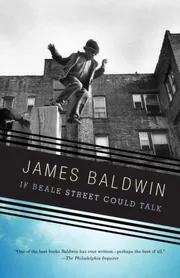
If Beale Street Could Talk
by James Baldwin · 1974
Best suited to mature teens and adults, given its themes of imprisonment, injustice and teenage pregnancy.
208 pages, about 3.5 to 5 hours.
A tender, furious love story told by a pregnant Harlem teenager. 64% taste match
The story
If Beale Street Could Talk is a novel by James Baldwin, first published in 1974. It is the fifth novel he wrote, and it belongs to the romance category, built around a young couple in Harlem in the early 1970s. The narrator is Tish, who is pregnant and engaged to Fonny, a young artist. Fonny has been arrested and jailed in New York, and Tish sets out to see him released while preparing for the birth of their child.
The book follows the bond between the two of them and the support of their families as they face an arrest they consider unjust. Its concerns include teenage pregnancy, prison, and the workings of justice as experienced by African American men and their relatives. The title points to the blues song "Beale Street Blues" by W. C. Handy, which was written in 1916 and named for a street in Memphis, Tennessee. The novel runs to roughly 208 pages and has appeared in 44 editions.
I look at myself in the mirror.
Themes
Teenage pregnancyPrisonsInjusticeLove storiesAfrican AmericansAfrican American menMan-woman relationshipsJustice (Virtue)
- Want to read 227
- Reading now 10
- Read 24
Most people shelving it are saving it for later.
Of 261 readers who put it on a shelf, 87% want to read it, 4% are reading it now, 9% have finished it and 0% stopped before the end.
By the numbers
- The median edition runs 208 pages. Counting about 275 words a page and an adult reading pace of 250 words a minute, that is about 3.8 hours of reading.
- Open Library tracks 44 editions from 35 publishers, the earliest dated 1974 and the latest 2024, across 7 languages.
- On reader demand it ranks in the top 6% of the classic books in our catalog (8,749 of them).
- Libraries shelve it under Dewey 813.54 and Library of Congress class PS-3552.00000000.A45 I4 1996.
 BookWard’s take
A tender, furious love story told by a pregnant Harlem teenager
Baldwin gives the whole novel to Tish, who narrates in a clear, unshowy voice while her fiance Fonny sits in jail and she carries their child. It is short, and it earns that brevity: the book is a sustained argument for love as a form of resistance, not a plot machine. The voice is where it shines, since Tish's cadence is unmistakably Baldwin's and unmistakably hers. The characters have real depth, especially the two families pulled into the fight to free Fonny. The prose is lyrical without being ornate, and the emotion is intense but handled with restraint. If you want a fast, twisty thriller, this is not it. If you want a love story with real moral weight, it is.
At 208 pages it is compact and concentrated, which suits BookWard's preference for tight books.
It moves steadily rather than quickly, giving scenes room to breathe, a little slower than BookWard likes.
A blues-inflected romance and a justice-system indictment in one voice is a combination few novels attempt.
The sentences are musical and rhythmic but conversational, lyrical without turning ornate.
What drives the book is the bond between Tish and Fonny and their families, more than any mechanics of plot.
Love is the engine, and it keeps a thread of hope alive despite the injustice, though it is not a cheerful book.
Tish tells the story with shifts back and forth, but the shape stays conventional and easy to follow.
There are warm, human moments of levity within a largely serious story.
Wrongful imprisonment and its toll give it real weight, though the tone is never gratuitously grim.
The feeling runs deep and close to the surface, carried with dignity.
See all 50 dialsEvery position, side by side with this book
Where it lines up
- LengthBookWard 1 · book 2
- OriginalityBookWard 9 · book 8
- Character depthBookWard 8 · book 9
Where it pulls apart
- OpeningBookWard 10 · book 7
- Familiar tropesBookWard 10 · book 8
- Internal logicBookWard 10 · book 8
At 208 pages it is compact and concentrated, which suits BookWard's preference for tight books.
Tish's voice pulls you in immediately, though the opening is more intimate than urgent.
A love story with a wrongful arrest at its center, yet Baldwin avoids the standard beats of both.
Events follow cleanly from Fonny's arrest and Tish's pregnancy, with consequences that feel earned and consistent.
It moves steadily rather than quickly, giving scenes room to breathe, a little slower than BookWard likes.
A blues-inflected romance and a justice-system indictment in one voice is a combination few novels attempt.
Tish, Fonny and their families are drawn with specificity and warmth, matching BookWard's taste for deeply drawn people.
The book resolves its central tension with feeling, though not every thread is tied off.
It is openly tender, but Baldwin keeps the feeling honest instead of syrupy, a bit warmer than BookWard prefers.
The darkness comes from injustice itself and is never used for cheap effect, which BookWard values.
This is a novel, so the rigor dial does not apply.
Baldwin's cadence is unmistakable and fully alive, exactly the distinctive voice BookWard rewards.
Ideas about justice run through it, but they arrive through Tish's lived story, not essayistic argument.
Baldwin shows life through scene and memory rather than explaining his themes outright, as BookWard prefers.
The momentum holds through the family and relationship scenes, with only mild drift in the reflective stretches.
The sentences are musical and rhythmic but conversational, lyrical without turning ornate.
What drives the book is the bond between Tish and Fonny and their families, more than any mechanics of plot.
Love is the engine, and it keeps a thread of hope alive despite the injustice, though it is not a cheerful book.
Tish tells the story with shifts back and forth, but the shape stays conventional and easy to follow.
There are warm, human moments of levity within a largely serious story.
Accessible and readable, though the emotional and moral weight asks for some attention.
Everything is filtered through Tish, one narrator, one steady point of view.
The narration moves between the present crisis and memories of how the couple came together.
Entirely grounded in real streets and real institutions.
A focused circle of family and friends around two lovers keeps the cast manageable.
The story is intimate, centered on one couple and their families, even as it speaks to a larger system.
Much of the book lives in Tish's thoughts and feelings rather than in external action.
Conversation carries a lot of the story, with family exchanges doing real narrative work.
Tish and Fonny's love is the heart of the book, though the story widens beyond romance.
Harlem and New York in the early 1970s are rendered concretely, and may feel unfamiliar to many readers.
Set in the early 1970s, so firmly of the past, though its concerns still resonate.
Its portrait of love and injustice has outlived its moment and still reads as urgent.
Tish tells it plainly and sincerely, with no sign of an unreliable teller.
The book is clear that Fonny's treatment is unjust, though human motives are not painted simply.
Baldwin gives you enough texture of place and feeling without lingering on elaborate description.
This is fiction, so the nonfiction style dial does not apply.
This is fiction, so the nonfiction perspective dial does not apply.
A self-contained novel with no sequel needed.
The story is driven by situation and emotion rather than surprises.
It confronts hard truths about justice and race, offering consolation through love but not easy comfort.
Wrongful imprisonment and its toll give it real weight, though the tone is never gratuitously grim.
The feeling runs deep and close to the surface, carried with dignity.
Where humor appears it is dry and affectionate, not broad.
The harm is mostly the quiet violence of institutions rather than graphic scenes.
Intimacy is part of the love story and handled frankly but not luridly.
Its critique of the justice system is central, woven into the personal story rather than bolted on.
The language is vernacular and rhythmic but readable, with no heavy dialect barrier.
Tish's voice carries clear feeling and judgment, so the narration is far from neutral.
It looks back at how things came to be while still pressing toward what comes next for the family.
Love is held up as a real force against cynicism, with idealism tempered by hard experience.
Review written by BookWard, dial version 1, November 2026.
Who is If Beale Street Could Talk right for?
Best suited to mature teens and adults, given its themes of imprisonment, injustice and teenage pregnancy. It treats intimacy and the justice system frankly, so some readers may want to be ready for that.
Accessible and readable, though the emotional and moral weight asks for some attention.
Wrongful imprisonment and its toll give it real weight, though the tone is never gratuitously grim.
The feeling runs deep and close to the surface, carried with dignity.
The harm is mostly the quiet violence of institutions rather than graphic scenes.
Book CompanionIf Beale Street Could Talk: ideas, characters, themes
A young woman's love for her imprisoned fiance, and for the child she carries, becomes a quiet act of defiance against an unjust system.
- A voice-first novel. The book is told by Tish, and her clear, lyrical voice is its greatest asset.
- Love as resistance. Tish and Fonny's bond, and the support of their families, stands against the pressures closing in on them.
- A story of injustice. Fonny's arrest and imprisonment drive the plot and frame the book's concerns about justice and punishment.
- The blues in the title. The title echoes W. C. Handy's 1916 song 'Beale Street Blues', setting the book's sweet and sad register.
- Harlem, early 1970s. The setting grounds the love story in a specific time and place in New York City.
Characters
Tish
Narrator
A pregnant young woman determined to see Fonny freed and to bring their child into the world.
Fonny
Tish's fiance
A young artist who has been arrested and jailed in New York.
Themes
Affection and loyalty as a sustaining force in hard circumstances.
How the legal system treats people, and who is protected or harmed by it.
The support and strain of relatives who rally around the couple.
Preparing for a child while the future is uncertain.
How being Black in America shapes the characters' experience of the law.
Discussion questions
- How does Tish's voice shape the way you see Fonny's arrest?
- In what ways is love portrayed as a form of resistance in this book?
- What role do the two families play in the story?
- Why might Baldwin have chosen a blues song for the title?
- How does the early 1970s Harlem setting affect the story's feel?
Personalize your Book Companion
This is the general edition. In BookWard, the Companion is written for you: your reading profile, your notes, and spoiler-safe to the page you are on.
Buy, listen or borrow If Beale Street Could Talk
Each link opens a search for this book on that store, in a new tab.
Read on a device
Borrow
Reviews and community
If you liked If Beale Street Could Talk
A son's memoir, and his mother's own voice breaking through it
Stone Butch BluesLeslie FeinbergA butch life told from inside, written as a call to action
The Price of SaltPatricia HighsmithA 1952 love story that dared to end with hope
Giovanni's RoomJames BaldwinA short, devastating confession of love and denial in Paris
Sources: Open Library.
Track If Beale Street Could Talk and find your next favorite
Add it to your shelf, rate what you have read, and BookWard will recommend what fits you.
Free to start. No credit card needed.