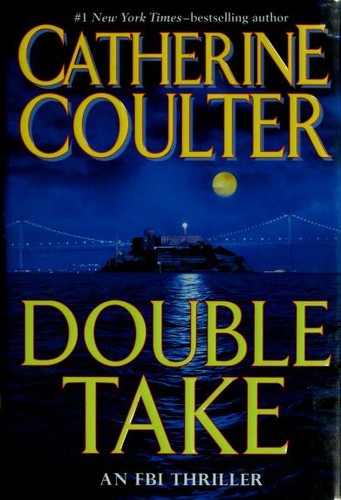
Double Take
by Catherine Coulter
★ Top 25 book of 2007 · #20 on Best Books of 2007
Julia Ransom is rebuilding her life after her psychic husband's murder when a stranger attacks her at San Francisco's Pier 39. FBI agent Cheney Stone rescues her and reopens the case, while a Virginia sheriff chases a lookalike of his missing wife.
Best for: Suspense fans who like linked crimes, a protector hero, and a series setting
Double Take is #20 on BookWard's Best Books of 2007, out of 53 2007 books that cleared our data bar.
What Double Take is about
Julia Ransom is still reeling from the brutal murder of her husband, the renowned psychic August Ransom, more than six months ago. The media frenzy that followed wore her down. Then, on San Francisco's Pier 39, a respectable-looking man draws her into conversation and throws her over the railing. Special Agent Cheney Stone, stretching his legs between courses at a nearby restaurant, pulls her from the water.
Cheney suspects the attack is tied to August's death. He reopens the investigation and sets out to keep Julia safe. A parallel story unfolds in Maestro, Virginia, where Sheriff Dixon Noble, familiar to readers of Point Blank, still mourns his vanished wife, Christie. A suspense novel with grief running underneath, it pairs a woman in danger with the agent who refuses to look away.
Double Take on the Best Books of 2007
Double Take came out in 2007. Of the 53 books first published in 2007 that met BookWard's data bar, it ranks #20 on our Best Books of 2007 list.
Why it made the list: 286 readers have shelved it on Open Library; readers rate it 4 out of 5 (29 ratings). The list ranks each year’s books on how many readers have picked them up, how highly readers rate them, and how many are reading them right now.
Nearby on the 2007 list
- Schooled Gordon Korman, #18
- The Shock Doctrine Naomi Klein, #19
- Tweak Nic Sheff, #21
- The Mysterious Benedict Society (the Mysterious Benedict Society #1) Trenton Lee Stewart, #22
See all Best Books of 2007 Best books by year
More years: Best Books of 2006 Best Books of 2008.
The numbers behind it
- Readers: 225 want to read it, 19 are reading it now and 42 have read it, according to Open Library.
- Ratings: 4 out of 5 from 29 Open Library ratings.
| Signal | This book (0 to 100) | Weight |
|---|---|---|
| Reach | 58 | 55% |
| Reader love | 34 | 25% |
| Being read right now | 72 | 20% |
Questions about Double Take
When was Double Take published?
Double Take by Catherine Coulter was first published in 2007.
Was Double Take one of the best books of 2007?
Double Take is #20 on BookWard's Best Books of 2007, out of 53 2007 books that cleared our data bar. 286 readers have shelved it on Open Library; readers rate it 4 out of 5 (29 ratings).
Why is Double Take on the Best Books of 2007 list?
286 readers have shelved it on Open Library; readers rate it 4 out of 5 (29 ratings).
More of the best books of 2007
- Dog Days Jeff Kinney, #1
- A Thousand Splendid Suns Khaled Hosseini, #2
- Harry Potter and the Deathly Hallows J. K. Rowling, #3
- The Titan's Curse Rick Riordan, #4
- The Name of the Wind Patrick Rothfuss, #5
- Rodrick Rules Jeff Kinney, #6
See the full Best Books of 2007, the Top 100, or new books on Rising.
How we know
This page uses public data: Open Library reader counts and ratings, and Wikipedia page views for recent years. The description is paraphrased from real source text. Rankings reflect reading interest, not quality or sales, and can be affected by data gaps. Lists update monthly.
Suits adult readers of crime and suspense.
Depends on the edition you pick.
An FBI thriller that opens on a pier attack and keeps moving. 52% taste match
 BookWard’s take
An FBI thriller that opens on a pier attack and keeps moving
Double Take is a Catherine Coulter FBI thriller from 2007 that opens with a bang: a widow is thrown off a San Francisco pier and rescued by a passing agent. The hook works because the attack lands in the very first scene, and that kind of immediate jolt is hard to resist. It is also part of a series, and it leans on familiar tropes: the protective agent, the reopened murder, the lookalike. Nothing here is a surprise, but the pieces are put together with confidence. The pace is fast, and the book is driven by plot more than by character, so don't expect much in the way of psychological depth or a fresh take on the genre. What helps is the structure. Two story threads, one in San Francisco and one in Virginia, give the book some welcome variety of viewpoint and keep it from feeling like a single straight line. Expect a brisk, solid page-turner more than a surprising one.
Scenes move fast and the stakes start early, in line with BookWard's own pace.
The premise is workable genre fare rather than something new, below what BookWard looks for.
Plain, functional prose in service of the plot, a little plainer than BookWard's middle position.
Plot drives the book, with the characters largely defined by what happens to them.
Both leads are recovering from loss and the book leans toward recovery.
A conventional thriller structure with intercut threads rather than formal experiment.
A serious, suspense-driven book with little comic relief.
A murder, a near-fatal attack and a missing wife give it real shadow, but within thriller norms.
Grief and fear are present but handled in a measured, genre-friendly way.
See all 50 dialsEvery position, side by side with this book
Where it lines up
- PaceBookWard 8 · book 8
- EndingBookWard 8 · book 8
- OpeningBookWard 10 · book 9
Where it pulls apart
- Familiar tropesBookWard 10 · book 3
- Internal logicBookWard 10 · book 6
- OriginalityBookWard 9 · book 4
It opens with a violent attack on a pier, exactly the immediate hook BookWard favors.
The protective agent, the reopened murder and the lookalike are familiar genre moves, short of BookWard's taste for fresh ground.
Thriller plotting asks you to accept coincidence, so it holds together less tightly than BookWard prefers.
Scenes move fast and the stakes start early, in line with BookWard's own pace.
The premise is workable genre fare rather than something new, below what BookWard looks for.
Characters are drawn for plot service, so depth is moderate against BookWard's taste for fully drawn people.
Grief and a possible new bond add some warmth, a bit more sentiment than BookWard likes.
The violence serves the plot, though thrillers like this use shock to drive momentum.
Fiction, so this dial does not apply.
The style is competent and plain, with a recognizable genre voice but little that is distinctive.
Firmly story-led, with plot and suspense rather than ideas at the center, matching BookWard.
Mostly dramatized through scene and dialogue, close to BookWard's preference for showing.
Two intertwined threads help keep the middle moving, though formula can slacken it.
Plain, functional prose in service of the plot, a little plainer than BookWard's middle position.
Plot drives the book, with the characters largely defined by what happens to them.
Both leads are recovering from loss and the book leans toward recovery.
A conventional thriller structure with intercut threads rather than formal experiment.
A serious, suspense-driven book with little comic relief.
An easy read that asks little beyond following the mystery.
The story splits between San Francisco and Virginia, giving it more than one viewpoint.
The events run forward in a straightforward line, with backstory only as needed.
A grounded crime story, though the husband's psychic reputation adds a faint touch of the uncanny.
Several leads and a supporting cast across two locations, a medium-sized group.
The focus stays on a few people and a personal mystery rather than a wide canvas.
Action and investigation dominate over interior reflection.
Thriller scenes lean on conversation and interrogation, so dialogue is fairly heavy.
San Francisco and a small Virginia town are familiar settings for the genre.
Set in the contemporary world of its 2007 publication.
A genre entertainment tied to its time, less likely to endure than a classic.
A straightforward third-person telling with no sign of unreliability.
Settings are sketched efficiently rather than lingered over.
It follows an earlier book, Point Blank, in a continuing series with recurring characters.
A comforting genre read that stays within what its readers expect.
A murder, a near-fatal attack and a missing wife give it real shadow, but within thriller norms.
Grief and fear are present but handled in a measured, genre-friendly way.
Humor is minimal and tends toward the light and dry.
An attack and a murder investigation put violence on the page at a typical thriller level.
The plot is about crime and personal loss, with politics absent.
Plain, accessible language throughout.
Narration stays neutral and tells the story without editorializing.
Looks mostly to the present, with the past mattering through unsolved loss.
Leans mildly idealistic, with justice and protection winning out over cynicism.
Review written by BookWard, dial version 1, November 2026.
Who is Double Take right for?
Suits adult readers of crime and suspense. It includes a violent attack and a murder investigation.
An easy read that asks little beyond following the mystery.
A murder, a near-fatal attack and a missing wife give it real shadow, but within thriller norms.
Grief and fear are present but handled in a measured, genre-friendly way.
An attack and a murder investigation put violence on the page at a typical thriller level.
Book CompanionDouble Take: ideas, characters, themes
A widow attacked on a San Francisco pier is drawn into a reopened murder case while a Virginia sheriff chases a lookalike of his missing wife.
- The pier attack. Julia Ransom is violently attacked at Pier 39 and saved by a passing FBI agent.
- A protector assigned. Special Agent Cheney Stone links the attack to her husband's death and becomes her protector.
- A husband's murder reopened. The killing of psychic August Ransom is investigated again after more than six months.
- A second thread in Virginia. Sheriff Dixon Noble still mourns his wife, who vanished three years earlier.
- The lookalike. A San Francisco woman named Charlotte Pallack resembles his wife and sends him across the country.
Characters
Julia Ransom
Widow
She is recovering from her husband's murder when she is attacked.
Cheney Stone
FBI special agent
He rescues Julia and reopens the investigation into her husband's death.
Dixon Noble
Sheriff of Maestro, Virginia
He is still mourning his wife, who vanished three years earlier.
Charlotte Pallack
San Francisco woman
Her resemblance to Dix's missing wife draws him to California.
August Ransom
Julia's late husband
A renowned psychic whose murder is reopened.
Themes
How loss shapes the way people move on.
Trust built between someone in danger and someone sworn to guard them.
What a lookalike does to our sense of who someone is.
Old crimes and disappearances that refuse to stay closed.
Discussion questions
- Why might the author pair two separate investigations in one book?
- How does the opening attack set your expectations for the rest?
- What makes a protective-agent story satisfying or predictable?
- How does grief drive the choices of both Julia and Dix?
- Does knowing this is part of a series change how you read it?
Personalize your Book Companion
This is the general edition. In BookWard, the Companion is written for you: your reading profile, your notes, and spoiler-safe to the page you are on.
Buy, listen or borrow Double Take
Each link opens a search for this book on that store, in a new tab.
Read on a device
Borrow
Reviews and community
If you liked Double Take
A fast truth-or-dare thriller that brings Bayview High back
One of Us Is BackKaren M. McManusA fast YA whodunit that returns to Bayview for a third round
Pop Goes the WeaselJames PattersonCross hunts a diplomat killer who fights back in court
2Nd ChanceJames PattersonA fast San Francisco thriller where short chapters do the heavy lifting
Find your own best books
Add what you have read, rate it, and BookWard will recommend what to read next.
Free to start. No credit card needed.